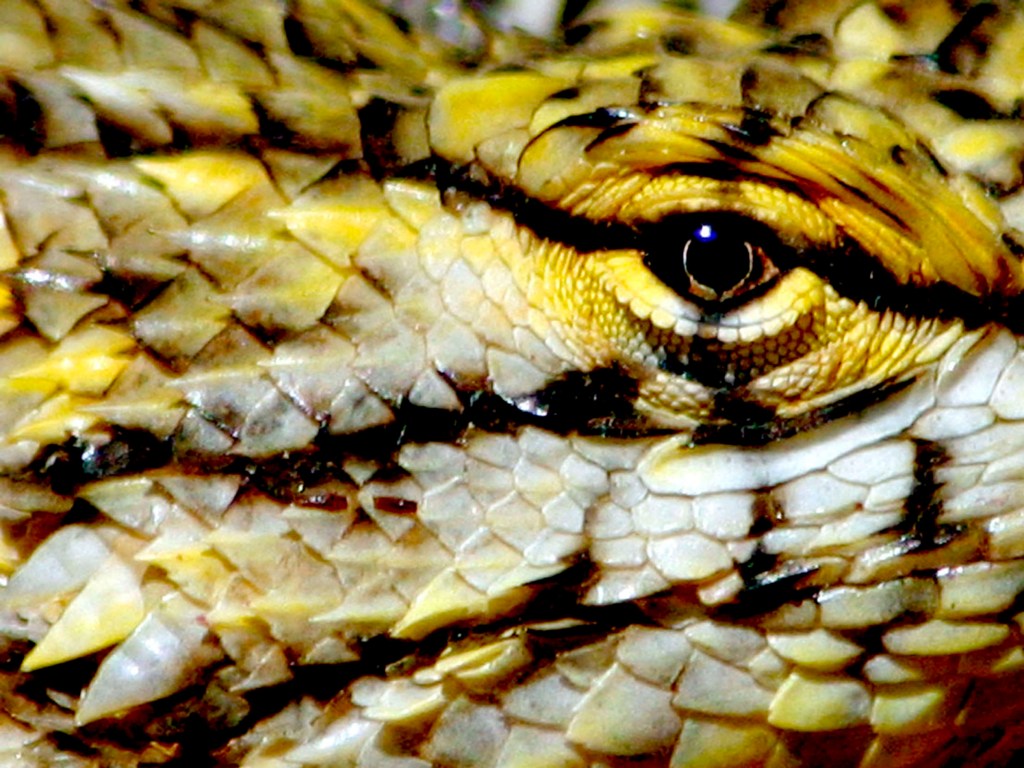
Yellow is a vibrant color associated with sunshine and happiness. So, don’t let this close-up of a Yellow Spiny Lizard frighten you.
Its scaly skin mirrors the colors of the desert, making it almost invisible against the sandy and rocky terrain and safe from predators. And its sharp scales provide additional physical protection. Yellow spiny lizards are not dangerous to humans. They are non-aggressive, do not possess venom, and rarely bite unless provoked. This one didn’t seem to mind being photographed at eye level from three feet away. So yes, despite its appearance, sunshine and happiness is what this creature offers to us humans.
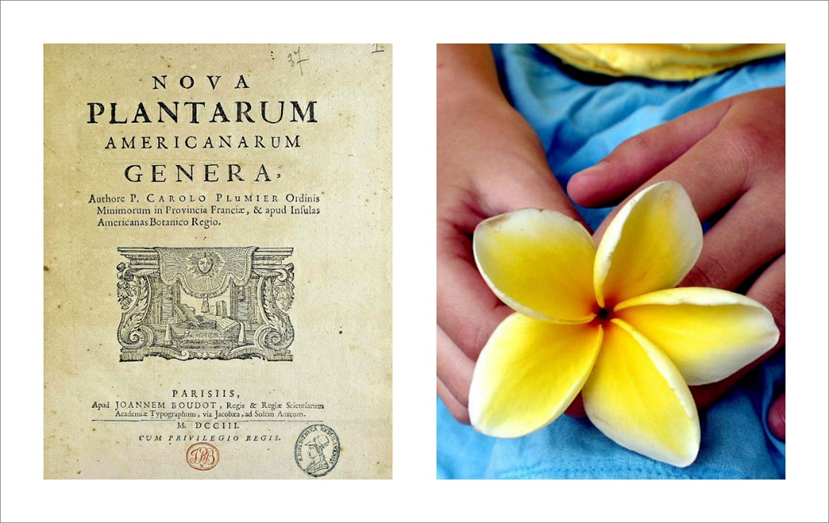
Granddaughter Brynna, holds a yellow Frangipani in Barbados. Native to the Caribbean, the genus Plumeria is named in honor of 17th-century French botanist and Catholic monk Charles Plumier (1646 – 1704) who traveled to the New World documenting plant and animal species. Perhaps he also smelled its sweet perfume as he held a similar blossom in this region three-hundred years ago.
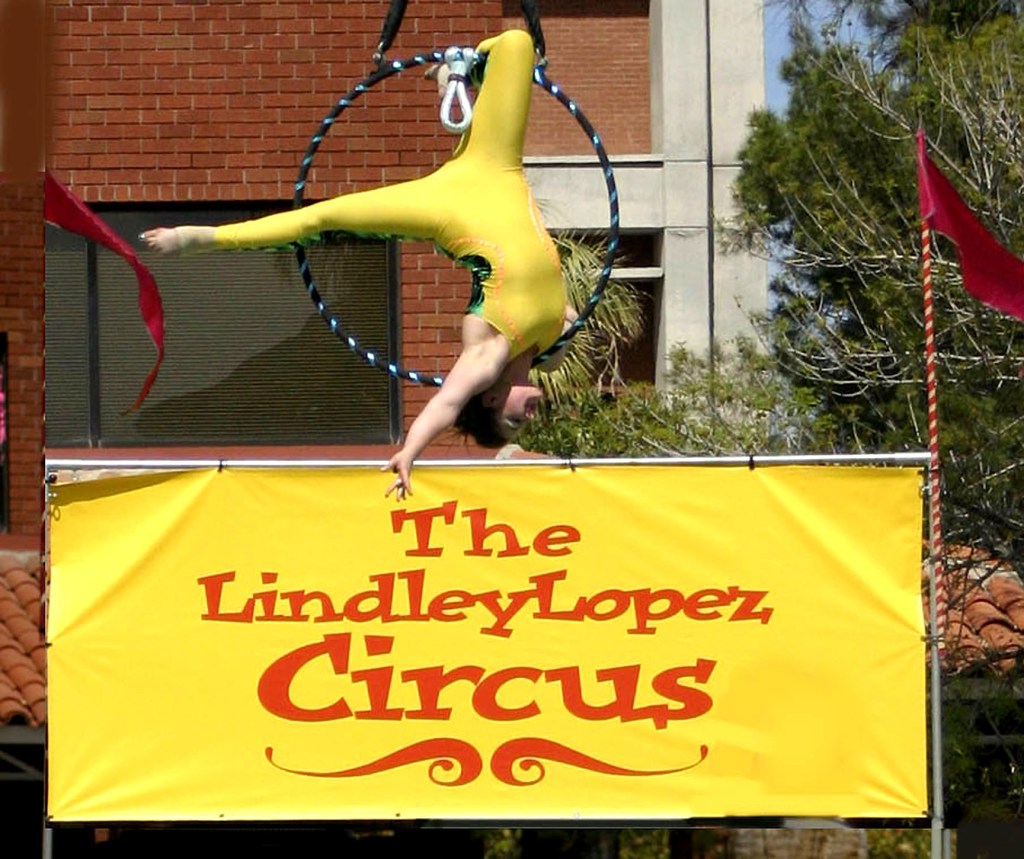
If yellow is the color of sunshine and happiness, this was a good choice for an outdoor circus performance I watched fifteen years ago. It featured acrobatics, aerial acts and live music. What most appeals to me is its low-tech traditional approach to family entertainment. No AI nor sophisticated stage-setting, no animals, no complex engineered structures. In some sad way, a lost innocence.
A sunflower in our garden. It catches our attention as much as it inspired William Blake in 1794
Ah! Sun-flower, weary of time, Who countest the steps of the sun; Seeking after that sweet golden clime Where the traveler’s journey is done; Where the Youth pined away with desire, And the pale virgin shrouded in snow, Arise from their graves, and aspire
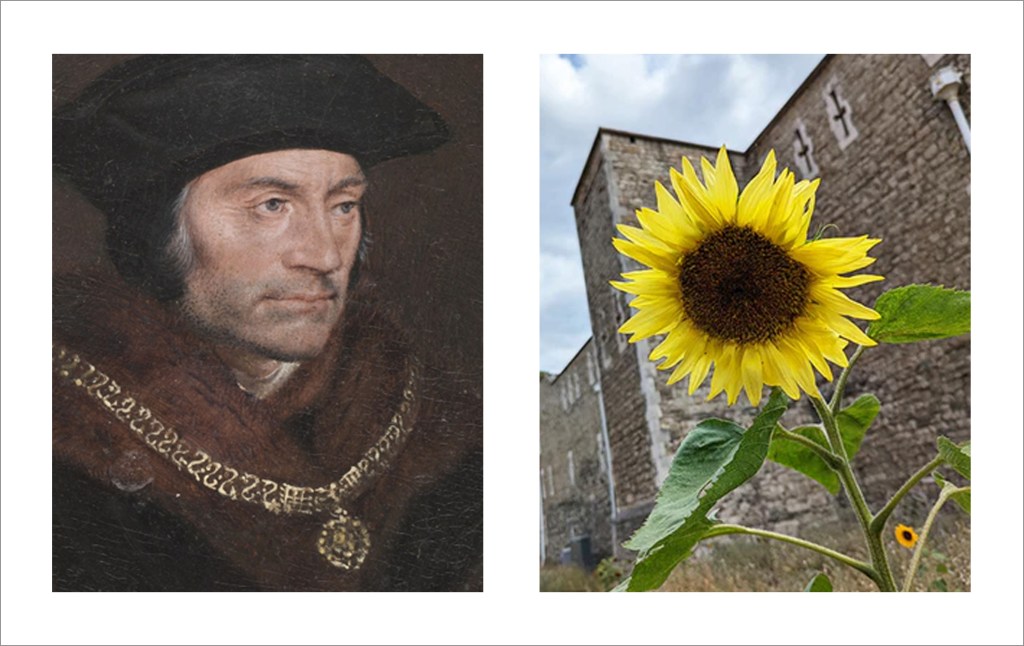
And even earlier, in 1530, Thomas More would perhaps look out from his prison cell in the Tower of London and write about the sunflower. (Portrait: Hans Holbein the Younger)
The sunflower turns on her god when he sets, The same look which she turned when he rose
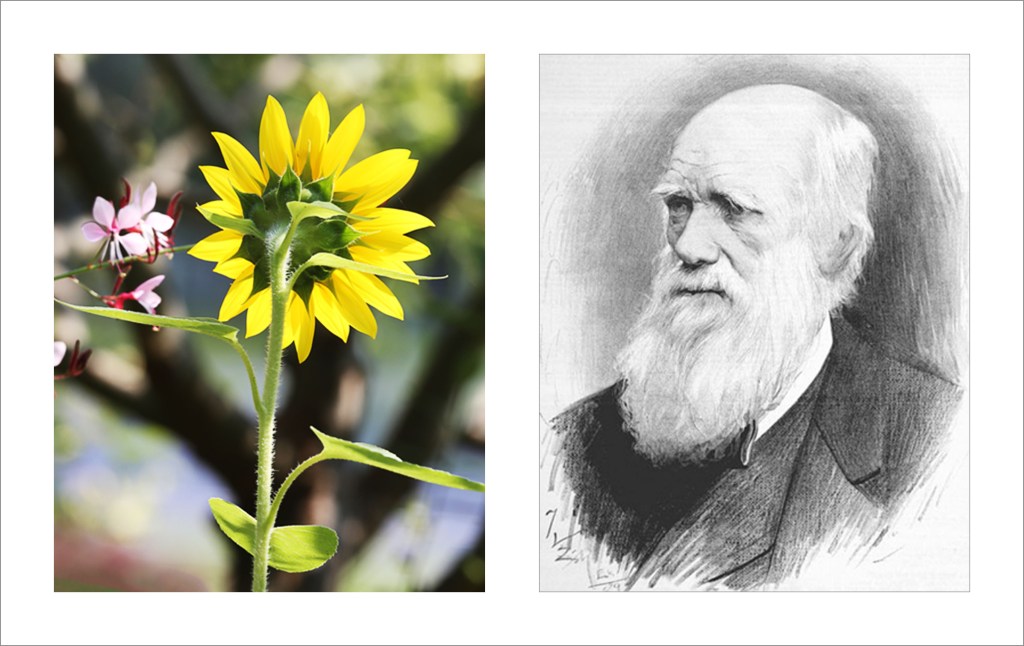
Like William Blake and Thomas More, Charles Darwin also wrote about the way in which the sunflower follows the sun. The phenomenon is known as heliotropism and allows plants to track the sun’s motion throughout the day, optimizing light capture for growth and reproduction.
He bows in homage to the rising dawn; Imbibes with eagle eye the golden ray, And watches as it moves the orb of day.
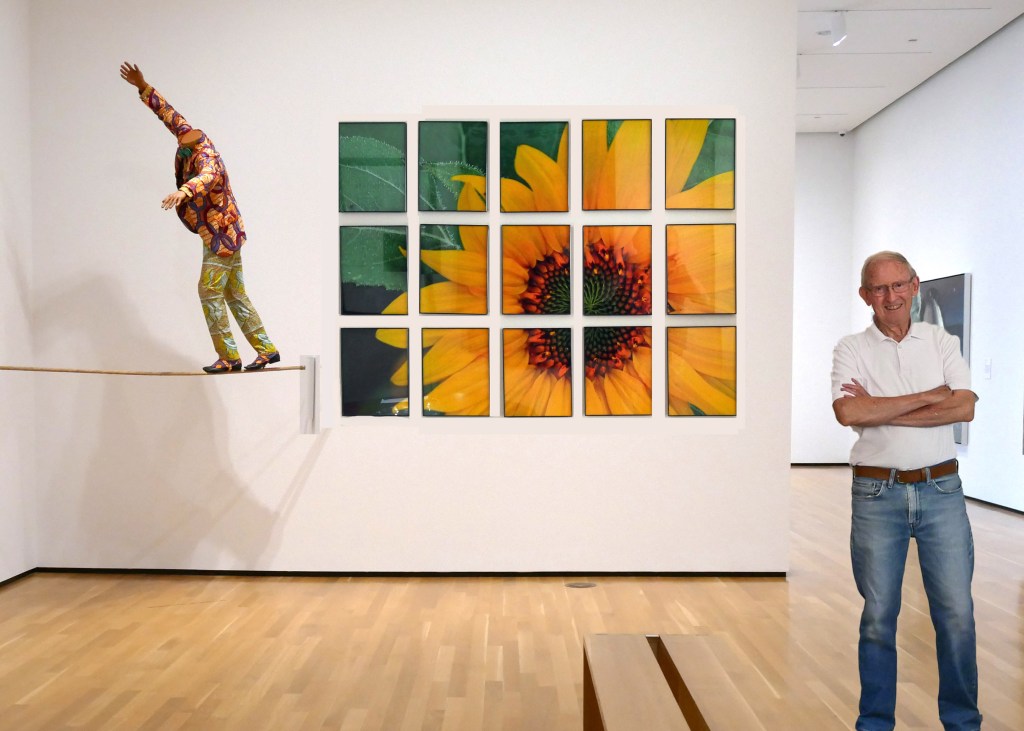
Equally inspired by the sunflower, I took a photograph and cropped it into twelve 8×10 images then mounted them in cheap plastic frames and hung them on a wall. Voila!
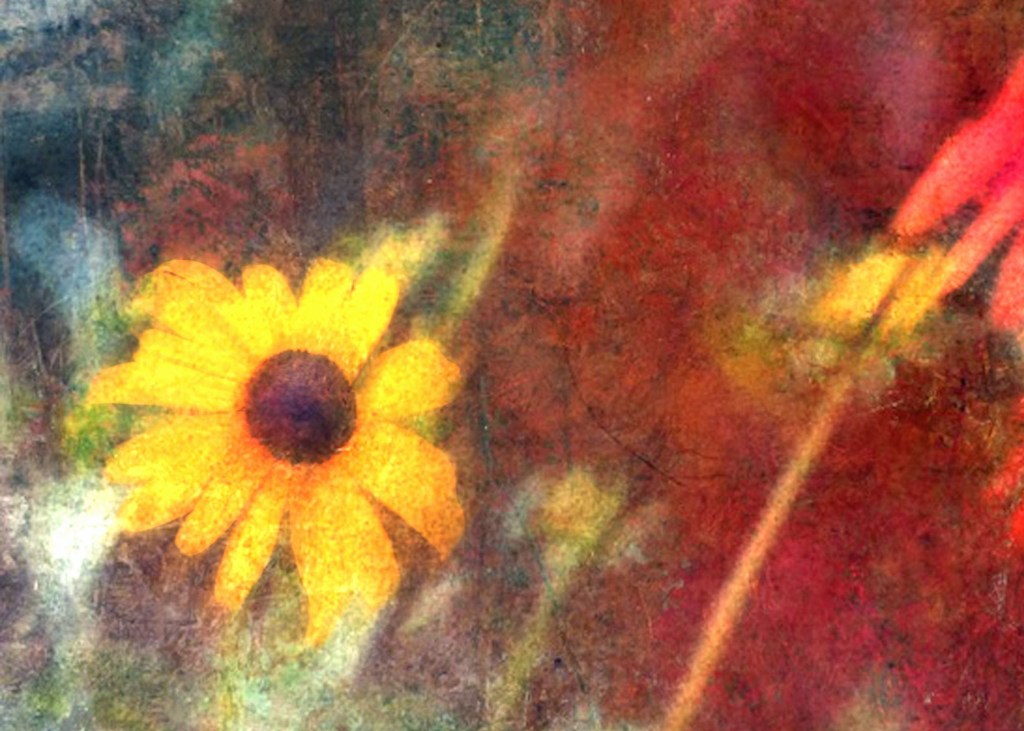
But, Mama, What does heliotropic mean?
It means that you are special, dear, among all the flowers. It means you look on the bright side And never look back, It means you turn your face to the sun And avoid looking down. It means you keep your eyes on the heavens And your feet on the ground.
Like it or not, the color red makes its presence felt. Associated with love or anger, pain or pleasure, it evokes an emotional response.
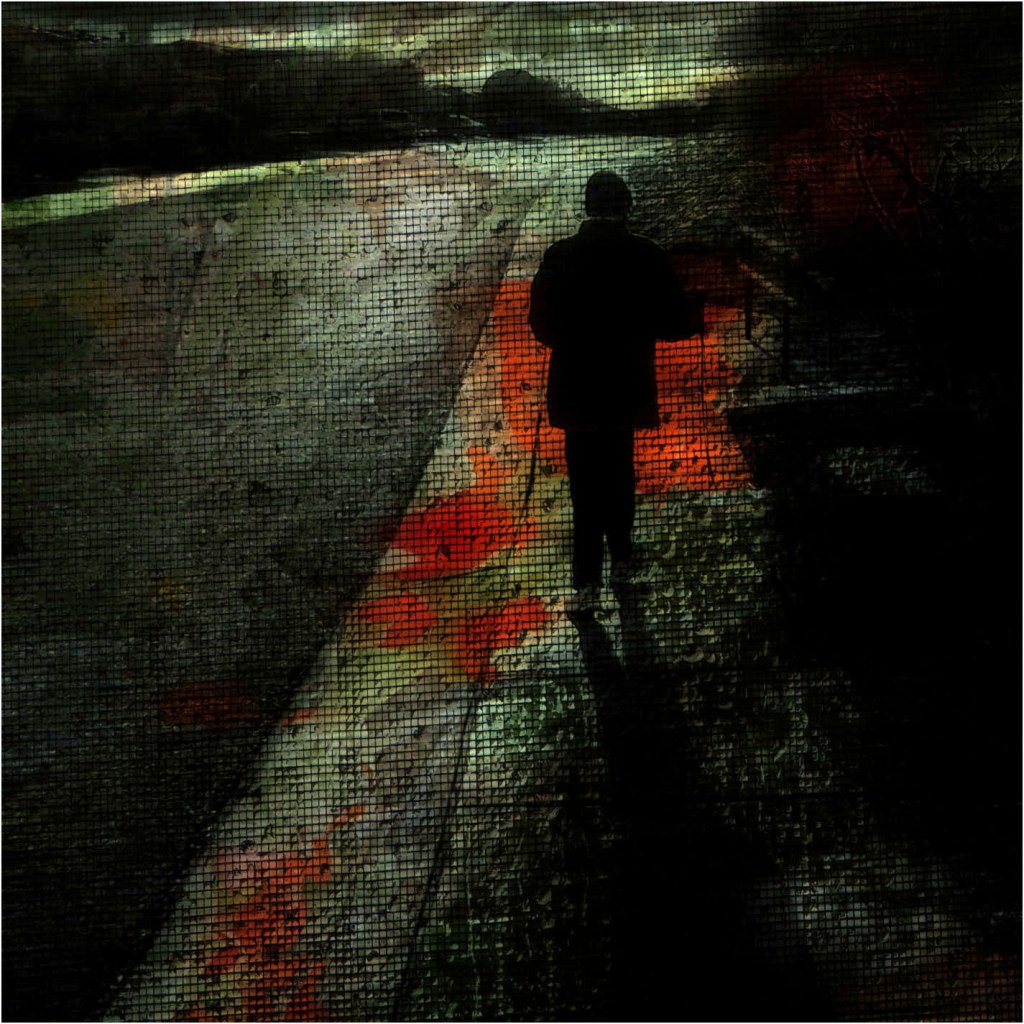
Here, after a fourth spine surgery, Lilian walks towards the setting Arizona sun. There is very little red in this image but, against the darkness of the photograph, it draws our attention to her pain.
Pain clinics are quite places.
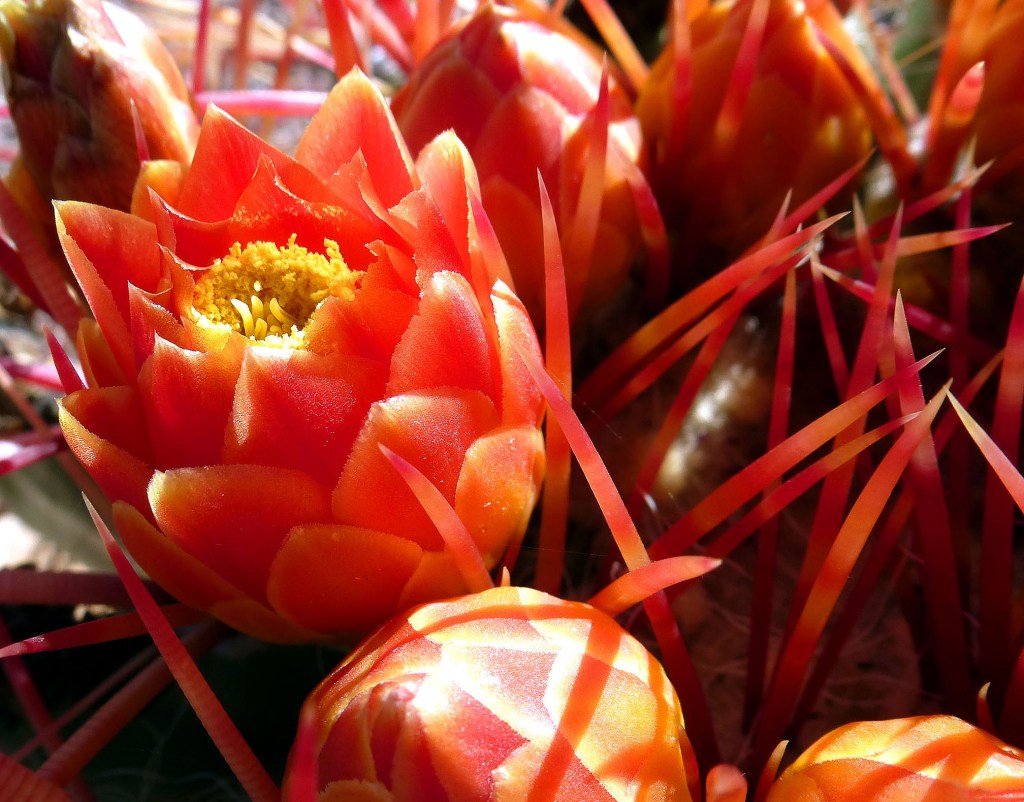
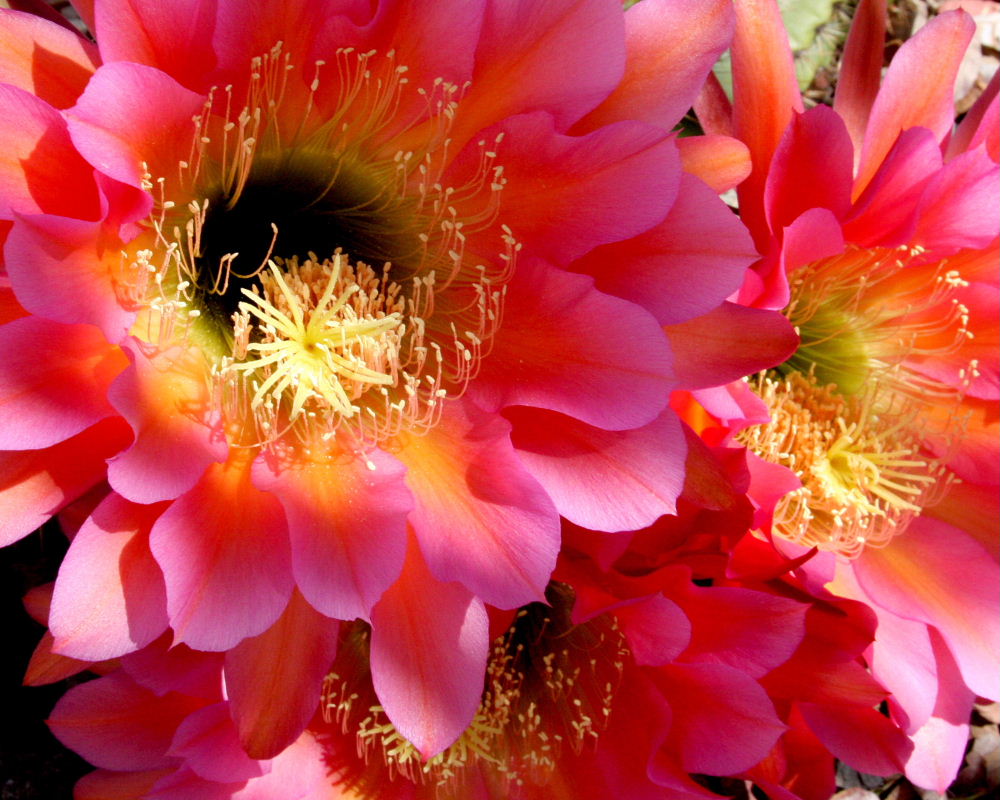
In the desiccating heat of the Sonoran Desert, a Barrel Cactus blooms.
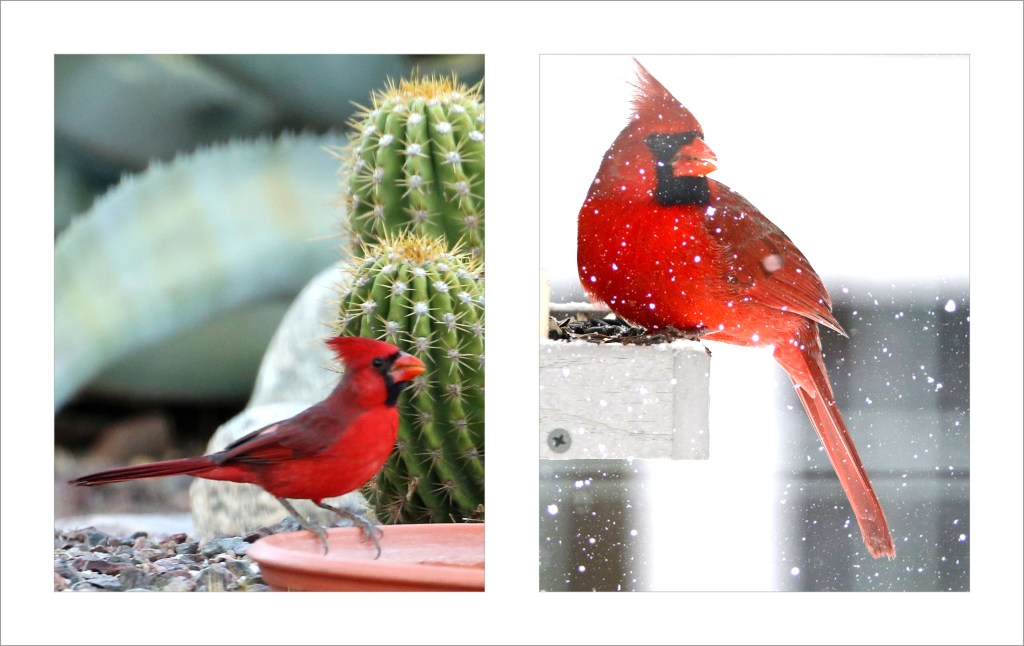
In the desert, we provide water. In the snowy north we fill the feeder with sunflower seed. The cardinal comes to us, a red reward: A living valentine’s card, if you will.
Cornell Lab of Ornithology
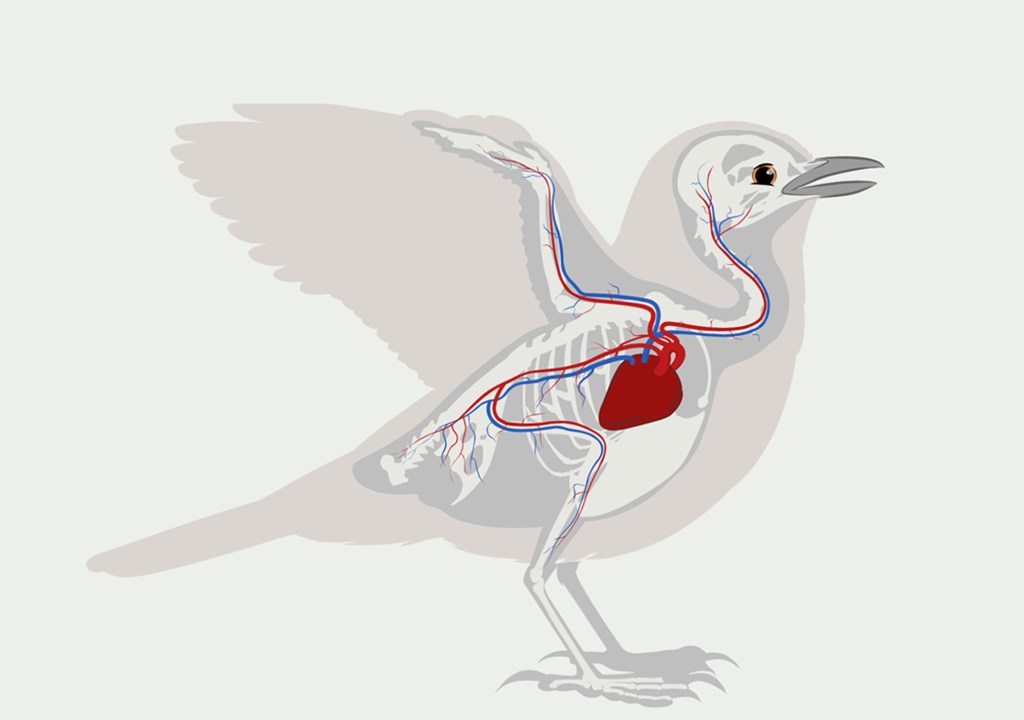
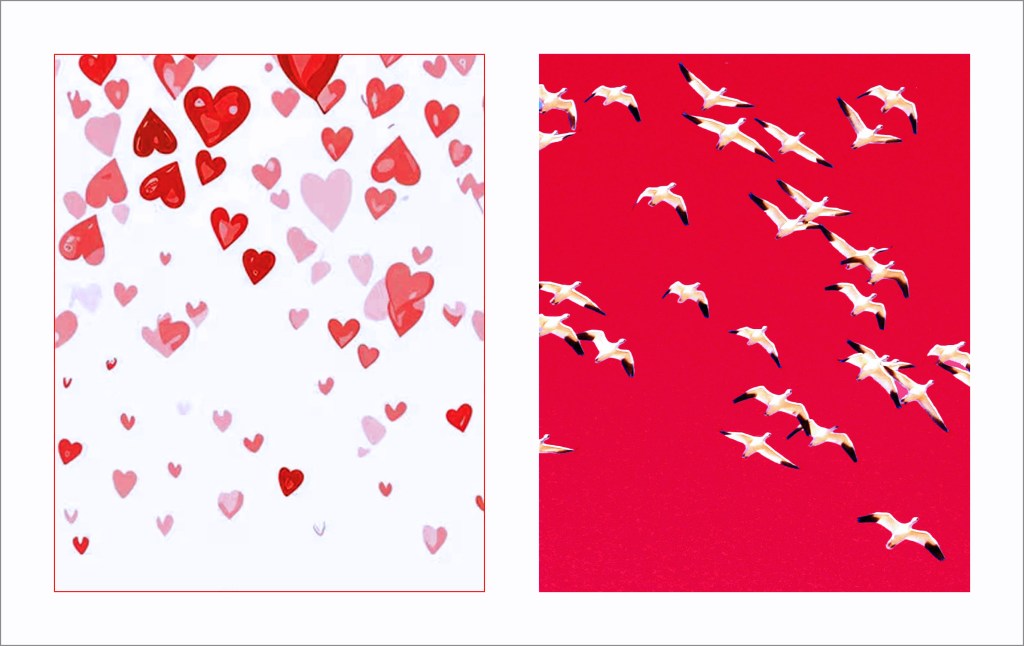
Each heart inside each bird, though smaller and faster beating, is similar to ours. And we share in the electro-chemical miracle that produces an electrical current from the movement of sodium, potassium and calcium ions through the heart cells. And these electrical signals keep us alive and keep the birds flying. All of us.
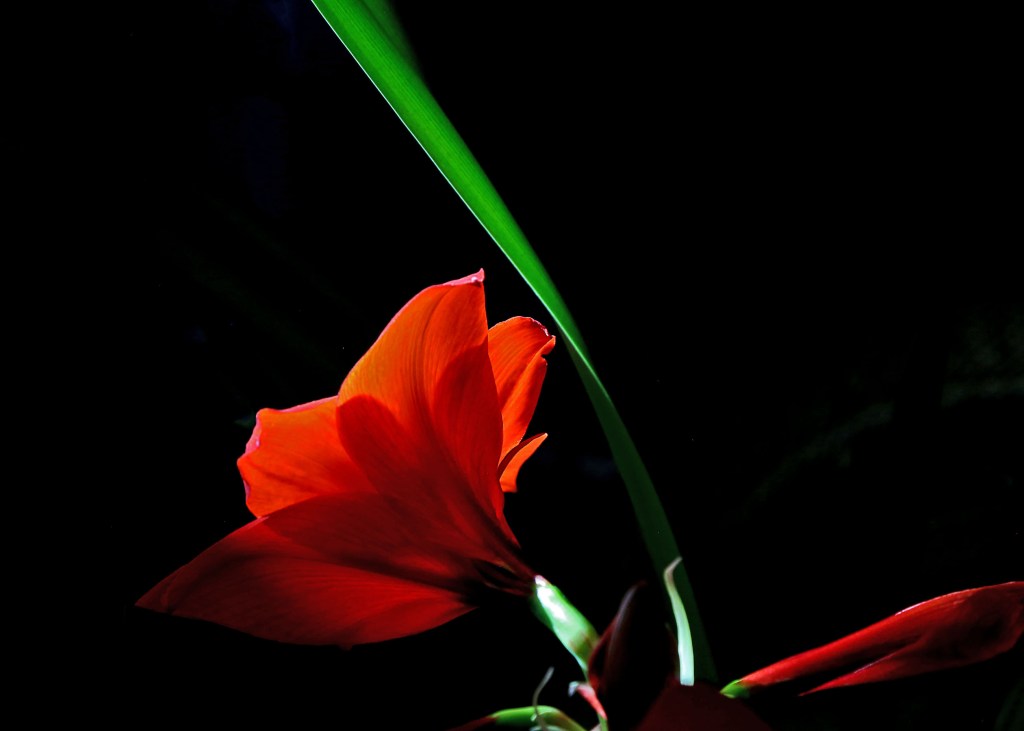
In the image below, there are several colors, black, green and red, but the red stands out.
Josef Albers (1888 – 1976) was a prominent figure in color theory and art education. He is most well-known for his work on color perception and interaction. He emphasized that color is a relative medium, influenced by context, light, and surrounding colors as is the case in this image of a red amaryllis.
This amaryllis was a gift in 2025, a bulb in a pot. It flowered in January. In the spring, we planted the bulb the garden then brought it back inside in September. In January 2026 it was in full flower again. Today the flowers are gone and the plant is patiently waiting to be planted back in the garden again when the danger of frost is past.
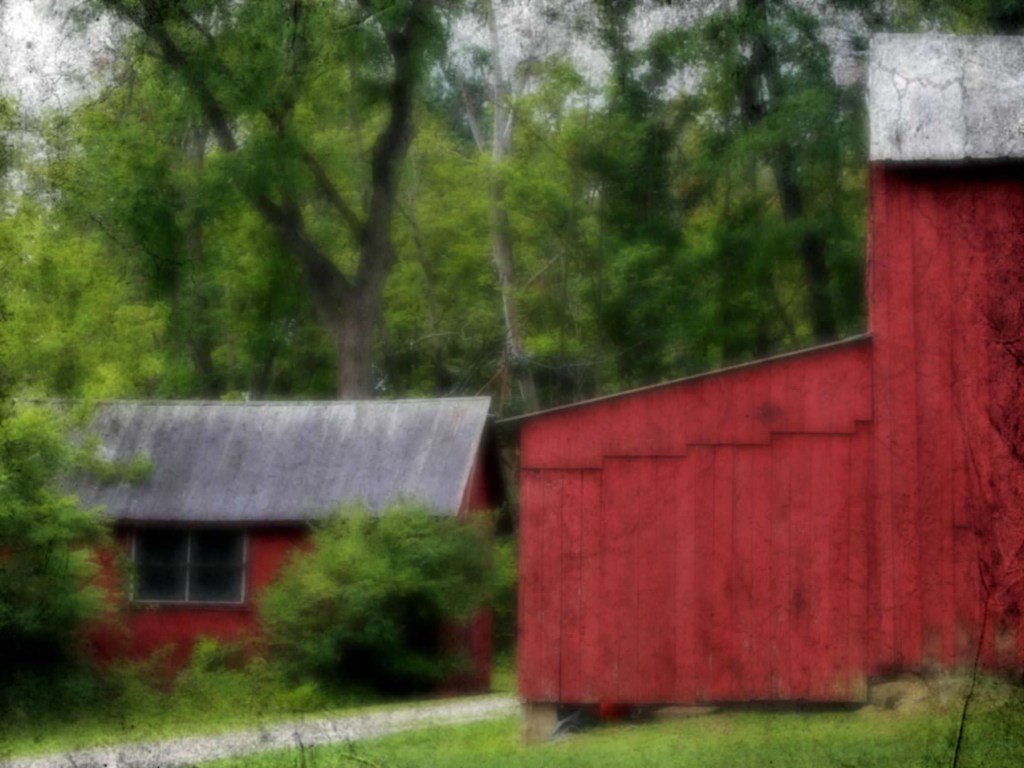
What do you see in the image below?
Yes, a red barn and a red shed. Even though there is as much green, we see the red. If a three-month-old infant looked at the scene, what would he or she see? Certainly not a red barn but rather shapes and colors. Perhaps the child would be attracted by the red, as we are. It is sometimes good to imagine seeing in the way of a child.
n the early nineteenth century, a non-objective art form emerged, art that does not attempt to accurately represent a visual reality. It is characterized by the absence of recognizable objects or figures, focusing instead on elements such as color, shape, line, and form to create a purely visual experience for the viewer. Pioneered by artists like Kandinsky and Malevich, the objective of non-objective art was to evoke emotions, sensations, or ideas, independently of the constraint of representational art.
Mark Rothko and Donal Jud are just two contemporary non-objective artists who make frequent use of the color red. It is unsurprising that they and other artists, who goal is to provoke an emotional response to their non-objective work, would work in red.
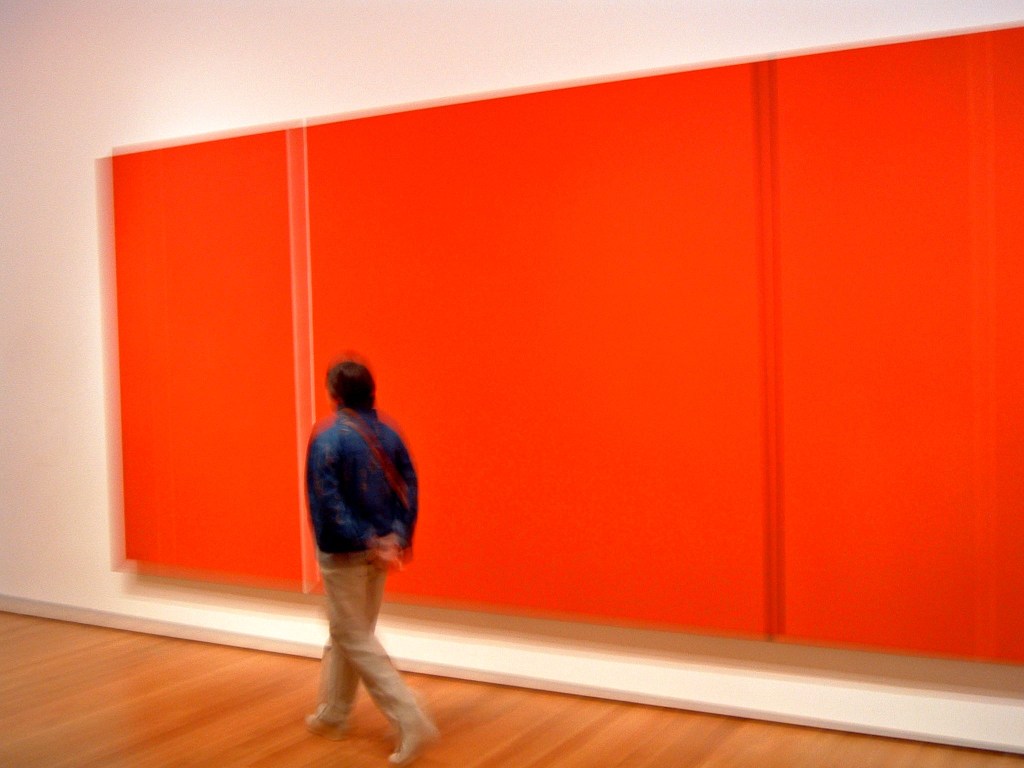
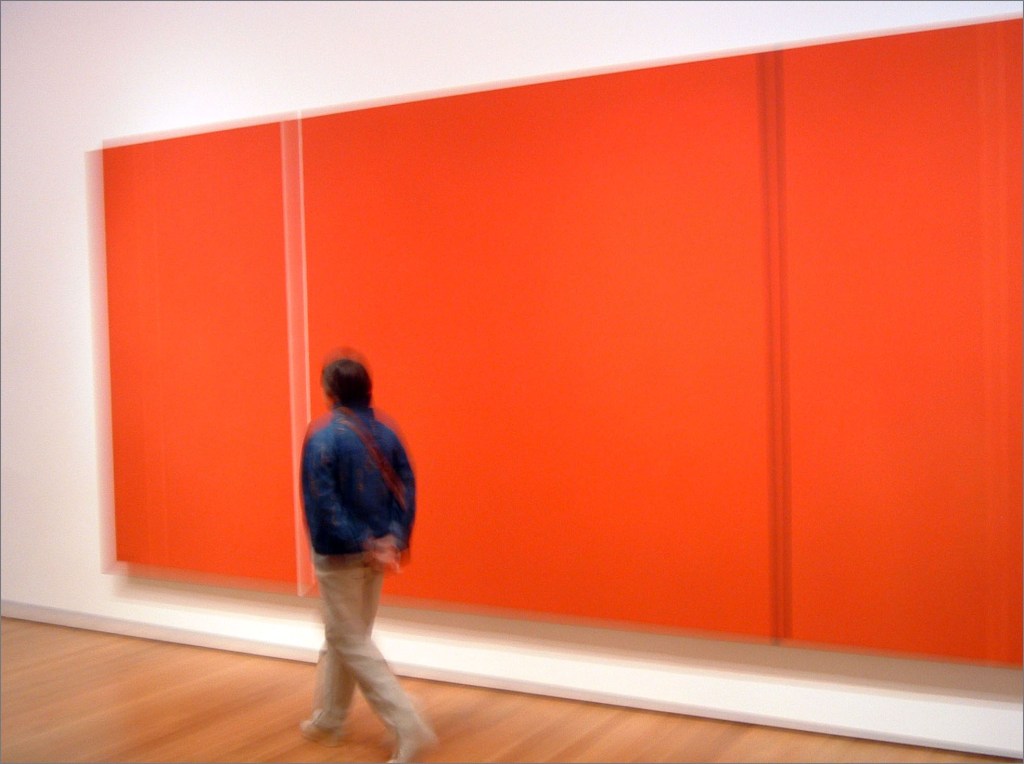
Vir Heroicus Sublimis Museum of Modern Art in New York.
Here is Lil walking past Barnett Newman’s (1950-1951) work at the Museum of Modern Art in New York. Because this work falls into the category of non-objective painting, some would say that it should not be judged but only experienced subjectively. This raises the interesting question of how a museum decides what paintings to add to its collection.
Off the cost of Quepos, Costa Rica
Red sky at night, sailor’s delight. Red sky in the morning, sailor’s warning
A red flower in the desert blooms. It blooms for just a day or two. It blooms for you the passerby So, pause and look while on the path. You’ll both be leaving soon.
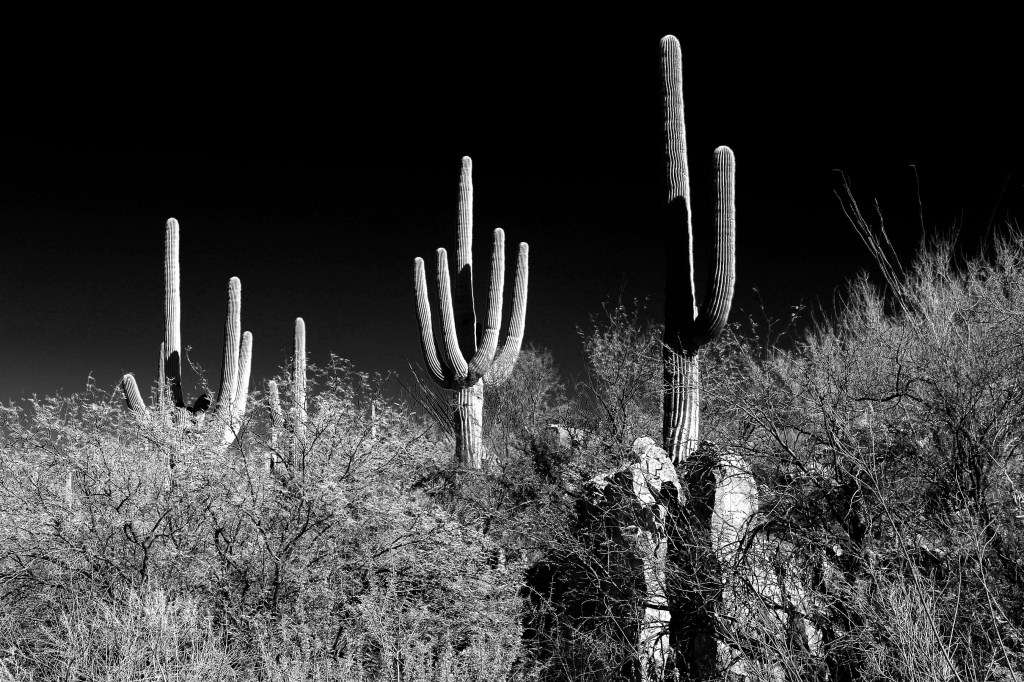
It is strange to talk about black or blackness when the color refers to the absence of visible light. In a sense, we know it through absence. If black is the absence of light, it’s difficult come up with an image of it. We ‘see it’ best only in relation to things we can see such as the saguaro cacti in the image below.
I used a digital infrared filter for this photograph taken near my home in the style of Anselm Adams. The sky appears black because the filter blocks visible light, something we see only because of the earth’s atmosphere. Once an astronaut leaves the earth’s atmosphere, space looks very much like the sky in my photograph.
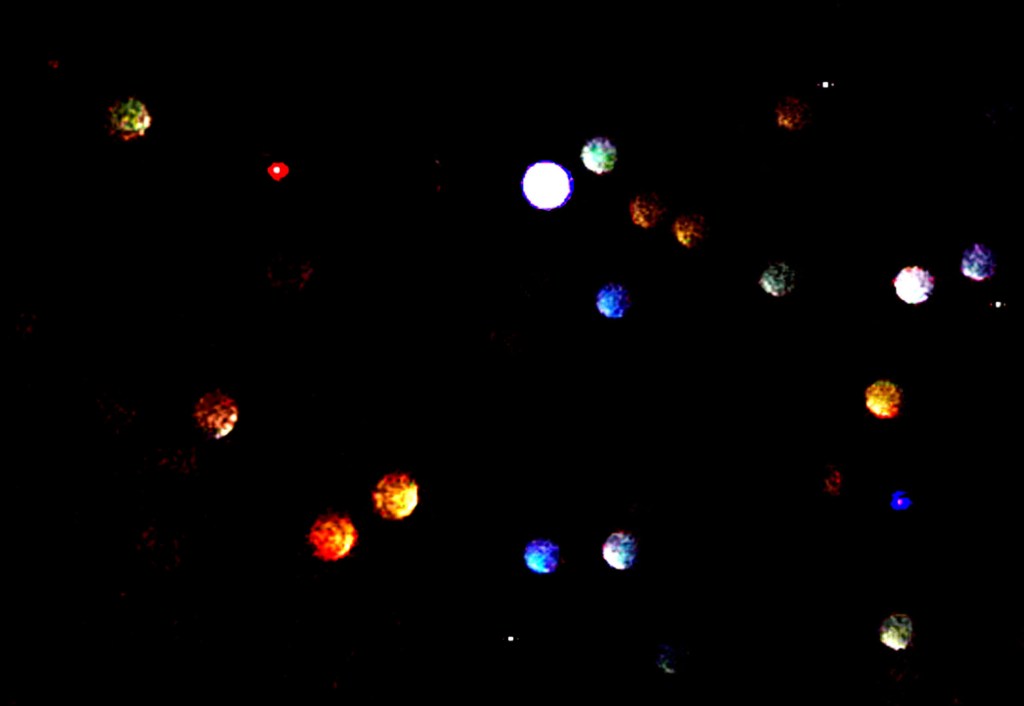
One clear night in the Sonoran Desert, I pointed my camera up towards the dark sky and took a photograph without any special telephoto lens. The result was a black image with thousands of scarcely visible pinpricks of light. These faint pinpricks were stars in the 13.5-billion-year-old Milky Way galaxy, the galaxy within which I stood. The sky appeared black because in space there is no atmosphere to scatter light.
To produce the image above, I cropped out a very small part of my original photograph then enlarged it very significantly and increased its brightness. The result was this collection of different colored circles of light against a black background. These are about twenty of the more than 100 billion stars in the Milky Way Galaxy which is only one of more than 100 billion galaxies in the universe. The different colors of stars are a result of their temperatures, chemical compositions, and the physics of light. Cooler stars appear red, while hotter stars can appear blue or white. The gold color of stars is a result of their composition, which includes heavy elements like gold and platinum. These elements are produced in supernovae and neutron star mergers, a process known as the r-process. The gold-rich stars today are essentially the remnants of ancient galaxies that merged with the Milky Way over 10 billion years ago.
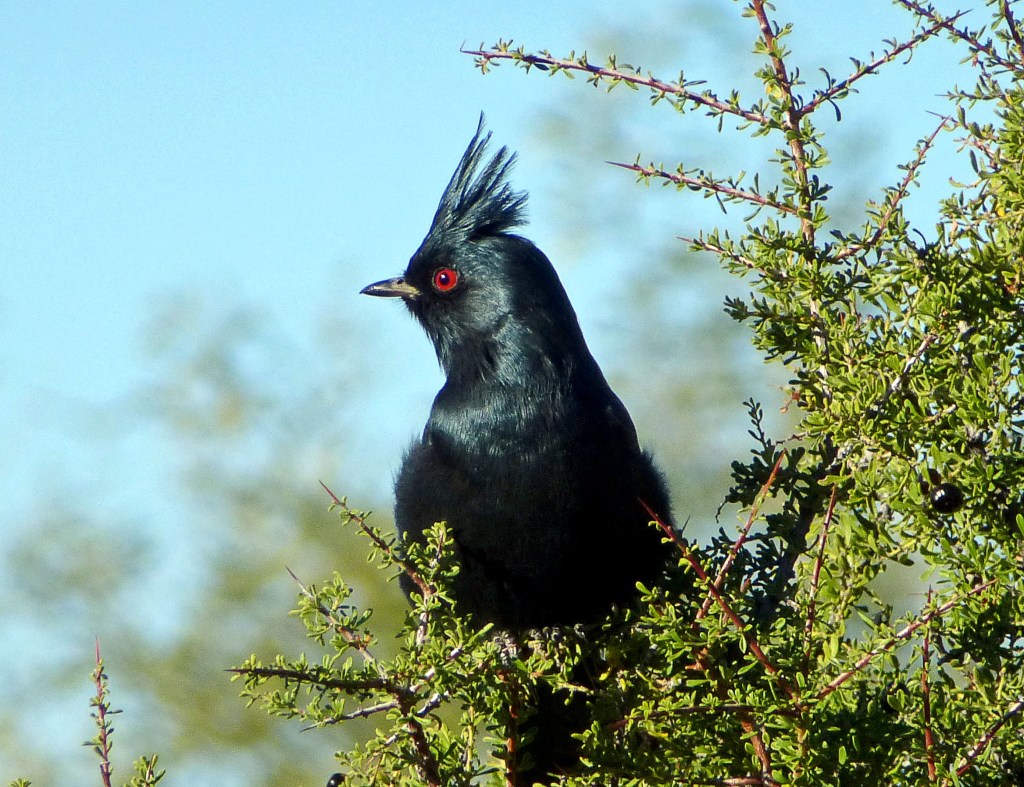
This is a Phainopepla. The word phainopepla comes from Greek meaning “shining robe,” referring specifically to the male birds sleek, reflective black feathers.
Phainopeplas are primarily found in the deserts and arid regions of the southwestern United States, from central California in the north to the Baja peninsula and central Mexico along the interior Mexican Plateau in the south. Their movements are influenced by the availability of berries that they find in desert washes, mesquite groves, and oak and sycamore woodlands. They are common in our Southern Arizona neighborhood, distinguishing themselves from other birds by the black color.
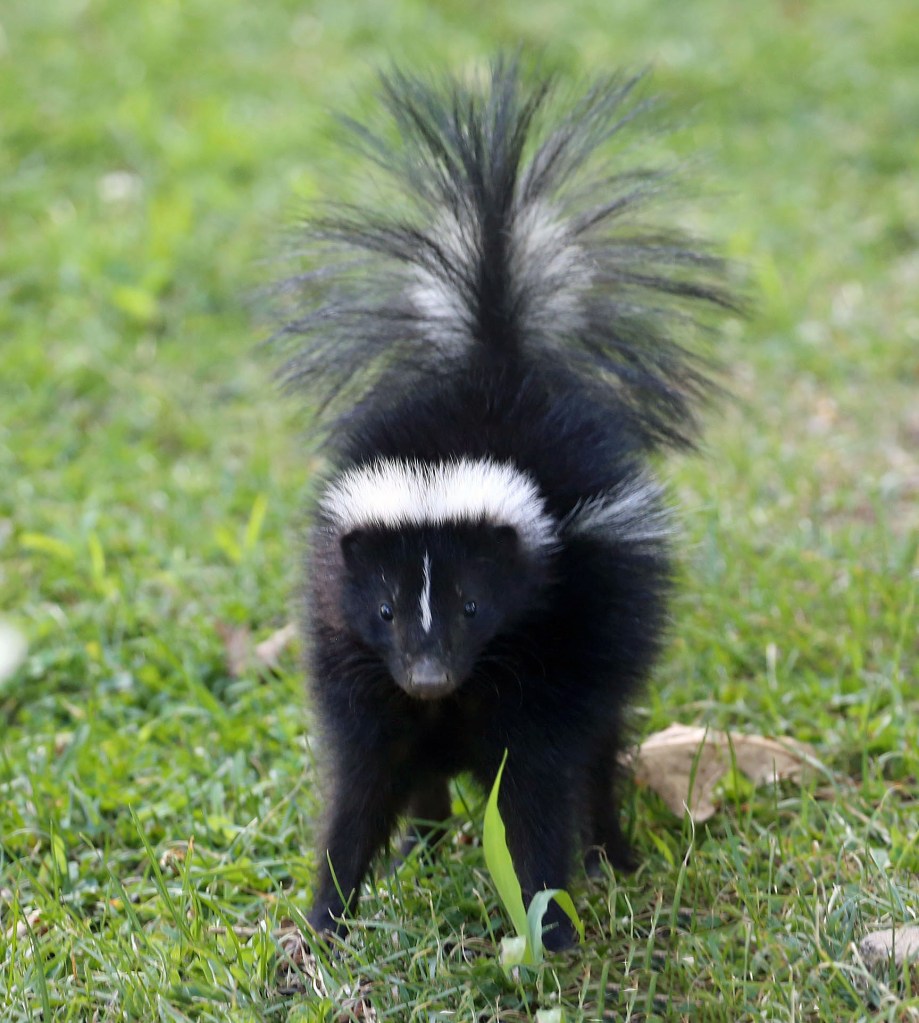
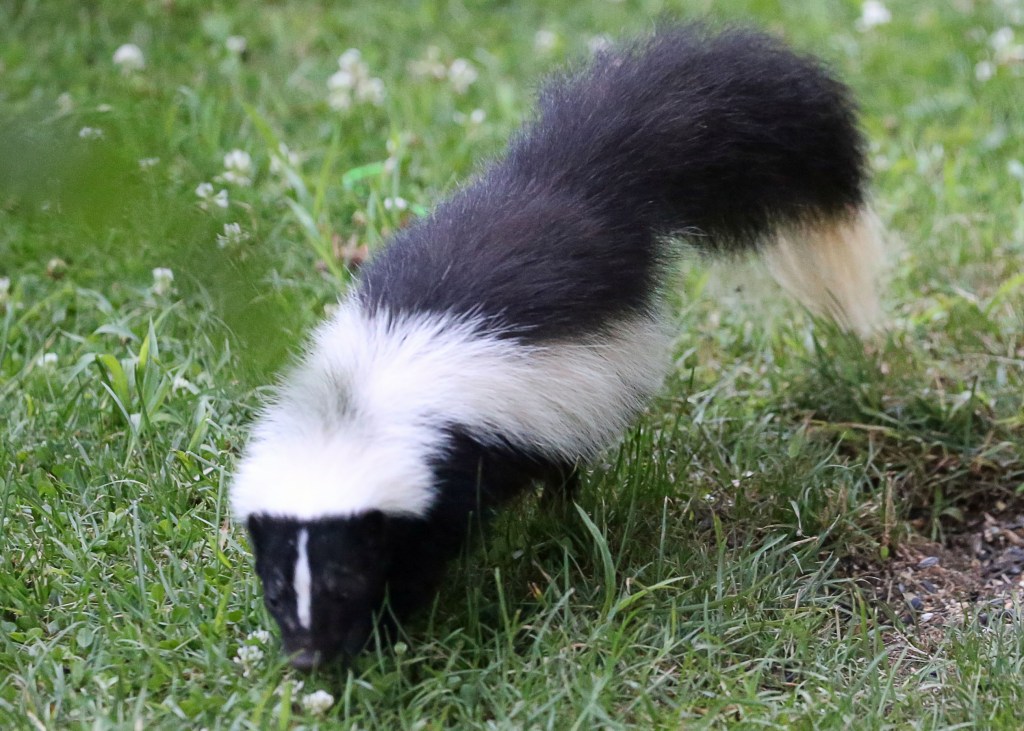
Here’s another black creature found in nature. The skunk’s black color is accentuated by its white stripe. It is a nocturnal animal and difficult to see at night. The word “skunk” was used in the Algonquin language in the early 1600’s. A description can be found in the Jesuit Relations, chronicles of the Jesuit missions (Relations des Jésuites de la Nouvelle-France) in the mid seventeenth century:
“It has black fur, quite beautiful and shining; and has upon its back two perfectly white stripes, which join near the neck and tail, making an oval that adds greatly to their grace. The tail is bushy and well furnished with hair, like the tail of a Fox; it carries it curled back like that of a Squirrel. It is more white than black; and, at the first glance, you would say, especially when it walks, that it ought to be called Jupiter’s little dog. But it is so stinking and casts so foul an odor, that it is unworthy of being called the dog of Pluto. No sewer ever smelled so bad. I would not have believed it if I had not smelled it myself. Your heart almost fails you when you approach the animal.”
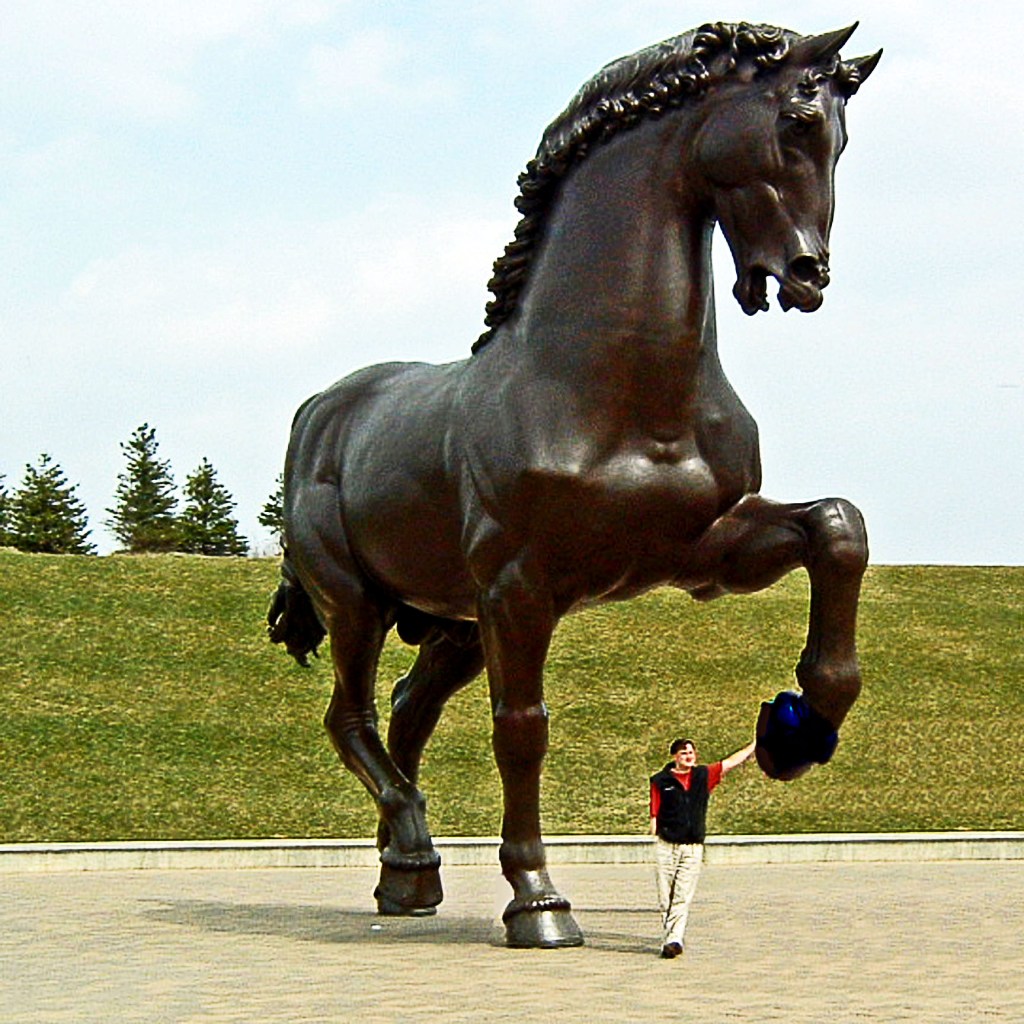
This sculpture in Michigan in the United States has its origins that date all the way back to 1482! Leonardo da Vinci first envisioned a horse sculpture for the Duke of Milan and sketched a rearing horse with a rider. Despite years of preparation, da Vinci’s designs for the towering bronze piece never materialized and the bronze originally intended for the sculpture was repurposed into military cannons in 1494.
In 1977, American art collector Charles Dent embarked on a 15-year journey to complete da Vinci’s vision and bring this masterpiece of a sculpture into existence. The sculptor Nina Akamu redesigned the piece creating two casts for the final bronze sculpture after Dent’s death in 1994. In 1999, the first bronze cast of Akamu’s stunning black beauty design was placed in Milan and the second cast was used for the American Horse sculpture depicted here with my son.
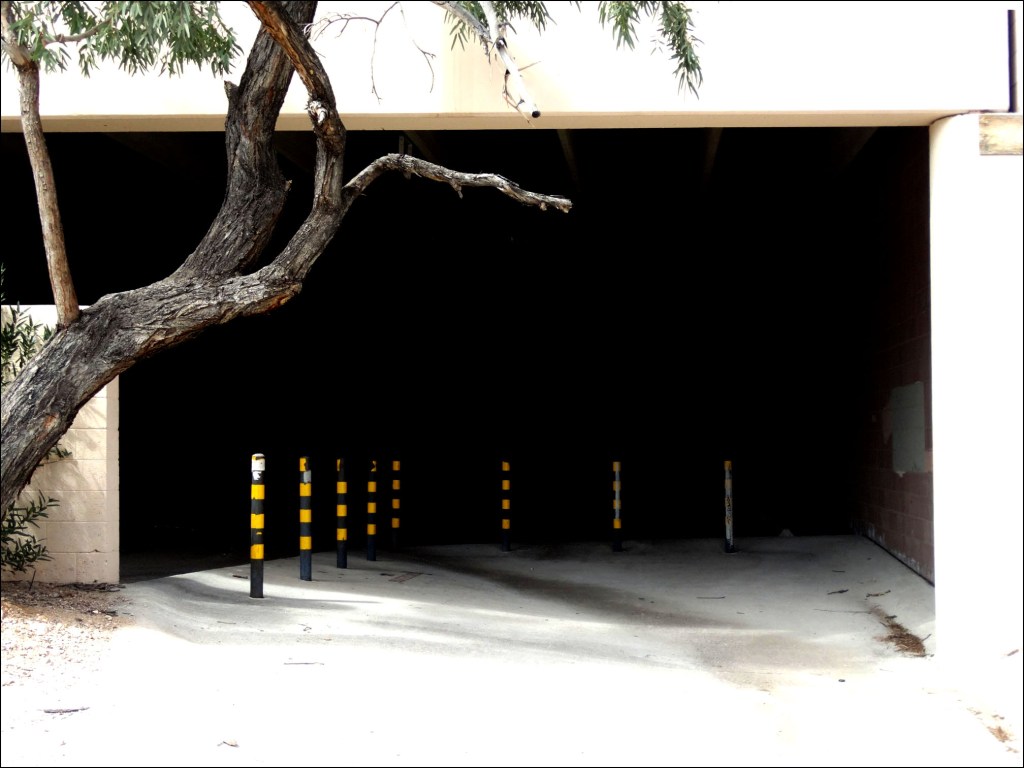
In the bright afternoon sun, the interior of the parking garage looks black. There seems to be a complete absence of light inside the building. Unless one has entered previously, one has no idea what the garage looks like inside. In prehistoric times, an early human might have been fearful about entering a dark cave, not knowing what danger to expect. Today, we generally know what to expect in a parking garage, but a deep-seated fear of the dark lurks somewhere in our inherited psyche.
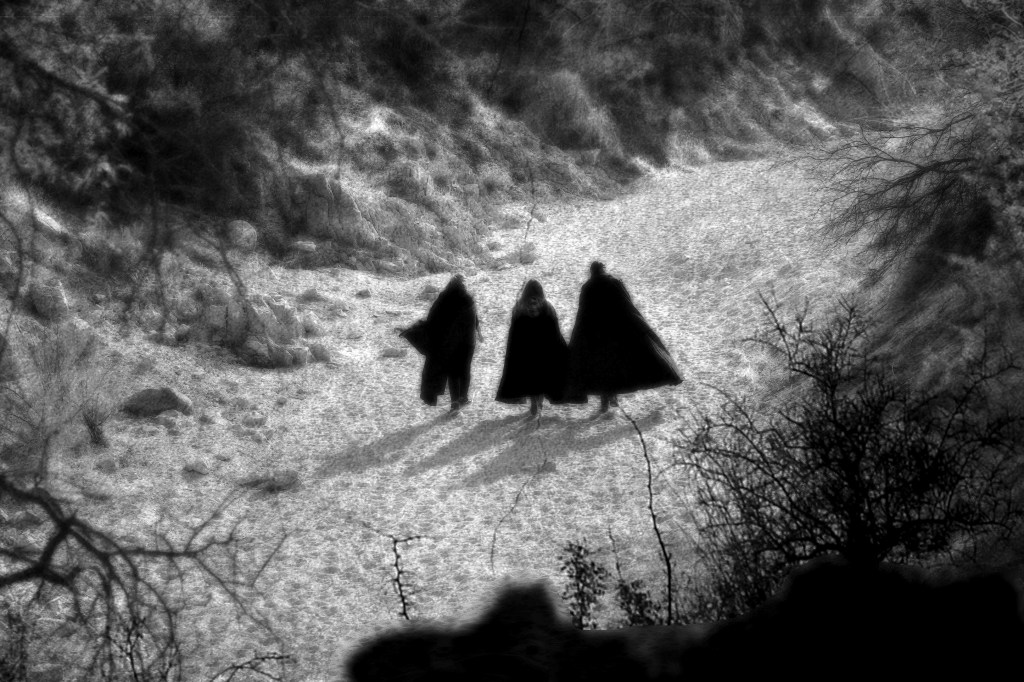
And now for something different. In this photoshopped image of mine, three witches scurry away in a desert wash. In the foreground, a dark shape broods menacingly.
Black was one of the first colors used by artists in Neolithic cave paintings. It was used in ancient Egypt and Greece as the color of the underworld. In the Roman Empire, it became the color of mourning, and over the centuries it was frequently associated with death, evil, witches, and magic.
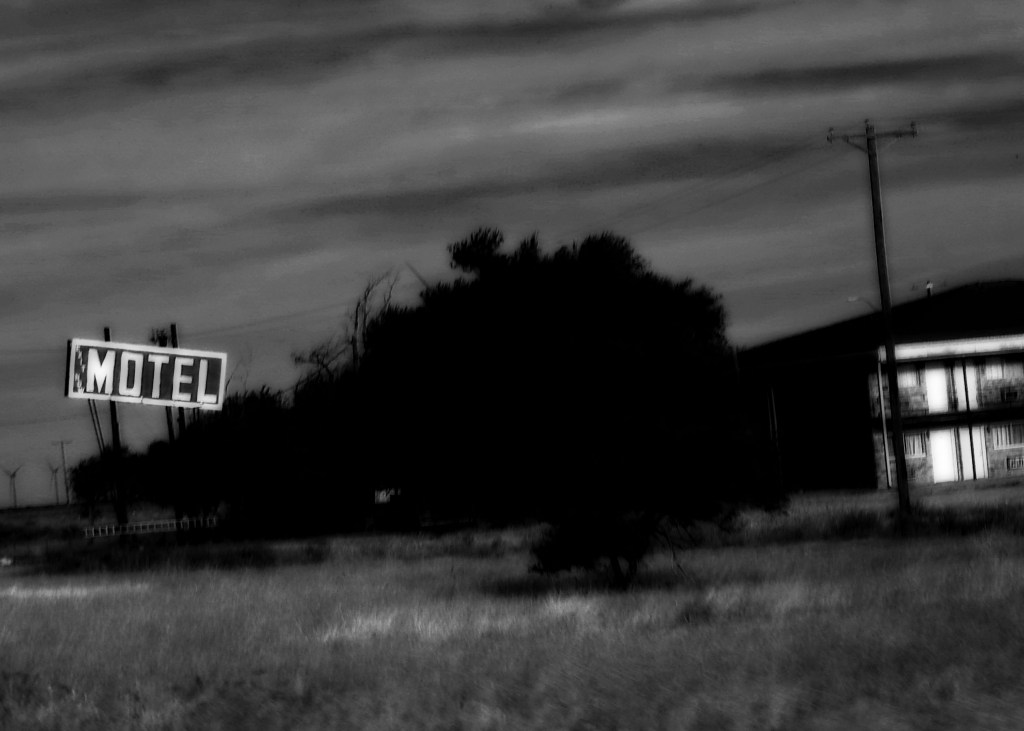
We may not have any good reason to fear the dark as our neolithic cave-dwelling ancestors might have. Black is often used symbolically or figuratively to represent darkness, the opposite of good, evil. Even though this image is simply a photograph of a motel, my treatment of it introduces something sinister, something we know nothing about, but which leaves us feeling uneasy
Not wanting to end this post on such a dark note, here is something more upbeat:
The sky is black. Ideal for watching the fireworks over the Danube on St. Stephen’s Day in Budapest.
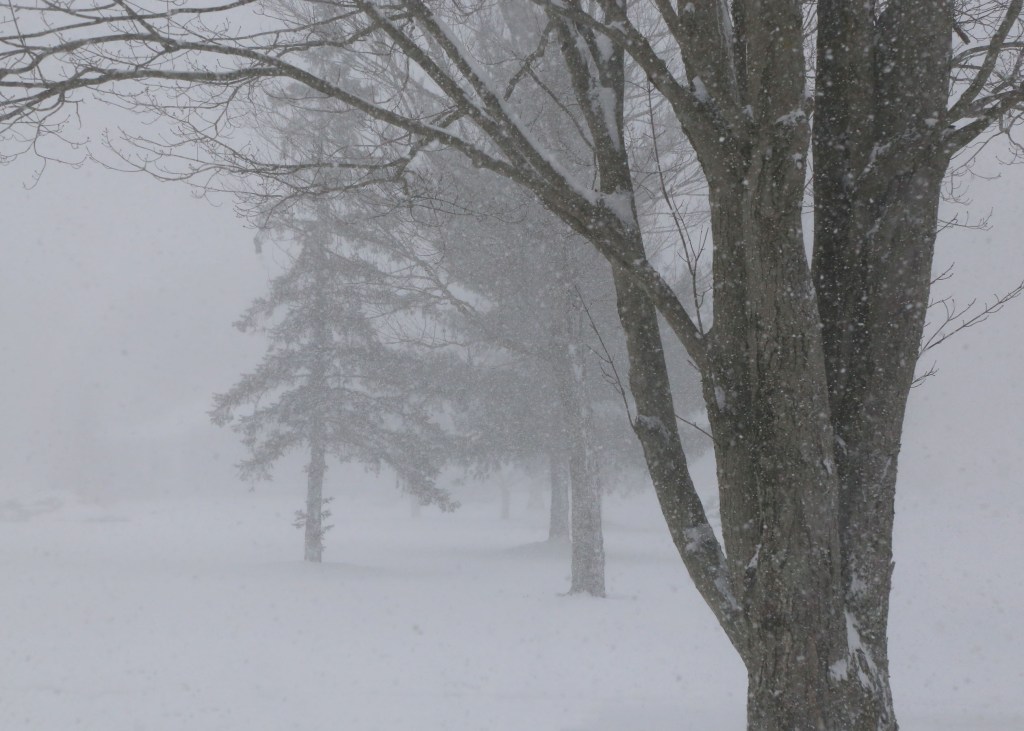
Looking out at the falling snow here in the Northeast United States, a thought comes to mind: “Now is the winter of our discontent.” The thought is accompanied by feelings of sadness, bordering on outrage, about what is happening on streets in many of our cities, and feelings of embarrassment at the behavior of my countrymen in Davos.
Now is the winter of our discontent
Where did this expression, this quote come from? Margaret Thatcher referred to the “Winter of Discontent” when addressing the British Conservative Party in 1985, but she was borrowing a phrase that had been used during the chaos of a strike in Britain in late 1978. But I doubt that this where the seed of the phrase was planted in my psyche.
Perhaps I was recalling the final novel written by John Steinbeck in 1961, “The Winter of Our Discontent”.
There is some logic supporting this. The novel tells the story of a man from a once-wealthy family in a corrupt, post WWII American town, as he abandons his integrity for wealth and status, exploring themes of ambition, disillusionment, and the erosion of traditional values, and ultimately questioning the nature of success and self-worth.
As I look out the window, the falling snow blankets the countryside but is insufficient to conceal the moral corruption among some in our country so well expressed by Steinbeck in his novel. But where did Steinbeck find the quote? Now it becomes clear; he borrowed it from another story about ambition, power, and corruption.
“Now is the winter of our discontent’ starts the soliloquy by the young Richard, in the opening line of Shakespeare’s play, Richard III. It serves as a poignant introduction to his character and the themes of ambition, power, and moral corruption that permeate the play. It highlights the contrast between the external appearance of peace and the internal struggles of those who seek power at any cost. This soliloquy remains one of Shakespeare’s most quoted lines, reflecting its enduring relevance in discussions of political and social dynamics.
The fact that this phrase is among the most famous and most quoted opening lines of any Shakespeare play, probably explains how and why it came to mind as I turned away from the TV news to sadly watch the falling snow.
The phrase has transcended its original context and is often used to describe periods of social or political unrest. So, it is understandable, then, that as I watch the snow falling, falling over our cities, falling over those in hiding, falling over the armed, masked, federal police officers, falling over the protestors braving sub-zero temperatures, and falling over the White House, we find ourselves in a bleak place, the Winter of our Discontent.
To be interested in the changing seasons is a happier state of mind than to be hopelessly in love with spring.George Santayana
Cleared for takeoff. Farewell Autumn
It seems as if all the flying things are leaving our garden, including this Cabbage White Butterfly
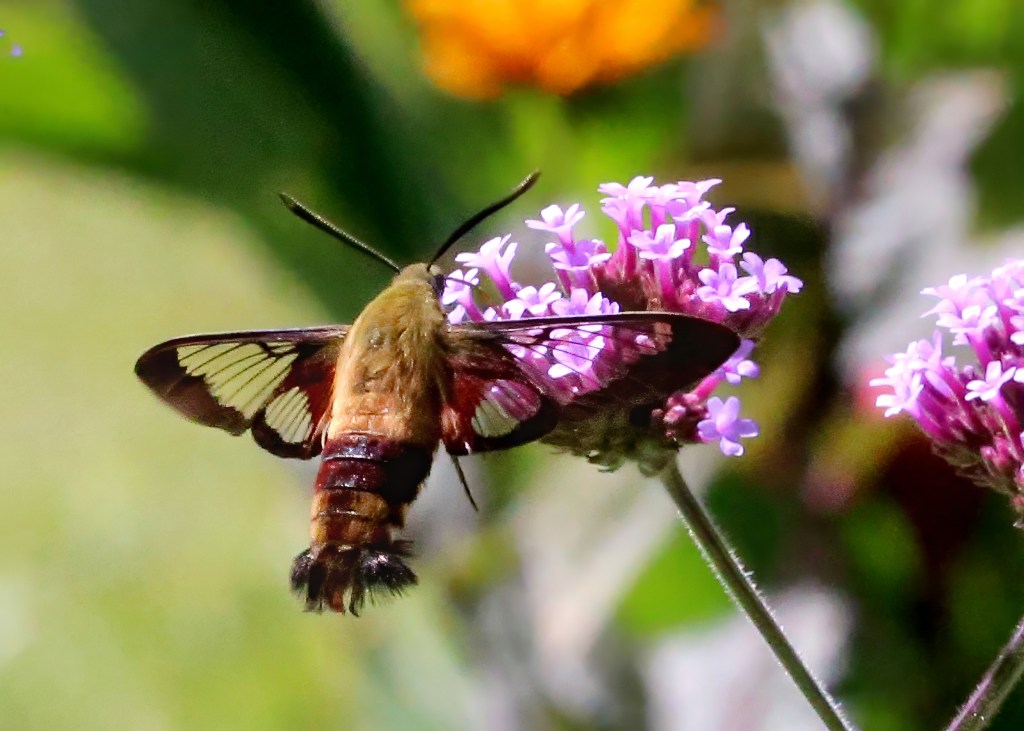
And the Bumblebee Moth disappeared a few weeks ago.
Over the summer we watched the Monarch Caterpillar feeding in our Butterfly Bush:
And then, after pupating, returning as a beautiful Monarch Butterfly
Not all the Monarchs survive. In the following image, a yellow garden spider, the Argiope aurantia, has captured a butterfly and wrapped it in a silk sheath.
Ten days ago, the last few Monarchs visited our garden. They had just flown south from Canada over Lake Erie and settle on our zinnia flowers to build up energy for their long flight to Mexico.
The Swallowtail butterflies have also left
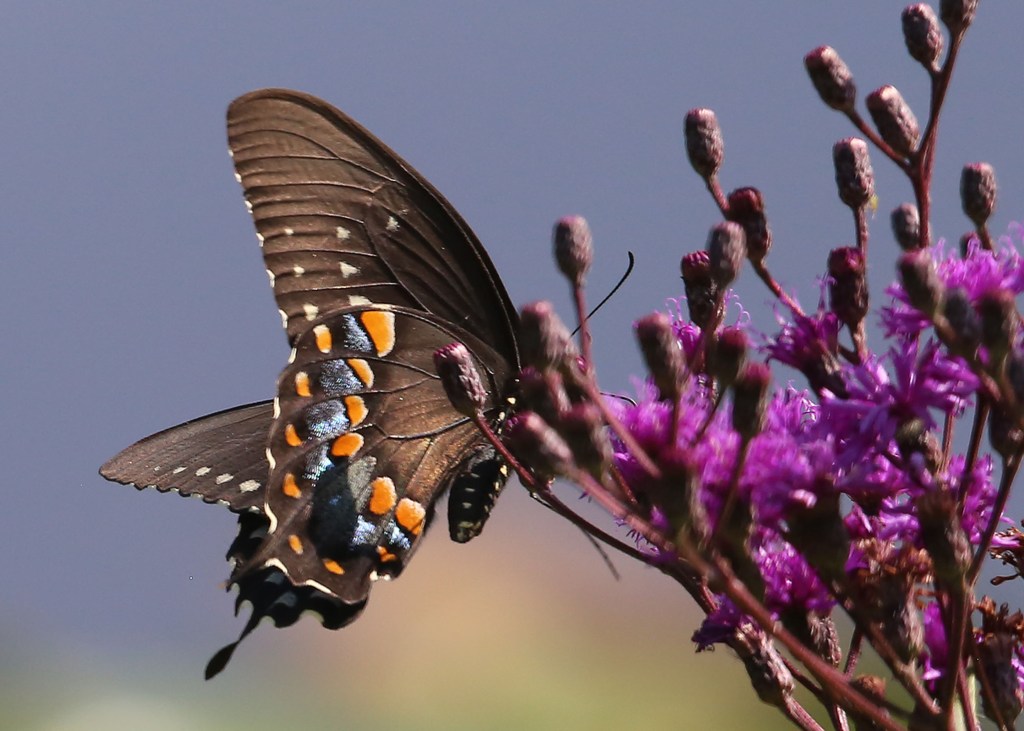
The Spicebush Swallowtail
And the Yellow Swallowtail sharing a viburnum blossom with a Bumblebee.
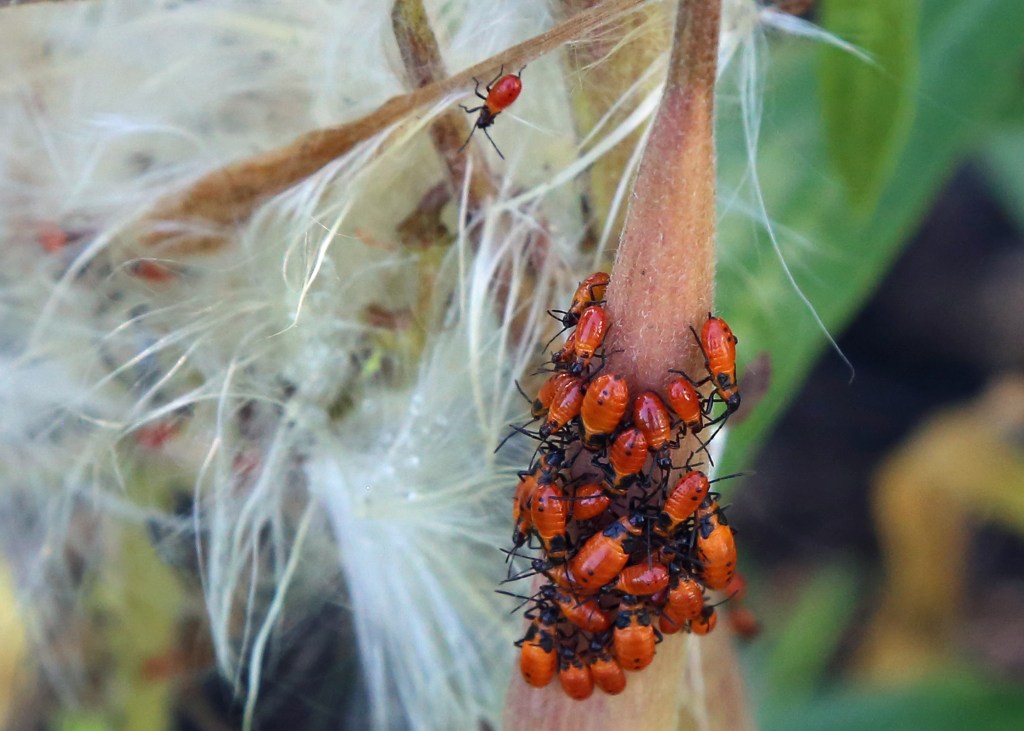
As the butterfly bushes start going to seed, we noticed Milkweed bugs (Oncopeltus fasciatus) on the pods. They are part of the milkweed ecosystem, we left them alone.
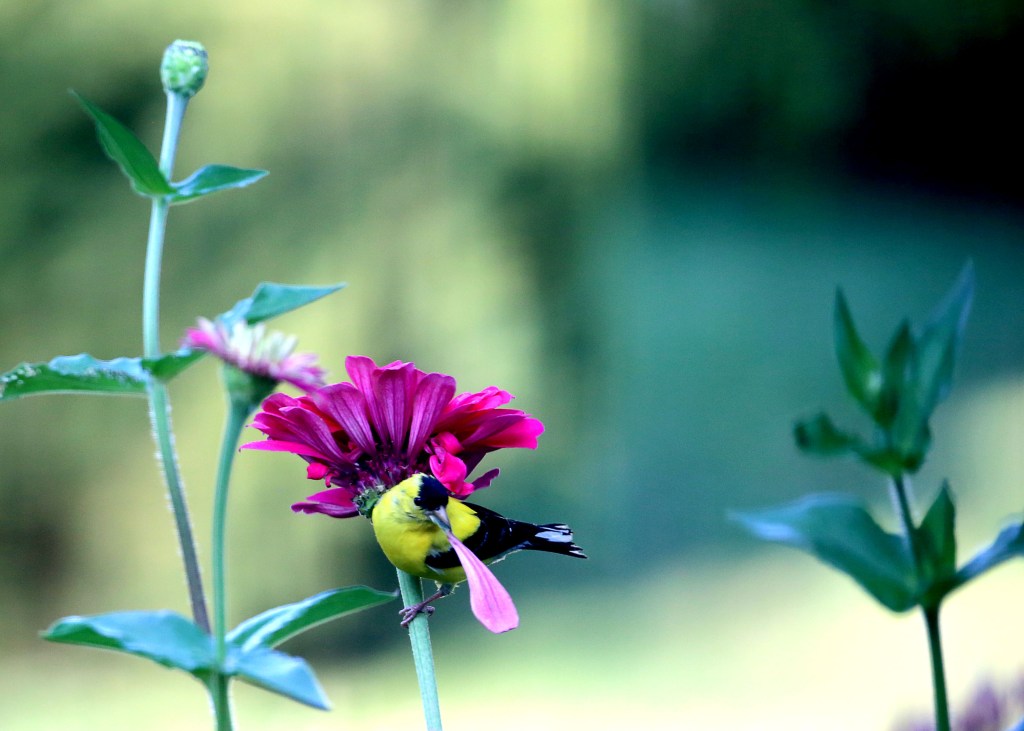
As summer slid into autumn, we watched the goldfinch plucking petals off the zinnia flowers to access the seeds.
We had bid farewell to the Ruby-throated Hummingbird that was with us all summer, and a few weeks ago a juvenile hummingbird passing through on its migration to Southern Mexico and Central America.
We still see Dragonflies, but they too will soon be gone.
We were fortunate to be able to retire in the country and align ourselves with the changing seasons. At our advanced age we have learned to say goodbye, which we must do every autumn. But we haven’t been completely abandoned. Here are some of our friends who will remain with us over winter
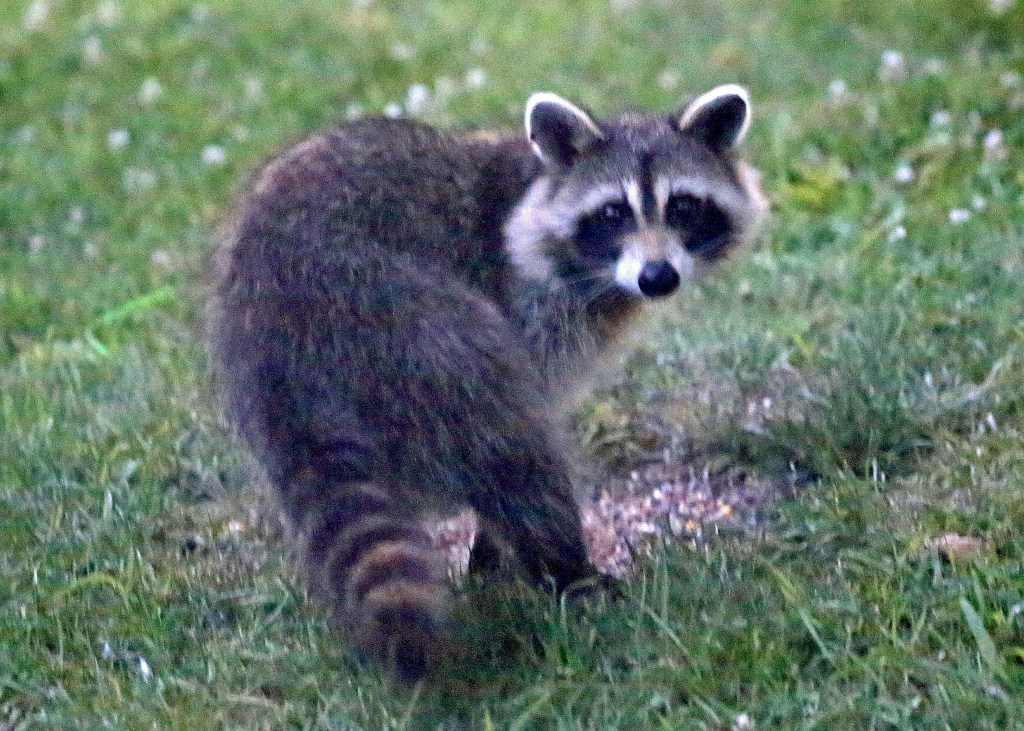
Racoon
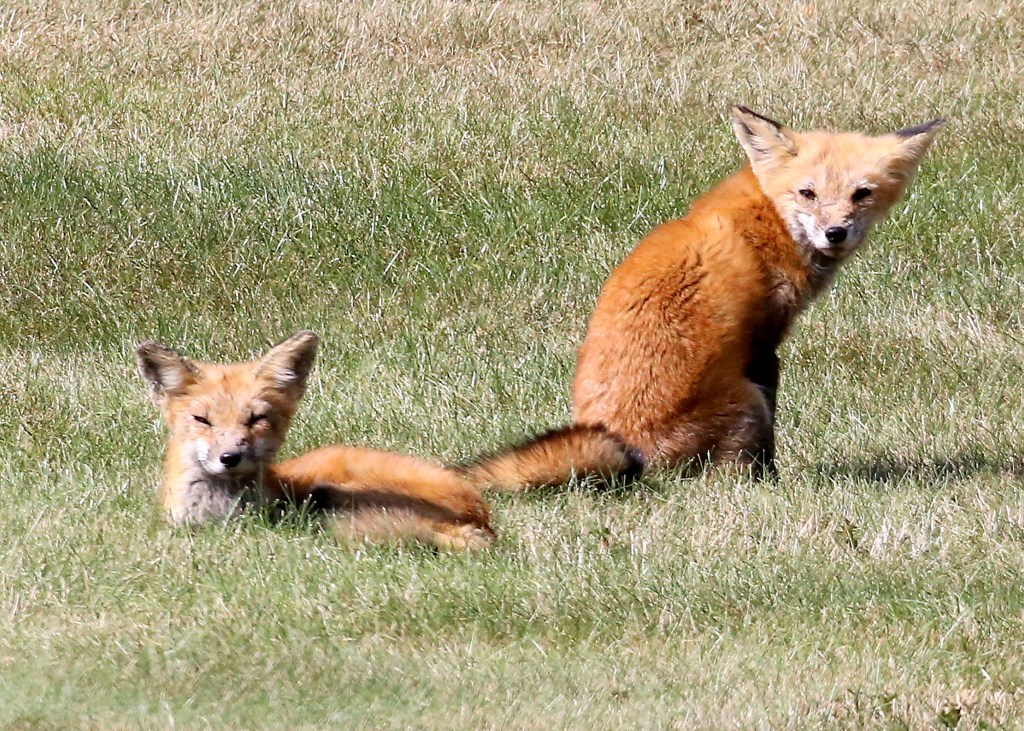
Red fox
Skunk
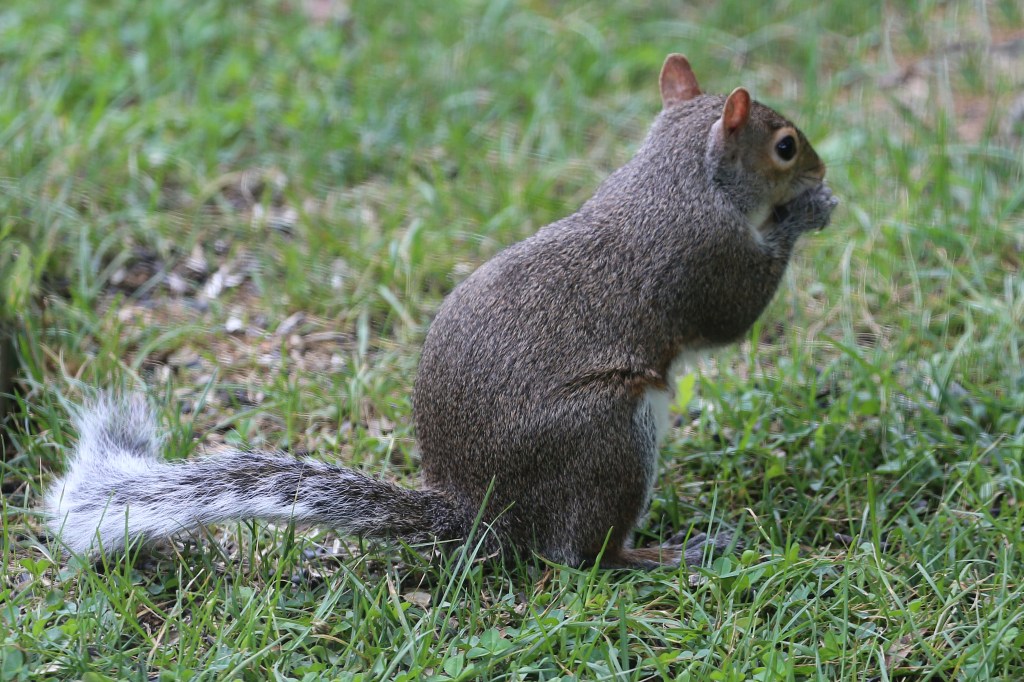
Eastern Grey Squirrel
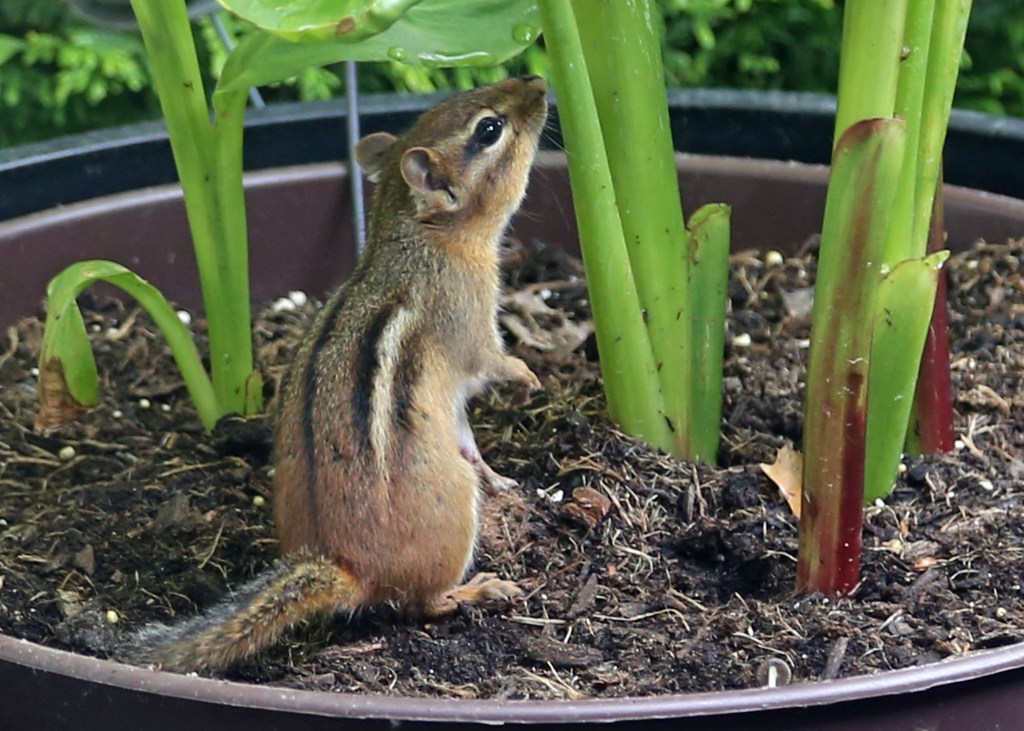
Chipmunk
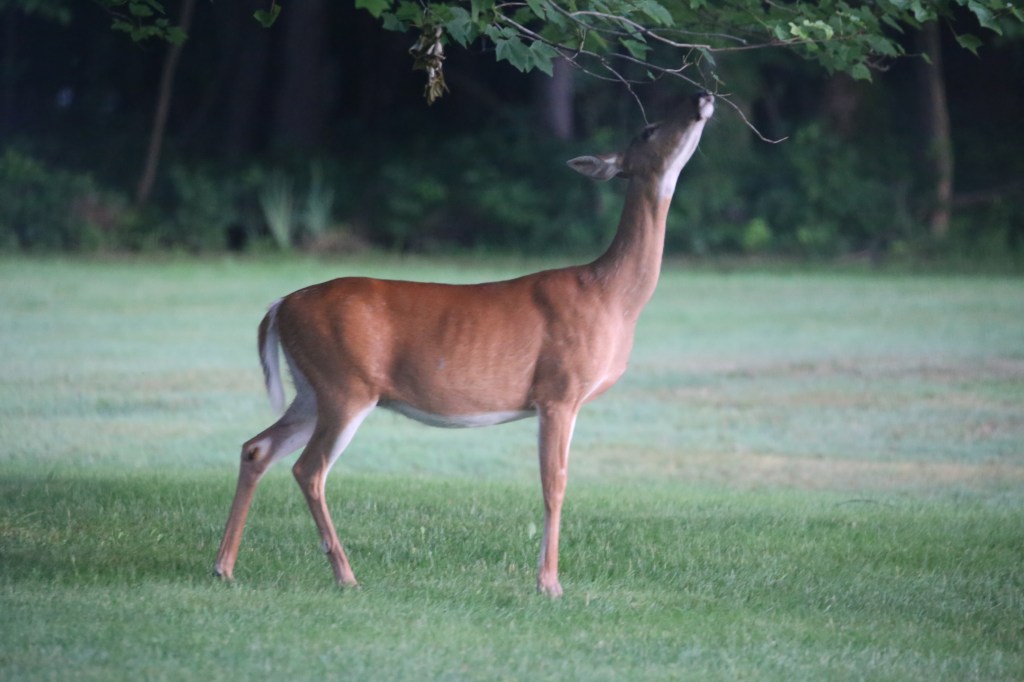
White-tailed deer
The Possums and Groundhogs will be nearby, but underground. We’ll see them in the Spring.
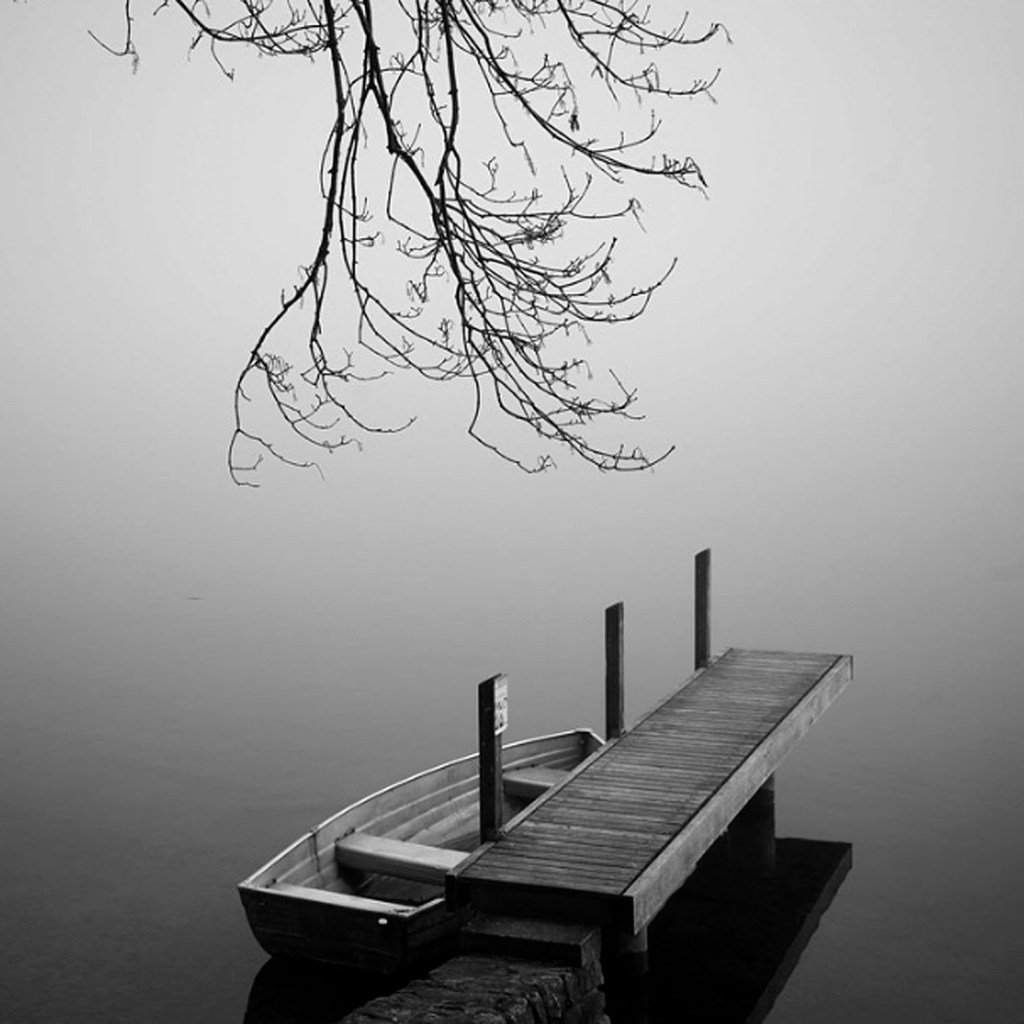
Step into the boat. No, you don’t need to bring anything with you. You can leave your things behind. Your pictures, books, clothes; Even your phone. Your shoes. The plastic glass of apple juice with a bent straw. You don’t need to bring anything with you, Not the sun warming your face, Nor the rain, softly falling on your hair, Nor dreams of the ocean, And your special places. You don’t need to bring any of that with you, Nor anyone. Not your children. Nor even your wife. Let the memories and the music Of days when you were young Disappear into the nothingness, Like the sigh and sudden emptiness In the bed where you no longer lie. Leave them weeping there. Come, hold my hand. Step into the boat.
Despite the heat and humidity of the last weeks of summer, we look out at a blaze of color in the gardens surrounding our little sunroom.
Yesterday afternoon, sitting with my camera for less than an hour and, without leaving my chair, I took the following photographs. The quality isn’t great: There were reflections in the windows and several of the pictures were taken through window screens. But I wanted to share the sensibility of being surrounded by nature’s beauty on a hot, muggy day.
There are over twenty species of this perennial. In this blurry image seen through the screen window we have a Heliopsis, Tuscan Sun.
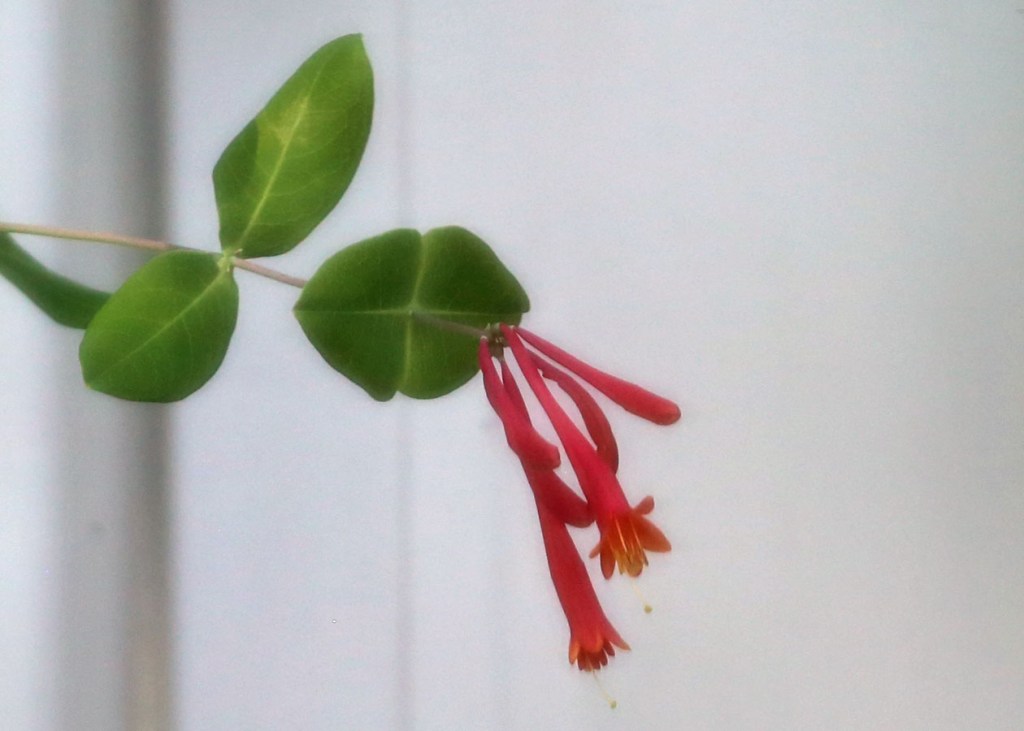
Turning in my chair and looking behind me, I see the Honeysuckle vine against a white wall. Sometimes I may see hummingbirds feasting on the flower’s nectar, but not this afternoon.
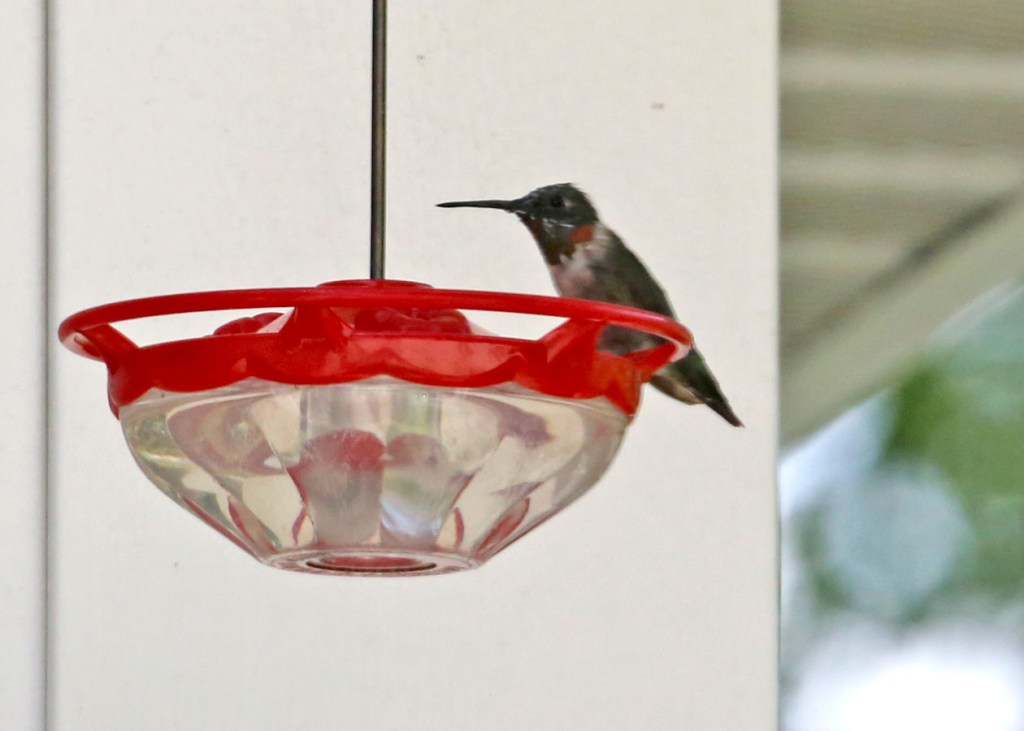
As I look to the front again, I catch a glimpse of the Ruby-throated Hummingbird at our feeder. Even though our garden has honeysuckle, verbena and monarda, our summer visitor will often take the line of least resistance by taking nectar from our feeder. In fact, if the feeder runs low on sugar-water, the hummingbird will sometimes hover just outside the window to remind us to fill it. Like the butterflies, the hummingbirds will soon be flying south.
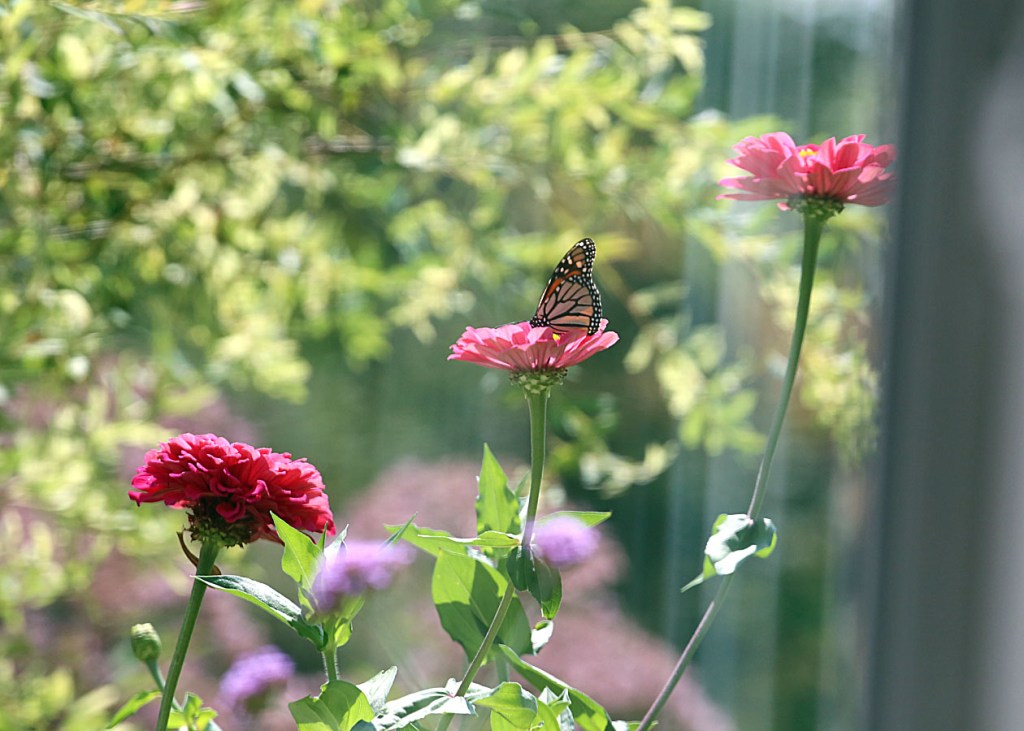
Speaking of butterflies, here is a Monarch settled on a Zinnia flower. Over the past few days, we have noticed lots of activity as the fourth generation of butterflies prepare for their long migration to Mexico.
We planted Zinnia seeds in the house in April, transplanting them to pots in May and taking them out to the patio when the danger of frost had passed. They are a tall-stemmed plant known for their twelve petal flowers.
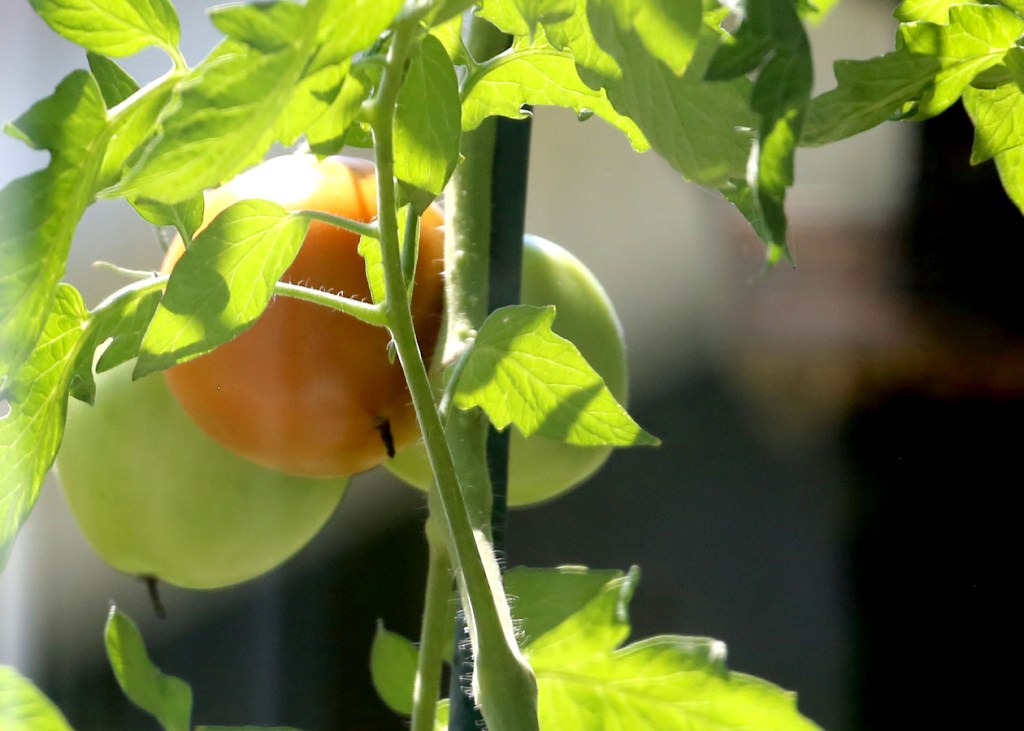
Close up to one of the windows is a tall tomato vine. We planted this several months ago and its fruit is only now ripening. This is the large ‘Beefsteak” tomato, a delicious, juicy, variety that we use for salads and sandwiches.
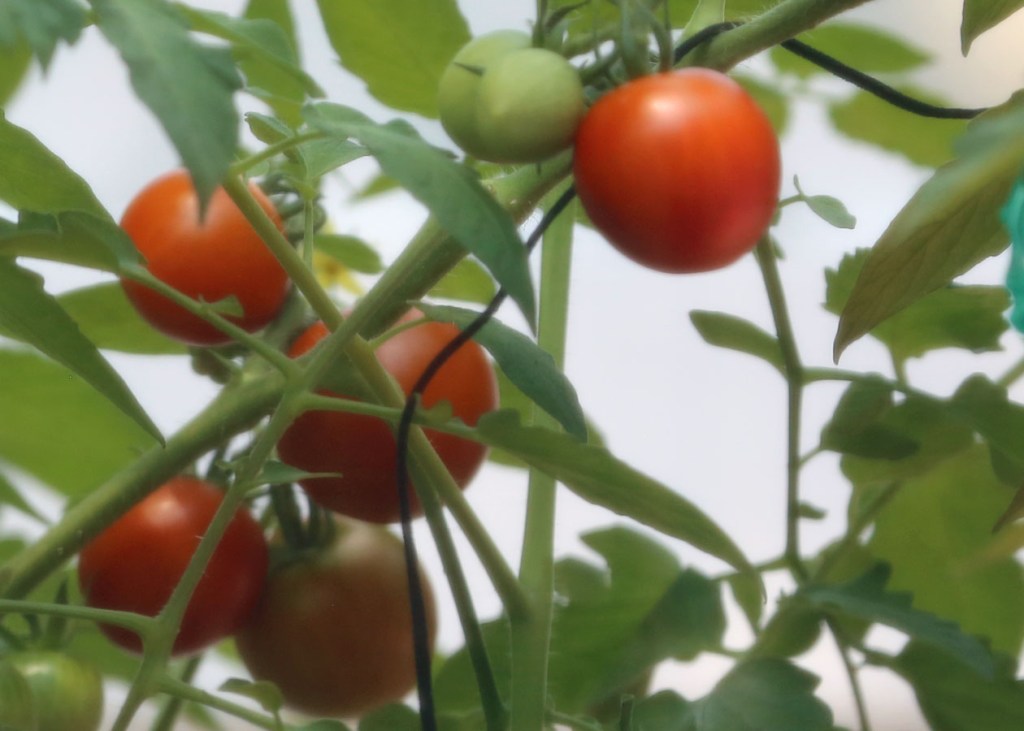
Turning around in the chair, I look out at another tomato vine. This one produces smaller slicing varieties in abundance
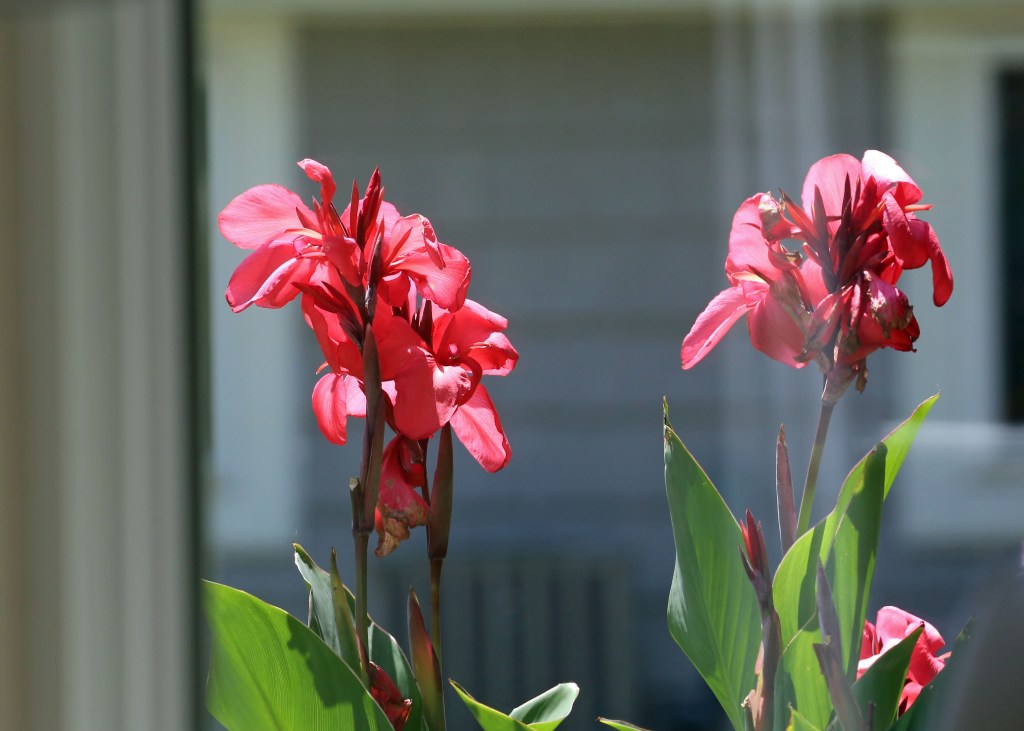
This Cana plant isn’t in the flower bed but in its own pot next to a tomato vine. We planted it in spring and expect it to continue enjoying its tropical-like green foliage and brilliant flowers until the first frost of autumn. Like the tomato vine, the Cana is so close to one of the windows of the sunroom, it could almost be in the room.
There is some shade under the old oak tree behind me where Hosta plants do well. But by this time of year, the flowers begin to wilt, and the leaves are losing their vibrancy. Earlier in the summer the several varieties in our garden created a luxuriant display of different textures, sizes and shades of green.
A variety of miniature Hostas in a blue pot keeps color in the garden.
The birdfeeder to my right attracts several species: chickadees, nuthatches, cardinals, bluejays, sparrows, finch, grossbeak, starlings, blackbirds, tufted titmouse, a variety of woodpeckers, doves, and goldfinch. This afternoon, only a male house finch makes an appearance.
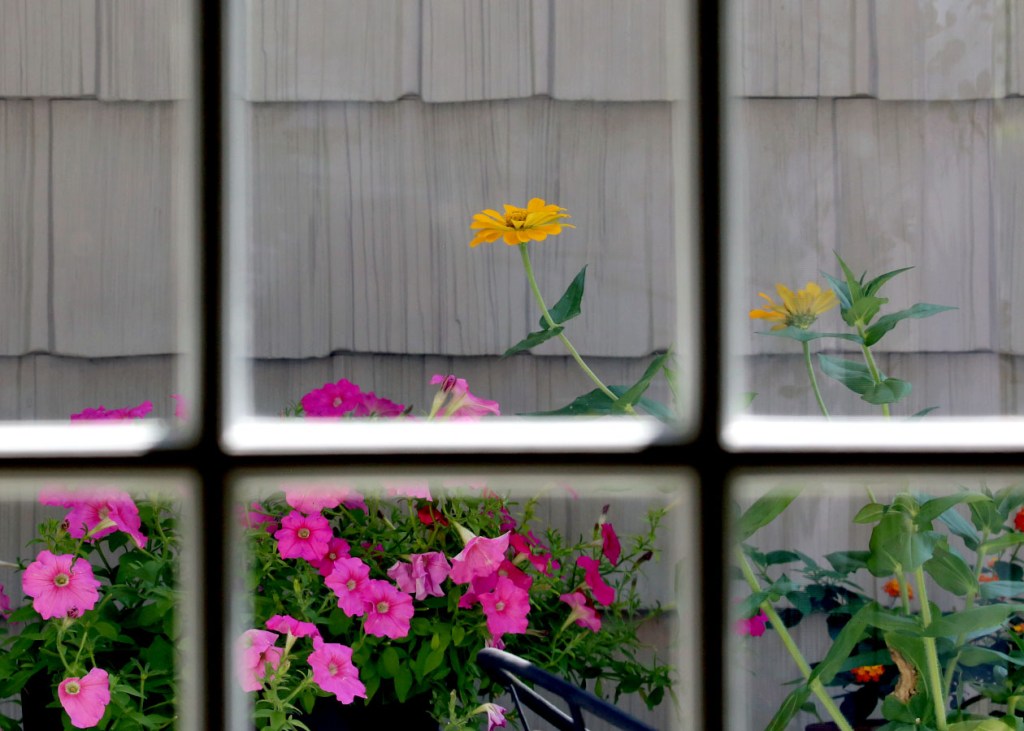
Looking through the glass door, one is struck by the bright yellows and pinks of a Zinnia and a pot of Petunias.
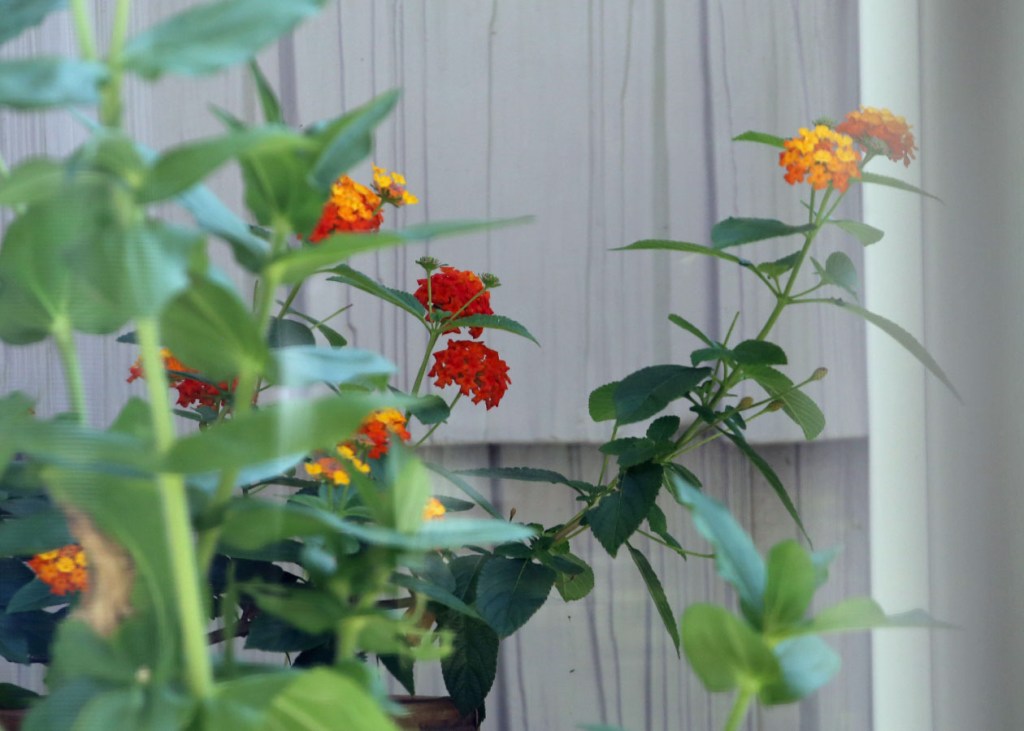
This Lantana plant is a nice addition to our pollinator garden. The species proliferated in our Arizona garden when we lived there but now are confined to a pot for their summer appearance in Ohio.
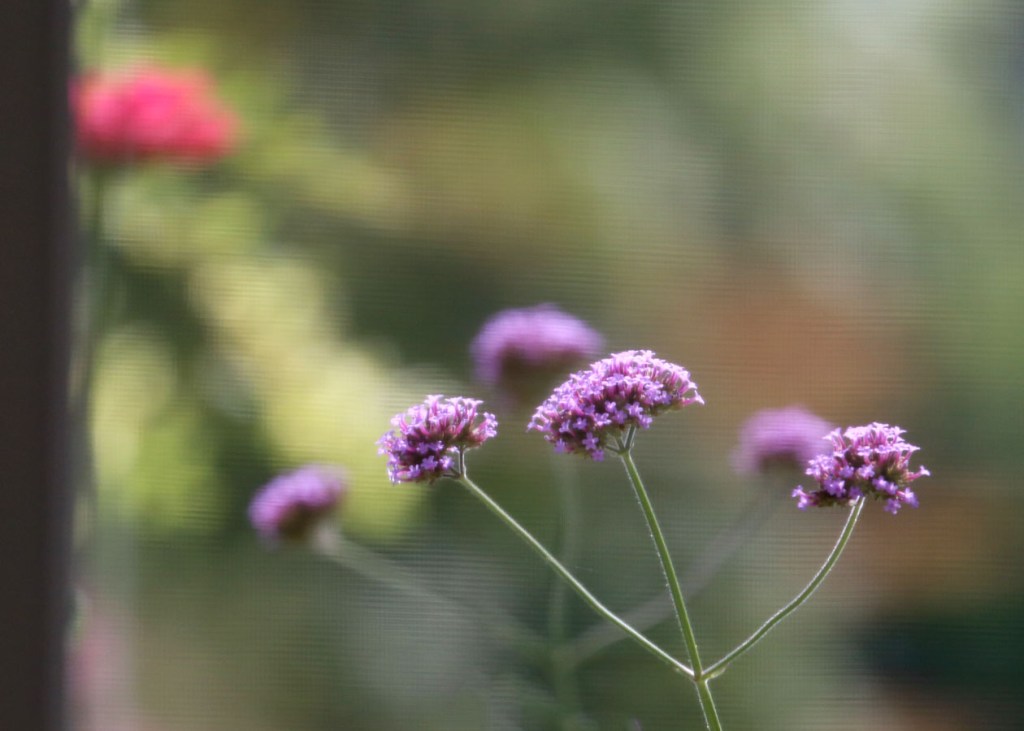
A blurry image through the window-screen of the tall, slender, stems of a Verbena with its cluster of purple flowers. It is a nectar source for butterflies and hummingbirds. A late-summer bloomer, it brings some nice color to the garden as other earlier blooming flowers begin to fade.
The Mandevilla is a subtropical vine native to the Southwestern United States, Mexico, Central America, the West Indies, and South America. We buy a small potted vine each spring and plant it next to an old lattice frame that it quickly covers, producing bright pink flowers. We can see one of its flowers sharing space with a Zinnia
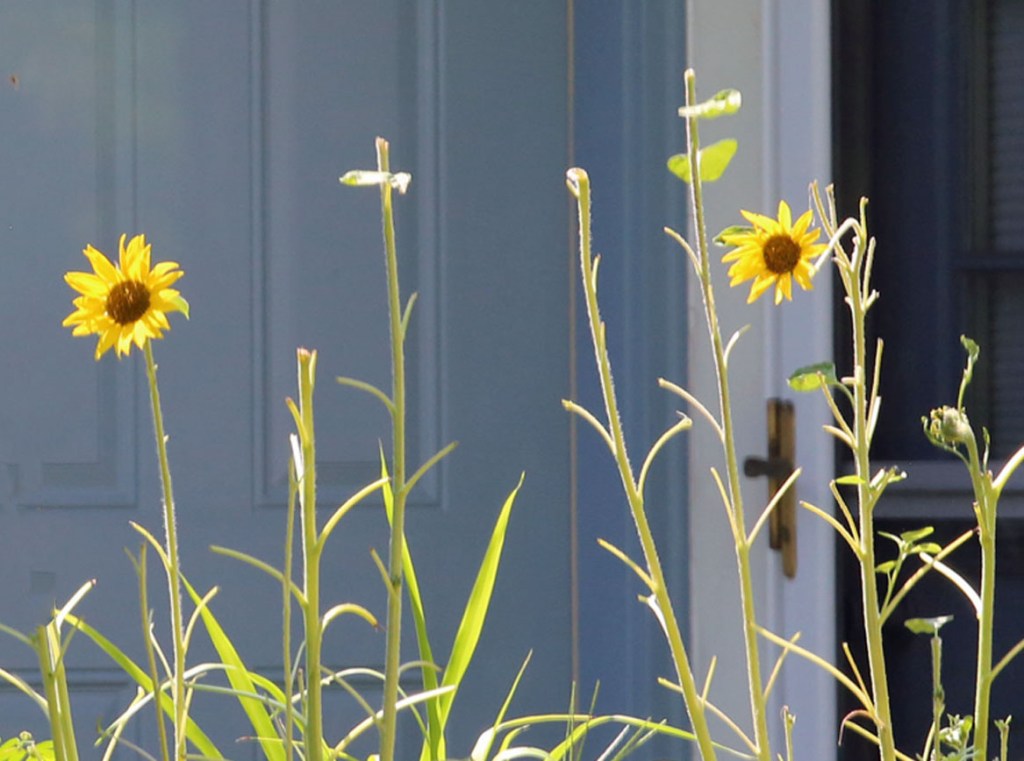
Beyond our own flower garden, a few sunflowers that our neighbor planted in her vegetable bed adds to the color of our surroundings.
This the chair from which all the photographs were taken during an hour on a hot, muggy end-of-summer afternoon
The danger of flying is the sense of detachment it brings from life on the ground
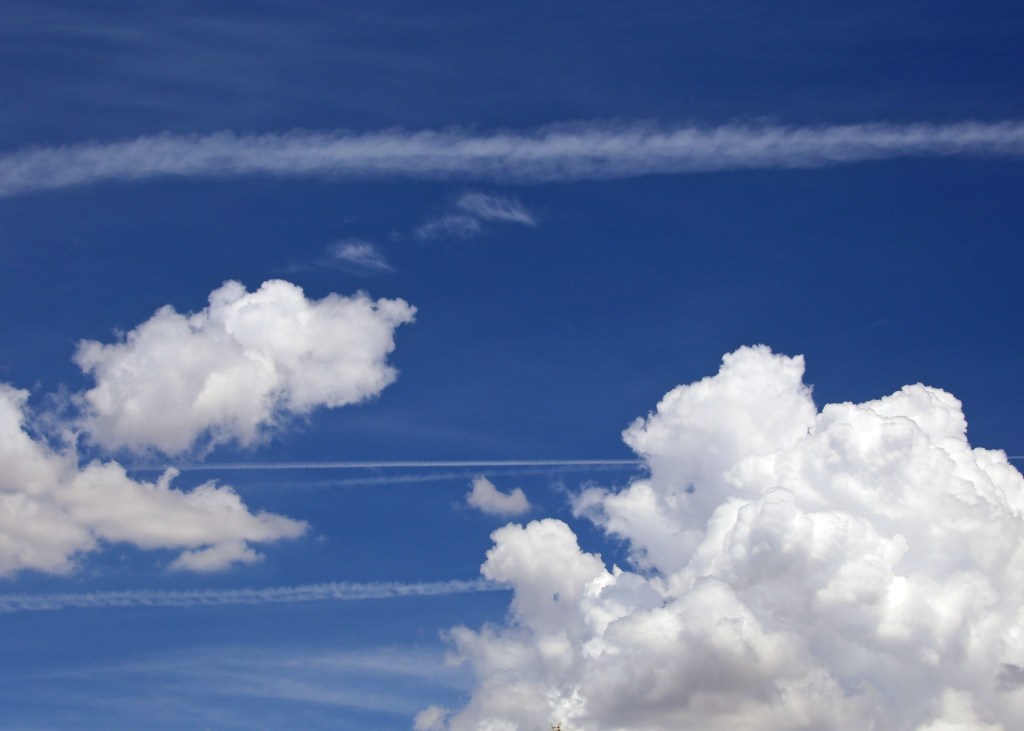
In 1953, I flew in a Pan American World Airways DC-6 from South Africa to Boston. It was the first of many long-distance flights that included flying on a BOAC Comet to Heathrow, and with Air China on an old Boeing 747 from Los Angeles to Shanghai. There was one memorable east-to-west around-the-world flight mainly on Quantas and north-south flights to Jamaica, Mexico, Brazil, Barbados and South Africa. And too many flights to Europe to count. One thing didn’t change: The view of the sky and clouds.
I liked a window seat so that I could turn away from the coach with its crush of passengers and video screens and look out at the clouds, but often with the guilt that sometimes accompanies the feeling of detachment from the real world below.
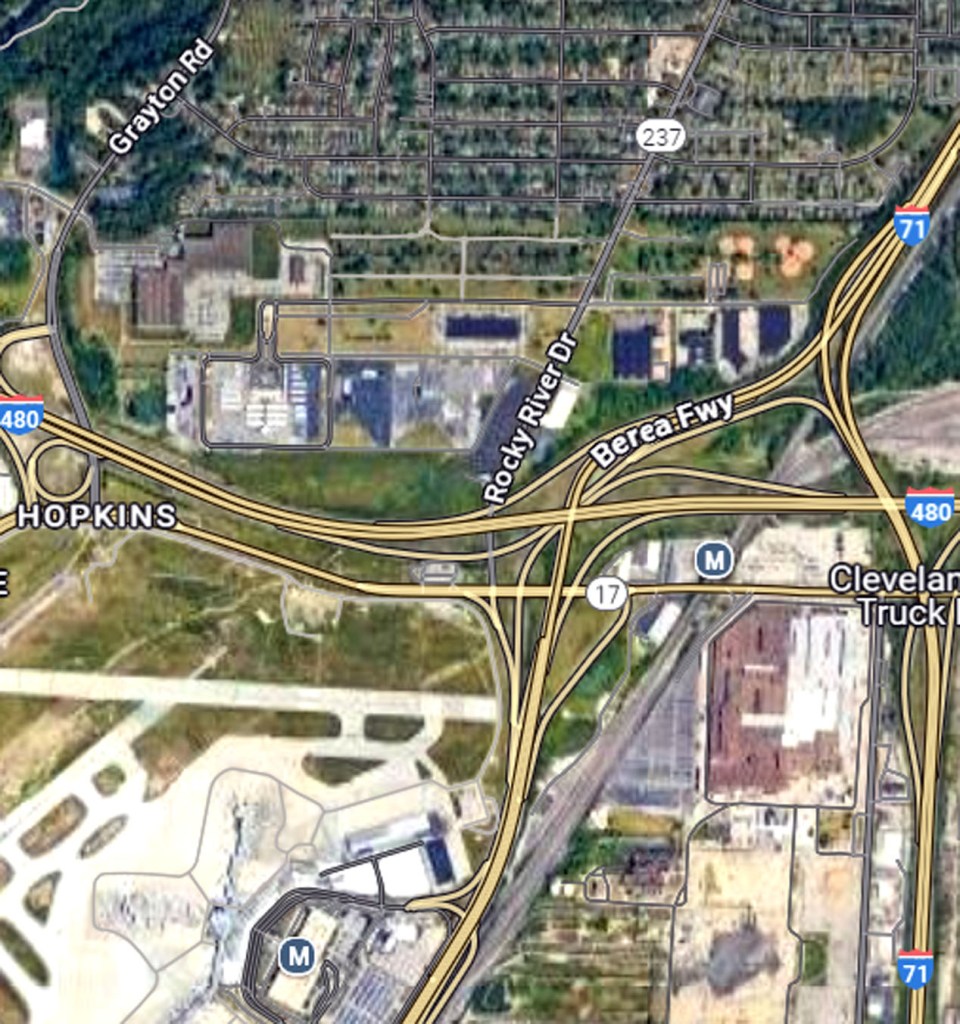
I recall flying home late one afternoon and, on the final approach, looking down at the little houses in the blue-collar neighborhood laid out on a grid of tree-lined streets squeezed in between highways and runways.
In an instant, I saw a family in each house with each member bringing home a sliver of the multiplicity and complexity of their lives outside the home: The teenager, a mother, a father. And a great compression of the larger worlds of which they are a part into the little structure that for now is home. Each house, a different family; each a little world to itself. A few hundred homes.
And from the plane, I watched cars moving on the streets, most coming home, some leaving: Each story the same, but different. Beyond the streets and trees and houses, the highways came into view with rush-hour traffic heading west and east and branching off to the south.
And, in that instant, I saw a sense of purpose in all the vehicles speeding in opposite directions, and all cars turning into the driveways of different houses in the little neighborhood.
And in the sky above, an unseen network of satellites provides location guidance to the drivers and the ability to call home to say that one will be late. And as a look down, I see a dynamic system at play, not comprised of autonomous agents, but a system of interdependent elements whose very existence is contingent on the system as a whole.
And I become conscious of the approaching runway and the other aircraft, some departing and others at the terminal, and I recognize that I’m not an observer of the scene below, but a participant in it, an element in the larger self-correcting system that shapes and is shaped by its parts.
And the words of my uncle George come to mind as he describes his experience looking down from a mountain at the village below:
And the streetlights come on, and a kettle whistles on the stove, and in a home a small child feels safe and secure. And yet … and yet.
There are philosophers who say that we only know things in their relationship to other things. It is perhaps like this in our awareness of the seasons.
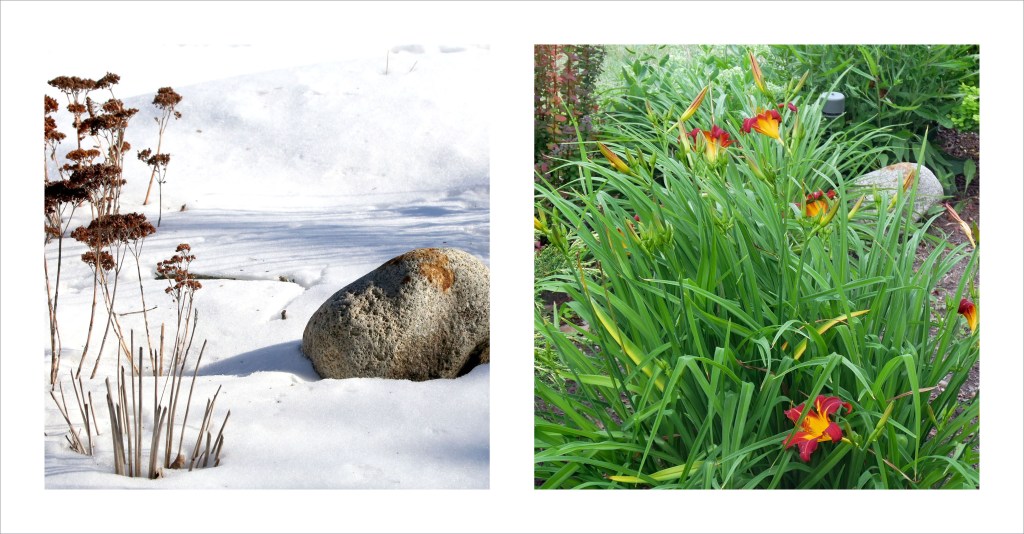
It was like yesterday, looking out the bedroom window: A rock and a few bare stalks in the winter snow. Now, life has returned. The rock is barely visible in the dense overgrown garden behind a clump of day lilies. These flowering plants, native to Asia, aren’t true lilies. They are prolific perennial bulbous plants whose flowers typically last only a day only to be replaced by new ones: Something like our own short lives.
Also like yesterday, I shoveled a path through the snow from the back door. And now, the Clematis flowers have come and gone and the tomato vine I planted in May is nearly 2 meters tall.
One of spring’s seasonal joys is watching the Clematis start to bud on old vines. Here they are. But now, in mid-summer, only the leaves remain.
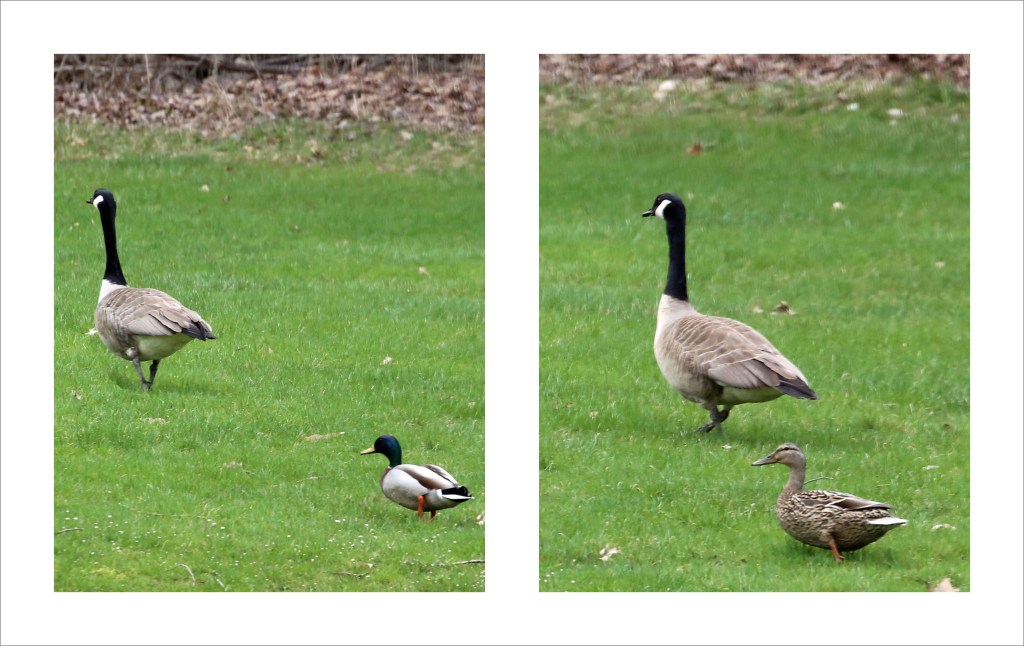
Each spring, a pair of Canada Geese and two Mallards arrive at the back of the house. Even though they are different species (goose and duck) they seem to get along together. The Canada Geese mate for life while the Mallards enjoy a brief liaison during mating season.
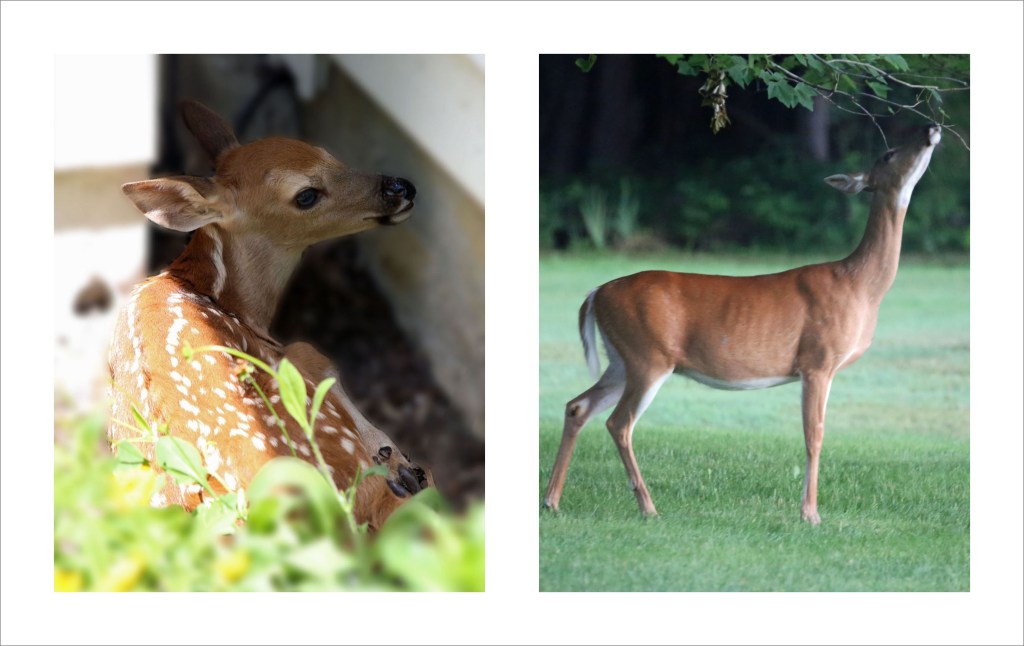
The forest behind our house is home to white-tail deer. In Spring, it’s common for deer to hide their fawns and leave them alone for long stretches of time while they gain the strength needed to run from predators. One of the instinctual gifts fawns have is the ability to stay quiet during the first three weeks of its life. After about a month, the fawn’s legs are strong enough to support running, and it is now able to keep up with the doe while foraging for food. In this image, an adult deer grazes from the low hanging branches of a maple tree. It has already eaten the flower buds of the Stella D’Oro daylilies in our garden!
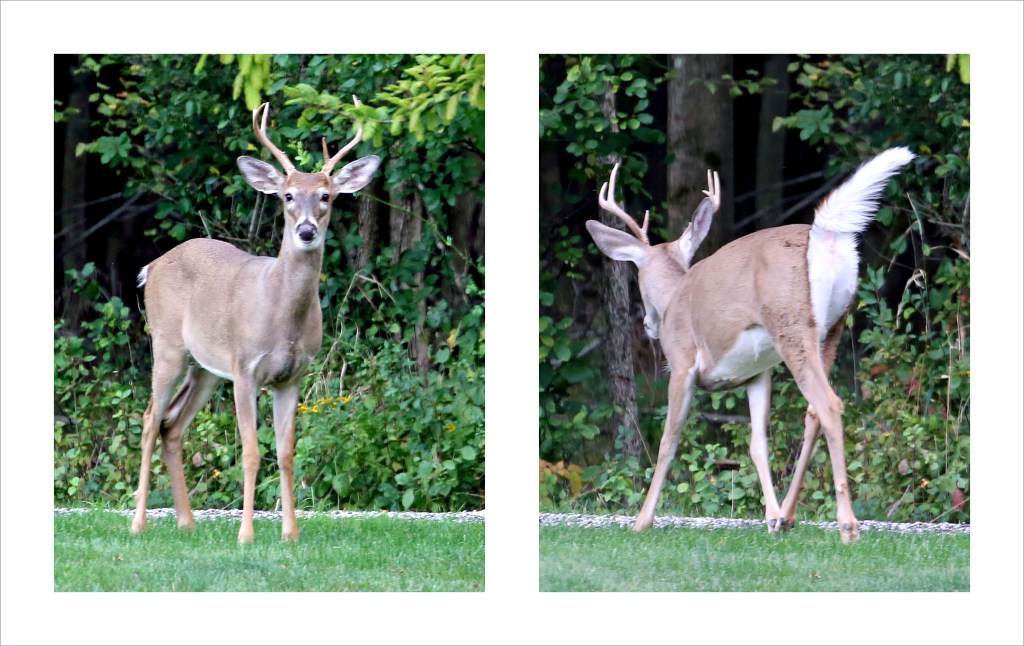
In this image of a young buck, it is easy to see why the species is called ‘White-Tailed’.
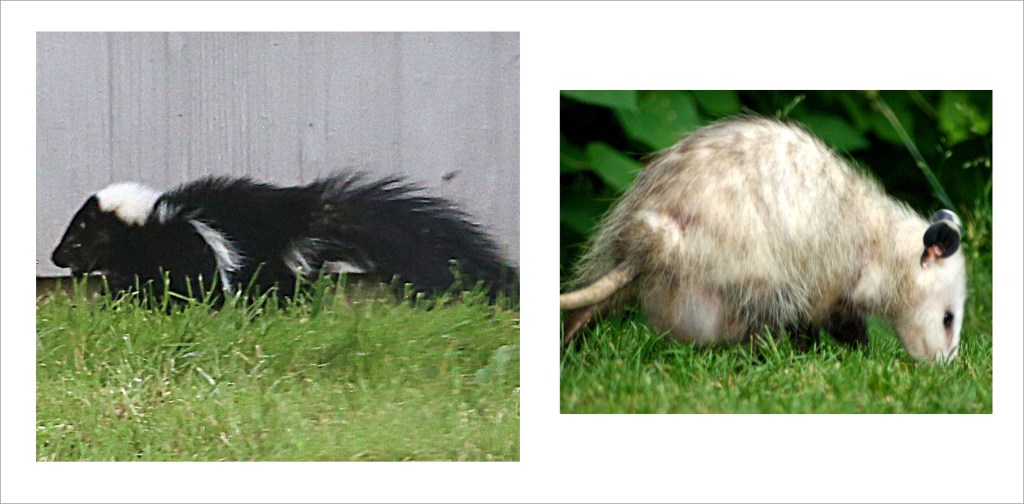
Skunks and Possums are both nocturnal mammals, so we seldom see them, although the skunk can make its presence known by spraying a foul-smelling liquid as a defense mechanism. The possum, on the other hand, will ‘play dead’ when threatened. In this image, one can see that the possum is a female marsupial by the pouch under its stomach in which it is carrying its young.
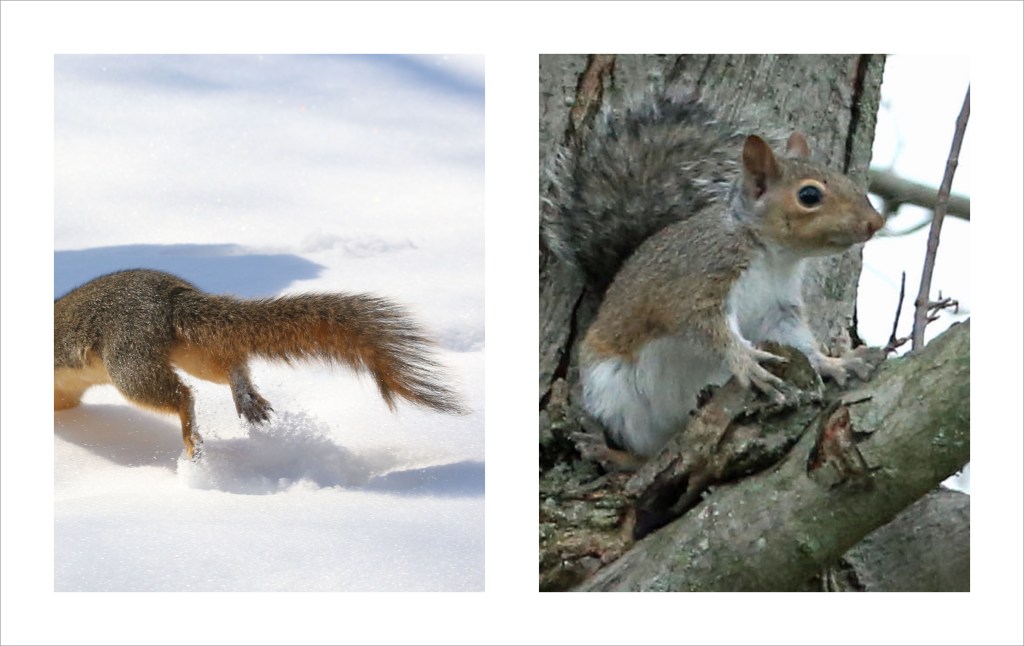
We see squirrels foraging for seed below the birdfeeders in winter. Their nests are often constructed of twigs and leaves in the fork of a tree or, in the case of our squirrel, in a hole in the lower trunk of a large maple tree.
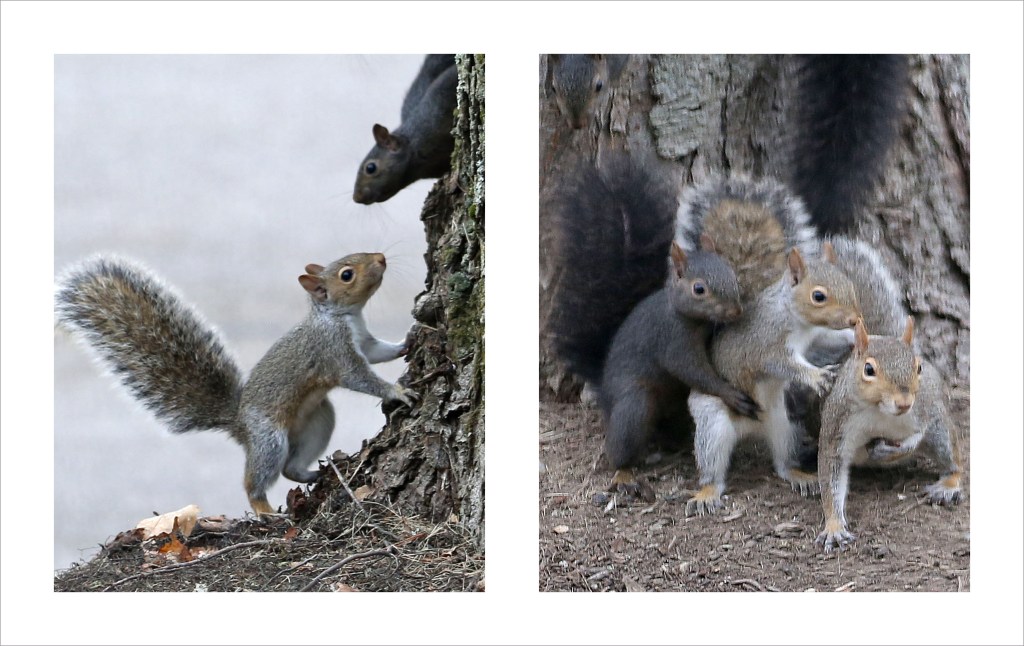
Another diptych. These are young grey squirrels venturing out of their nest as the weather warms up.
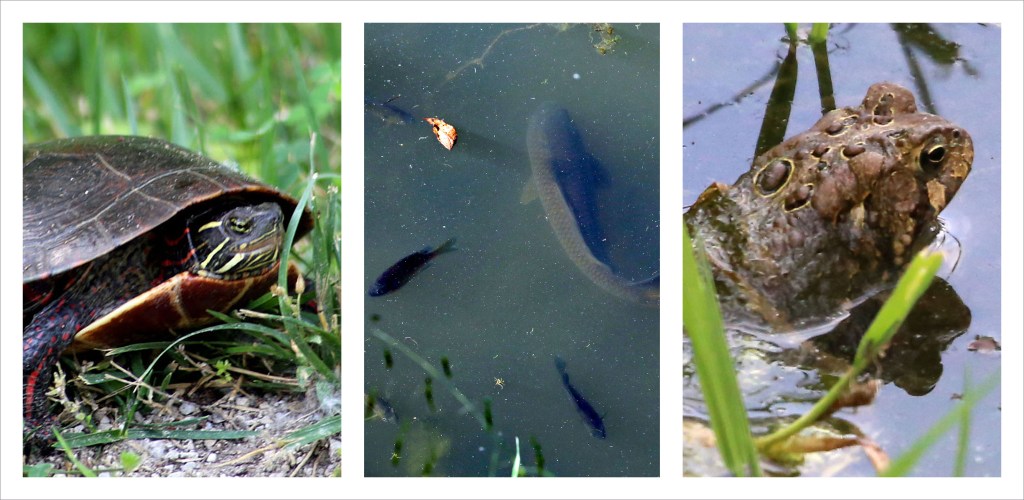
This triptych illustrates some of the aquatic life in the ponds close to our home. The European Carp in the center is one of the most common species in lakes around Ohio. The Midland Painted Turtle on the left is moving towards its primary habitat, the shallows of a quiet pond. The species hibernates in winter, tolerating freezing temperatures for prolonged periods. During hot summers, it will often be seen basking in the sun on a log or on the muddy edge of a pond. The Fowler’s Toad on the right is one of several amphibians in the pond near our house. A female can produce over 10,000 eggs that fertilize externally. The eggs hatch after about a week, giving birth to tiny tadpoles. They have a very high mortality rate with as few as 10 – 12 surviving to become frogs These young creatures go through the process of metamorphosis, changing into baby toads leaving the pond after about sixteen weeks.
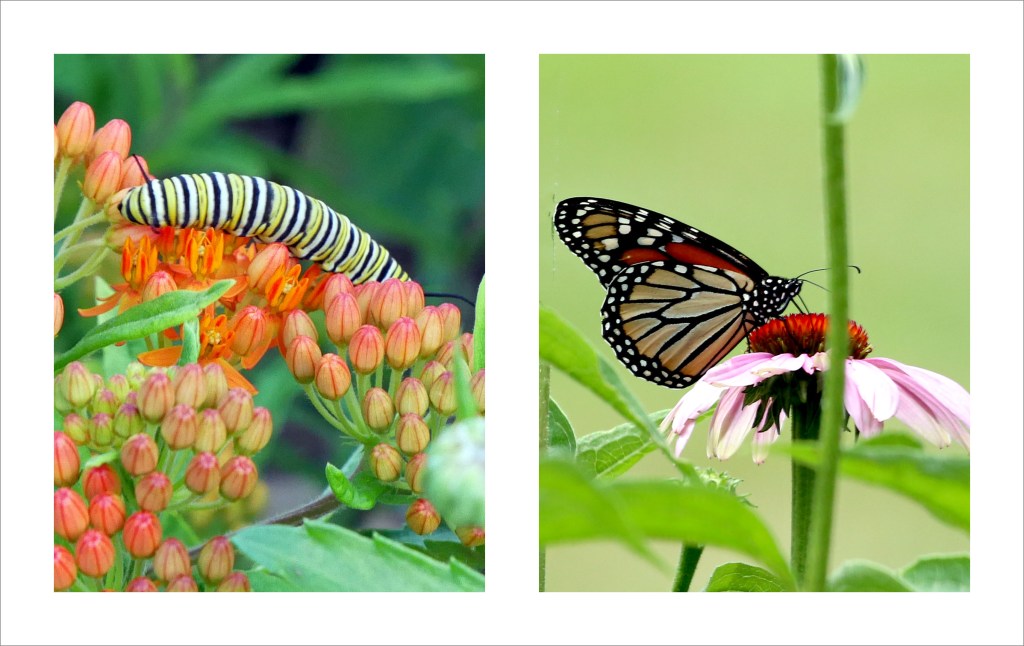
As in summers before, the Monarch caterpillar feeds on the Butterfly Bush and, within a few days, it will leave and look for a place to pupate. Hanging under a leaf, it will shed its skin, appearing as a chrysalis. And ten days later, it will amaze us as it does each summer fluttering upwards in spirals and swoops then diving in a haphazard aerial display that makes photographing them almost impossible.
The Slate Colored Junco on the left is a member of the sparrow family. They are sometimes referred to as snowbirds because they appear to carry gray storm clouds on their backs and white snow on their bellies. They also often fly into many areas just in time to usher in winter snows. On the right, a male Northern Cardinal shares a branch with a female Redwing Blackbird. We marvel at the fact that so many different species of bird come together to visit our feeders.
Summer is now in its full glory, The only sadness is our loss of Lucy, in whose memory we add this post.
Without Lucy, the skunks, chipmunks, squirrels, deer, possums, geese, ducks and even wild turkeys no longer have anything to fear as they wander behind our house.
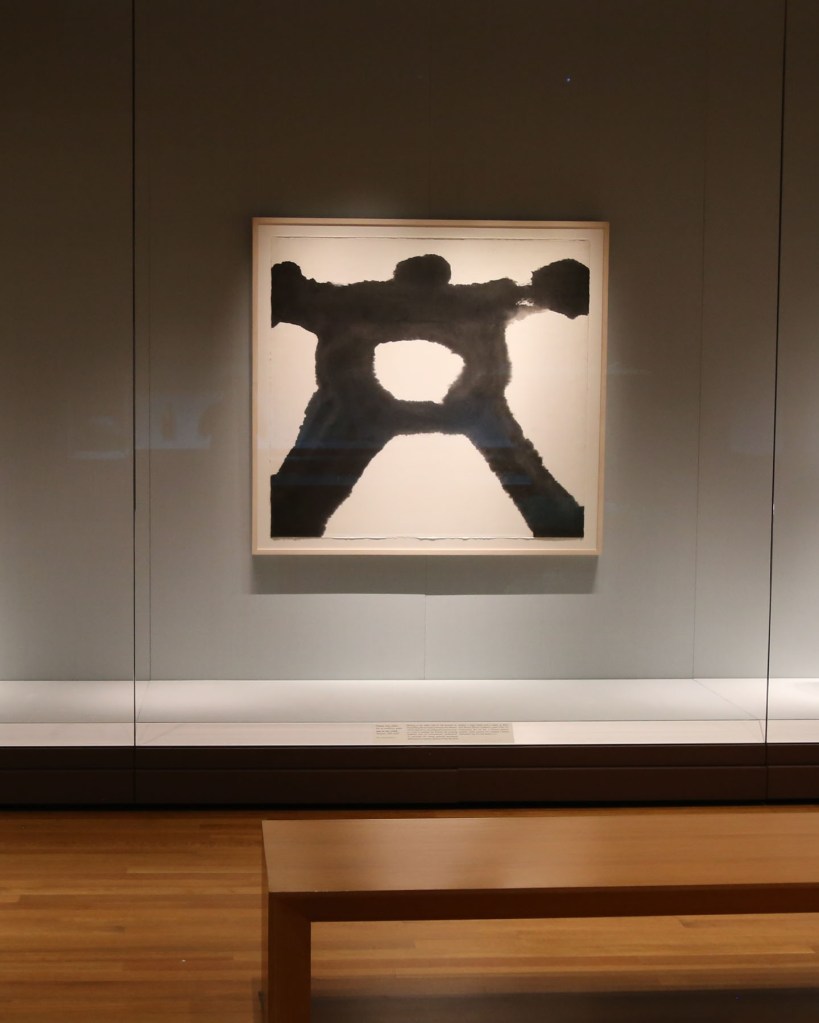
A visit to an art museum can be a contemplative experience if one has time to be still. One is less likely to have this kind of experience in busy museums like the Louvre, the Duomo, the Met and MOMA than in smaller local galleries. A camera can help one focus on the here and now as long as one doesn’t click at everything one sees. It can help one pause and look below the surface of things. Here’s an example:
Person, early 2000s. Suh Se Ok (Korean, 1929–2020). 130.5 x 139 cm (51 3/8 x 54 3/4 in. Ink on mulberry paper
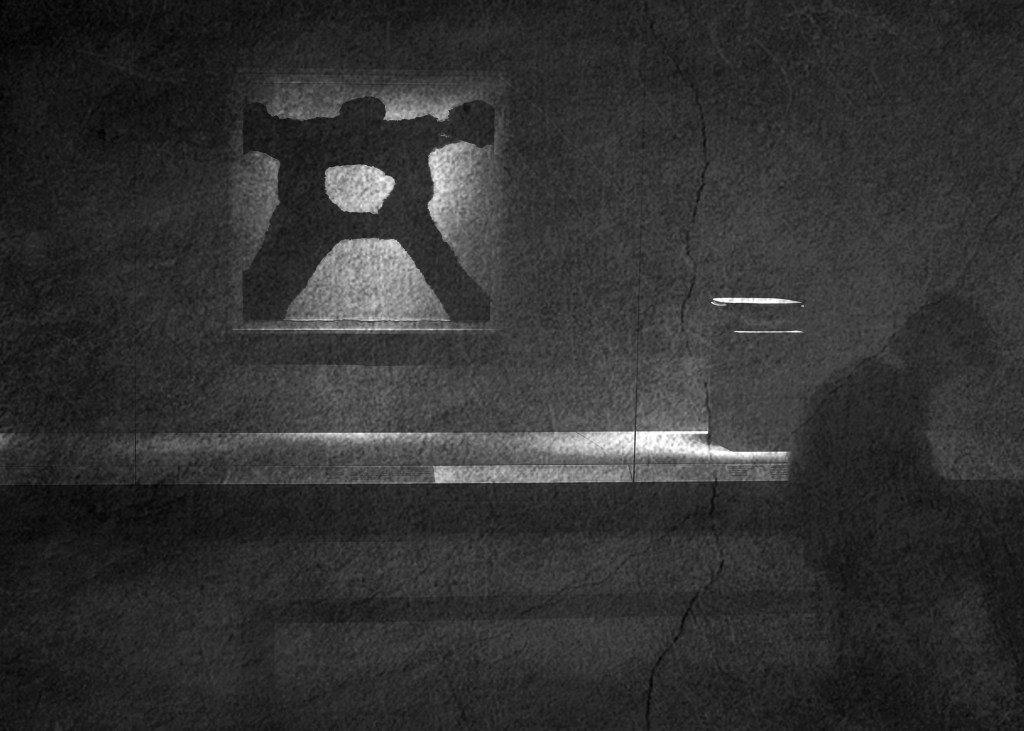
I’m alone in the gallery together with Suh Se Ok’s “Person”. It is mysteriously expressive: A cry for help, perhaps. Or an invitation for unity. Back at home, I modify the image.
The image has clearly evoked something below the surface even if I’m not entirely sure what it is.
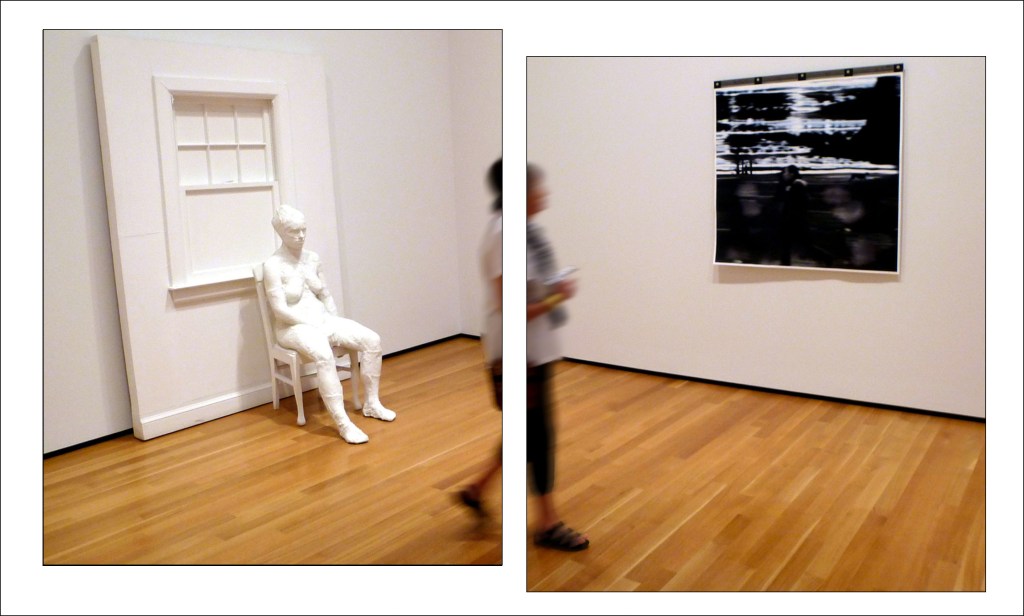
Other images are less obscure as I introduce some movement into them:
Lilian steps out of the space she occupied with seated sculpture into a new space in which she will engage with the somber abstract painting.
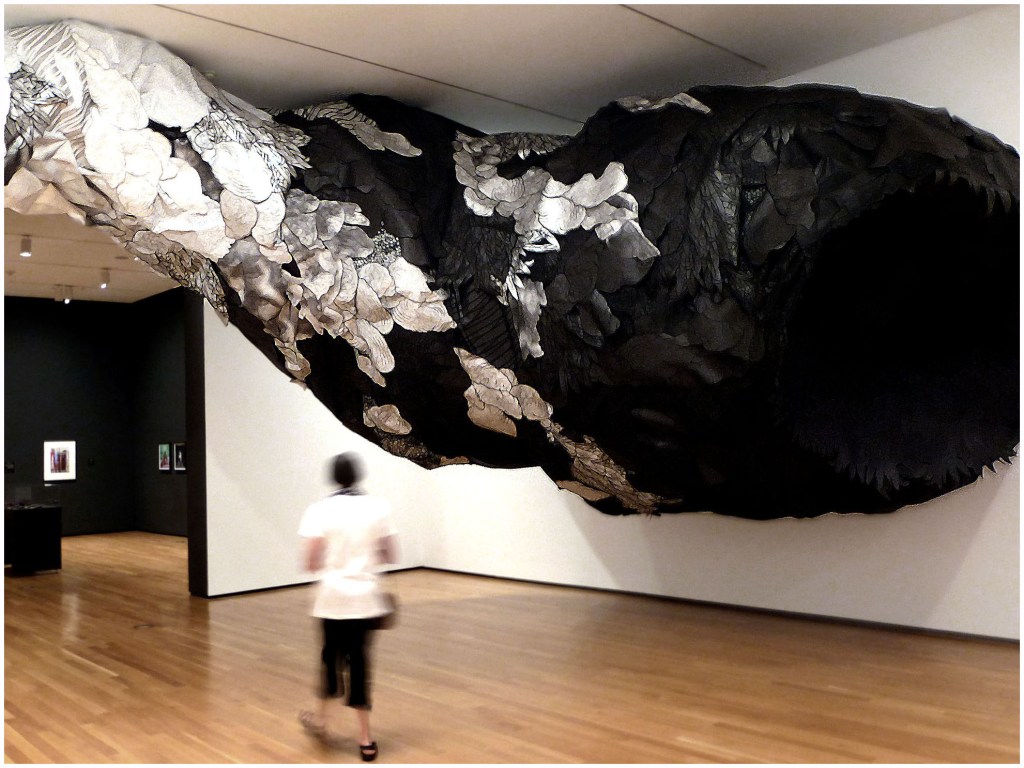
And again, below, the relationship between a human subject and an artistic installation stimulates an emotional response. Scale, color, and movement create a sense of foreboding.
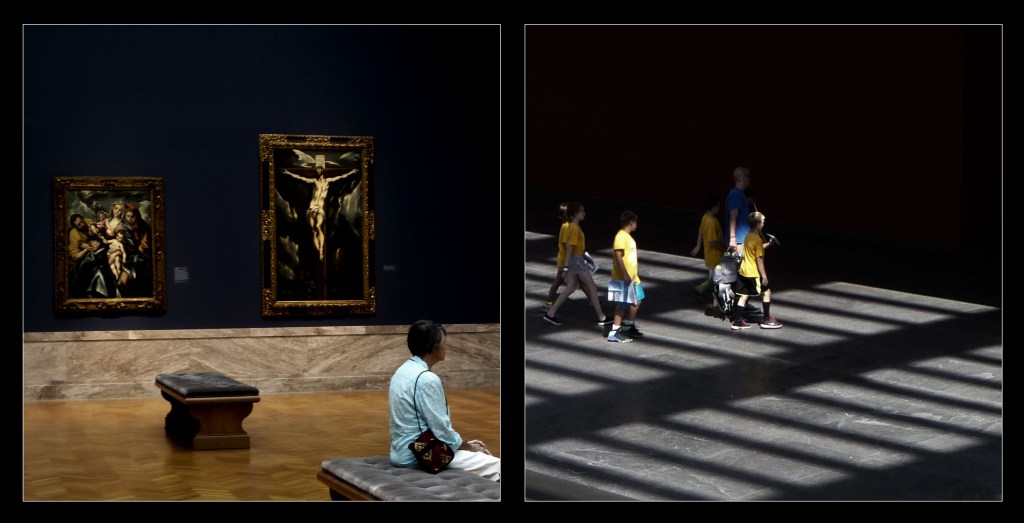
Below is another photographic, a diptych. It tells a story combining past, present and future.
On the left, an older person sits between paintings of birth and death. The image of the crucifixion projects a narrative of suffering and redemption. It was the explanation that many of us were given as children. It speaks of suffering in the human condition and, even though we were taught about salvation, there is nothing in the image to suggest it. And so, she sits in silence at the foot of the cross. The second panel in the diptych portrays a group of school children on a trip to the museum. There is movement. They are bathed in light. They don’t sit and ponder but run and explore. Perhaps they won’t be told the same stories with which we grew up. Perhaps they will write their own stories.
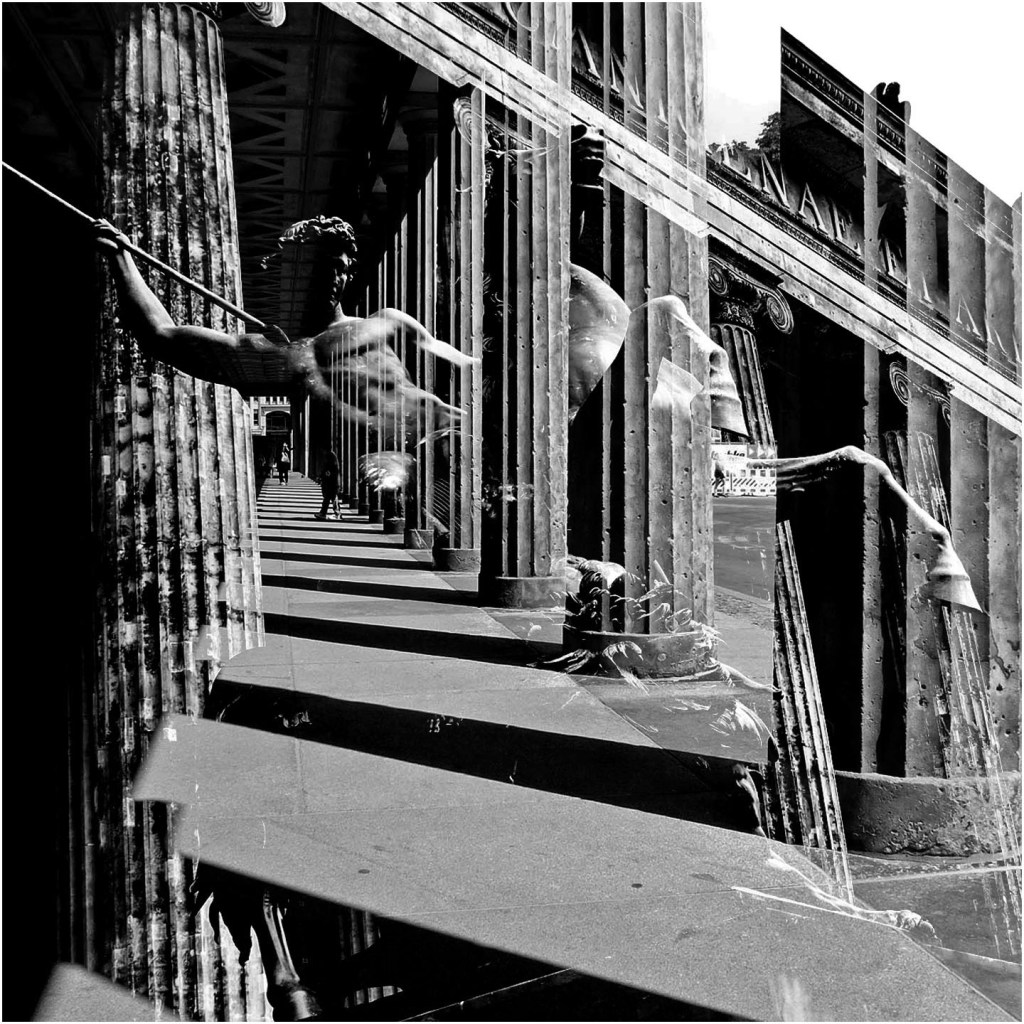
Let’s visit the Altes Museum in Berlin where the Neoclassical façade consists of a portico with Ionic columns and, on the steps in front of the museum is an 1858 bronze statue, The Lion Fighter, by Albert Wolff. I have combined two photographs to integrate the two ancient perspectives.
And in the Pergamon museum, a young woman is absorbed drawing one of the Ionic columns.
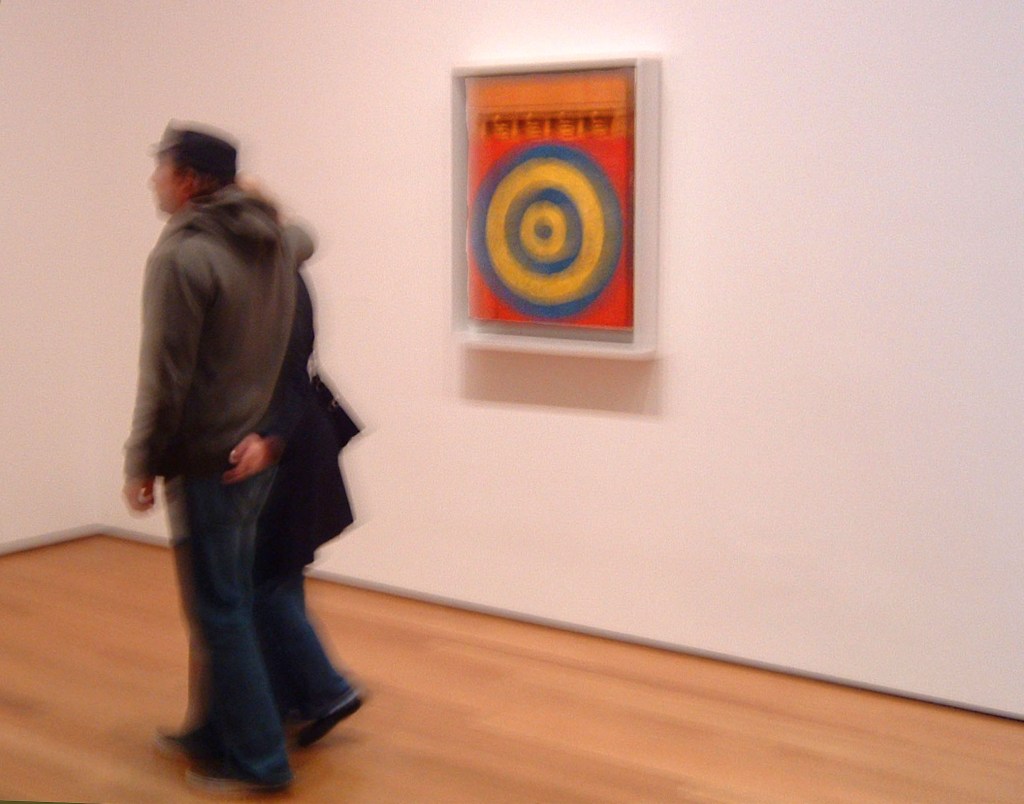
She is oblivious of the crowds around her, in the moment, at one with the ancient column whose form and beauty transcend time. There is a different oblivion in the following photograph I took at the Museum of Modern Art in New York.
Their absorption in each other involves, perhaps, a mutual sense of transcendence that one sometimes experiences in an art gallery.
A museum experience may not always be profound, but later to dwell on the photographic image quietly for several minutes brings its own reward.
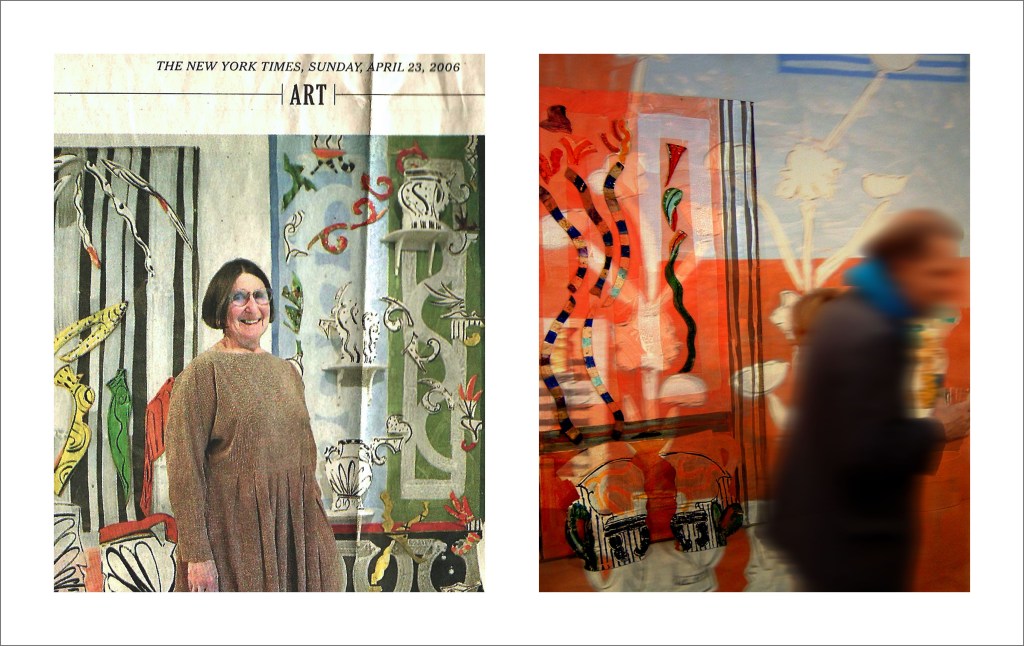
While thinking of color, I’m reminded of my aunt, Betty Woodman, a ceramicist, who nearly twenty years ago exhibited her work at the Metropolitan Museum of Art in New York
On the left is part of a newspaper clipping from the time, and I created the panel on the right by superimposing two photographs, one I took at the vernissage, and the other taken in her studio.
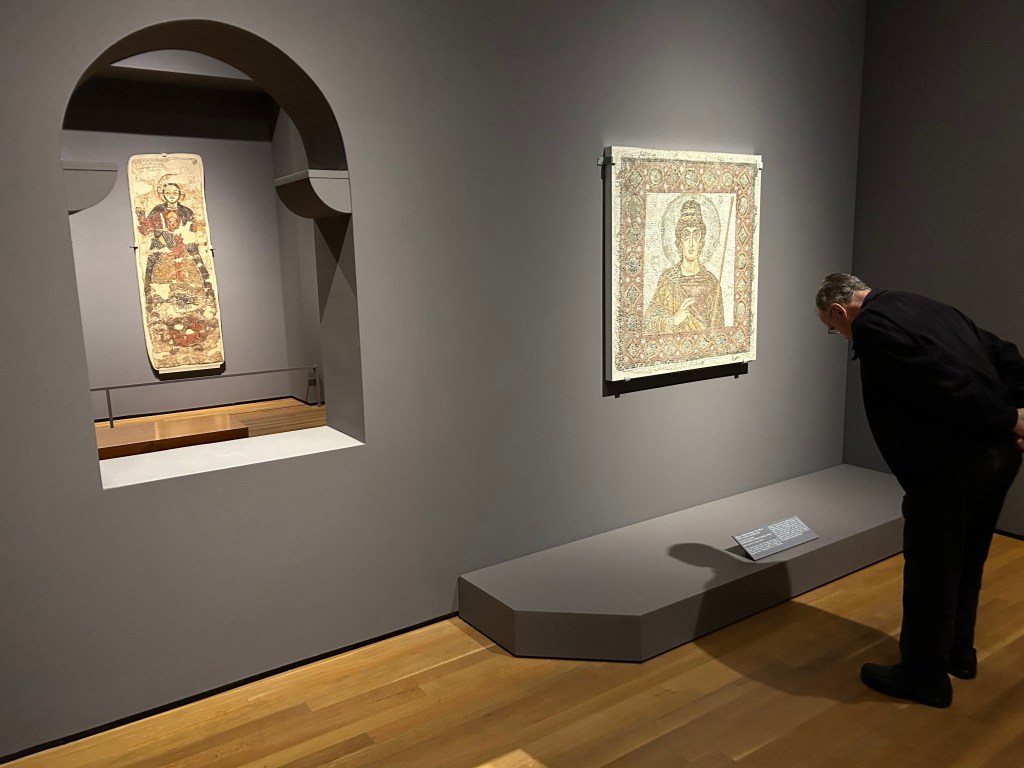
Returning briefly to the contemplative experience in the museum, the following unedited image of a man reading the art label conveys a sense of respect for the subject.
The Lady of Carthage mosaic (4th-5th century)
Engagement is another museum experience when the viewer is drawn in by the subject.
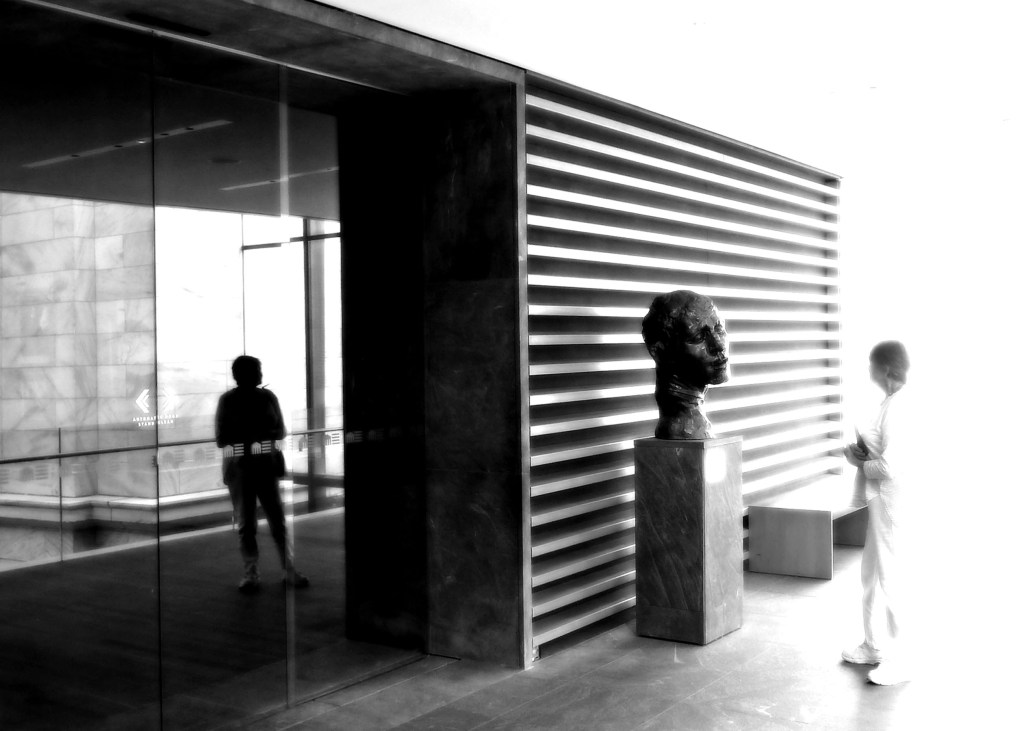
The doppelganger effect of the reflection in the glass door creates the illusion of a detached person observing the interaction, the unity of sorts, between the sculpture and the viewer. This raises the issue, perhaps, of the tension between detachment and engagement in our own day-to-day lives.
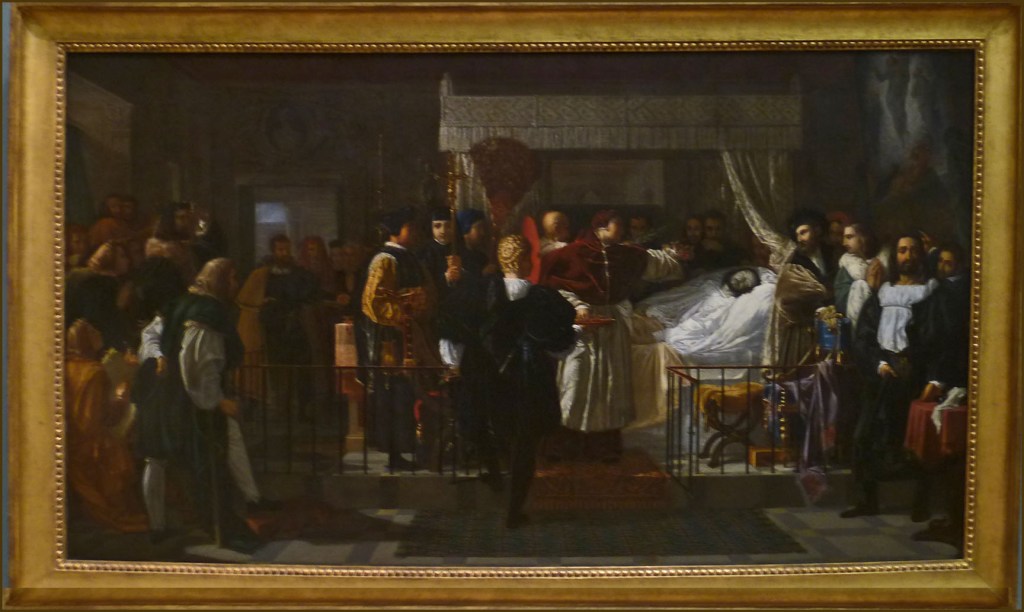
Some experiences are difficult to express through photographic manipulation. Take, for example, the following painting:
Honors Rendered to Raphael on His Deathbed: Pierre- Nolasque Bergeret: 1806
The painting hangs in Oberlin University’s Allen Museum of Art. I was particularly struck by it, not because it is an excellent example of the late eighteenth century tradition of depicting deaths of historical figures, not because it depicts Pope Leo X and an assemblage of notable figures including Michelangelo and the writer Vasari, but because the painting’s nineteenth century owner was Joséphine de Beauharnais.
Napoleon purchased the painting for his empress Josephine at the Paris Salon in 1806, and she hung it at her Château de Malmaison. As I gazed at the painting, I became acutely aware of the fact that this same piece of canvas just three feet in front of me with all its layers of oil paint carefully applied by Begeret was admired by Joséphine more than two hundred years ago. It was as if she was standing alongside me, both of us looking at the same painting, two viewers unable to find any common ground for communication across the centuries but both silently contemplating the striking image together.
I’ll end this stream of consciousness posting with a few more photographs:
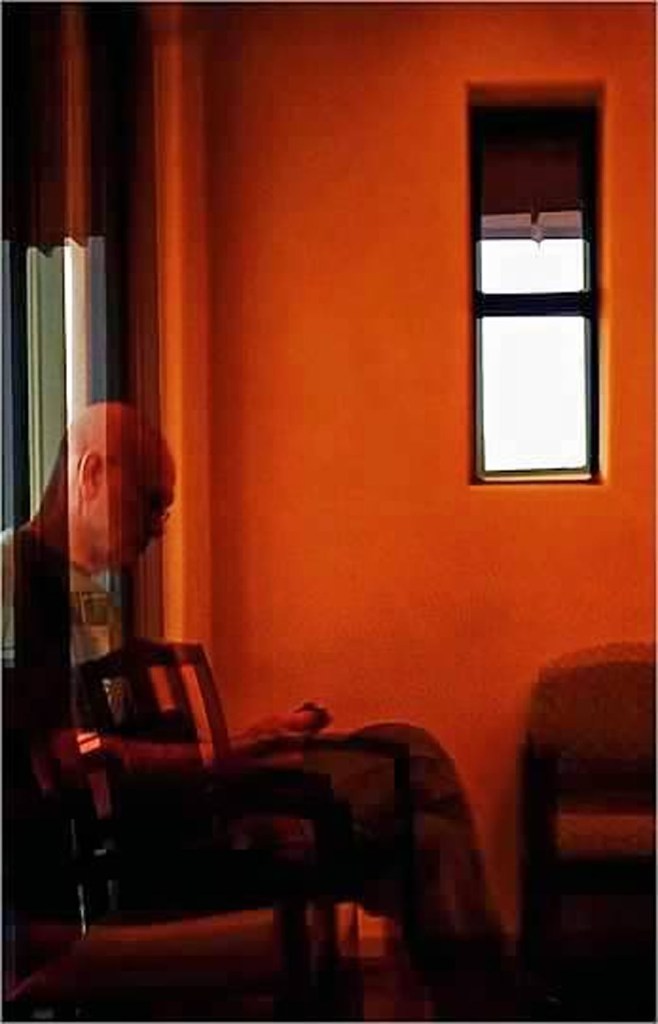
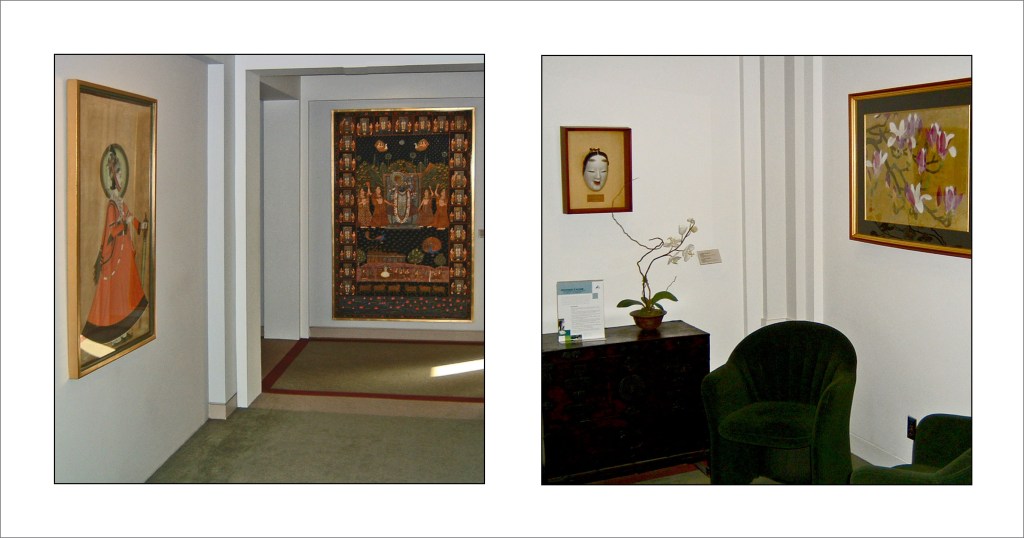
In the left panel, a ray of sunlight streams through the open door of my Montreal office many years ago. The right panel contains a corner of the waiting area.
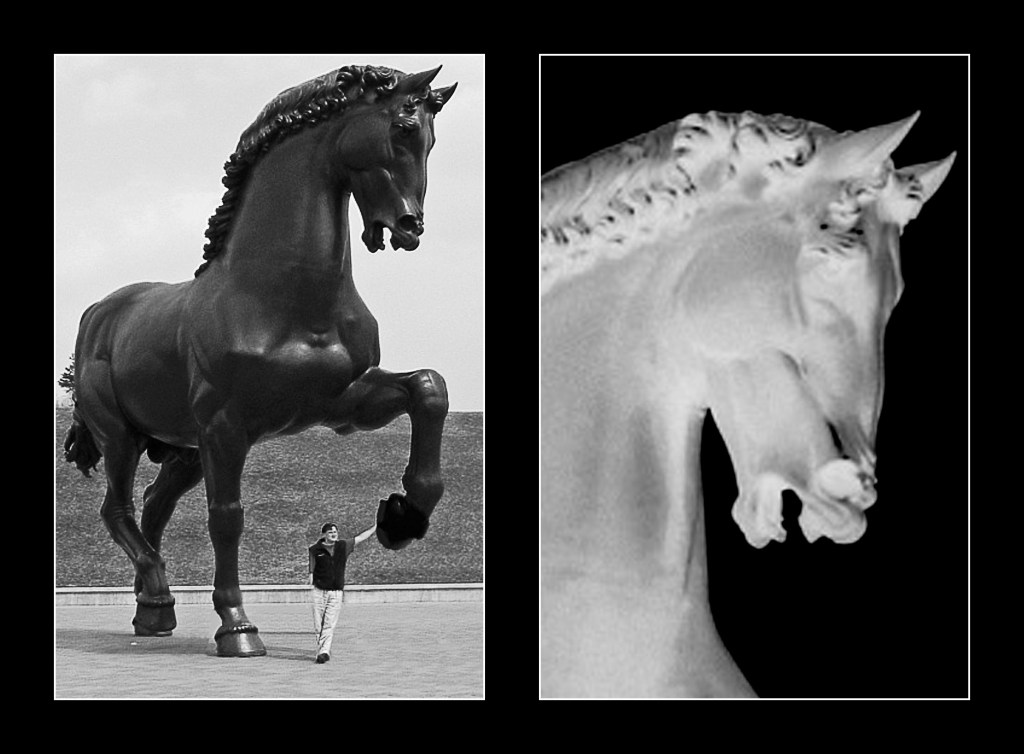
Da Vinci’s Horse, Grand Rapids, Michigan
In the late fifteenth century, Leonardo da Vinci embarked on a project to create the largest equestrian statue of his time. But the bronze earmarked for this sculpture was repurposed for warfare. Centuries later, sculptor Nina Akamu revived the project, and in 1999 two casts were poured, one finding its way to Milan, and the other making its home in the United States.
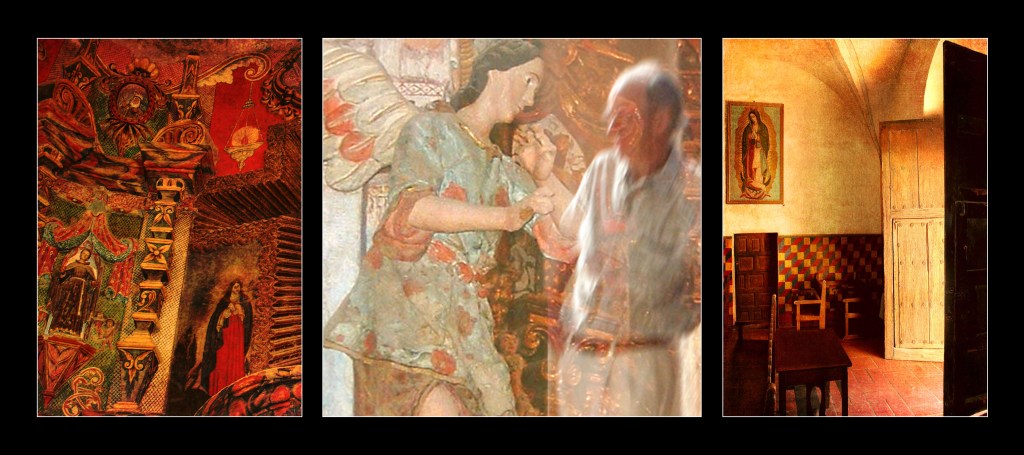
Finally, the photographer wrestles an angel in the church of Xavier del Bac, the Spanish mission founded in 1692 by Padre Eusebio Kino, an Italian Jesuit who traveled from Europe to the “new world” in the late 17th century.

























 The Final Stretch