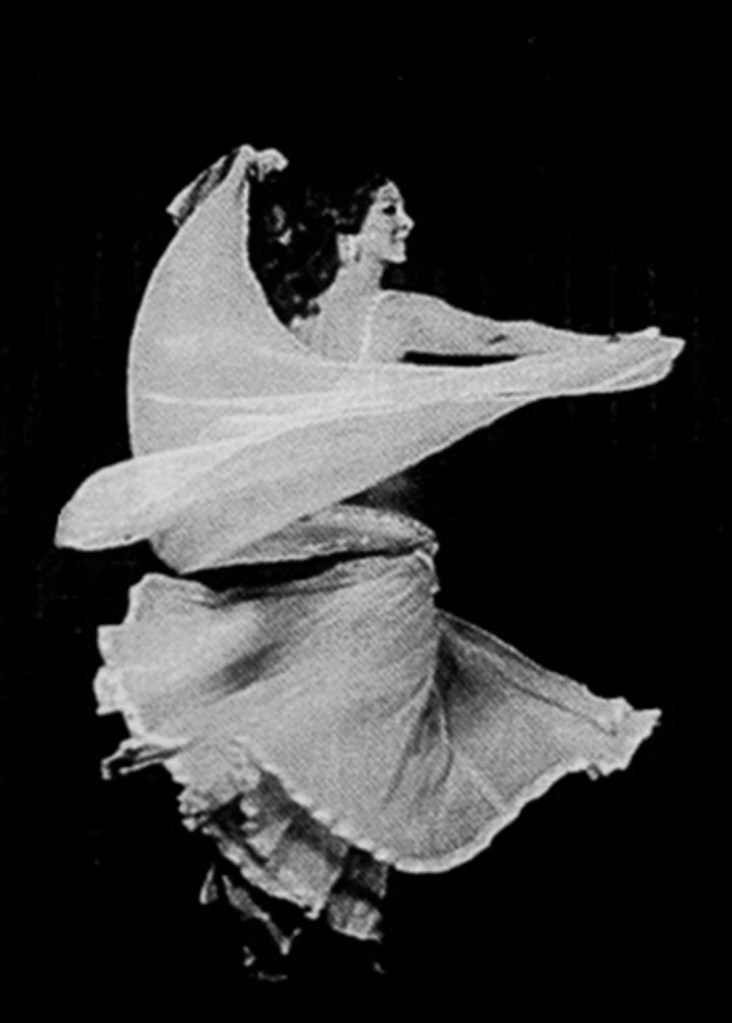
Joyce as a young woman
She shuffled slowly up the path
clinging to her walker
as a winter-ravaged Alberta pine
clutches a rocky outcrop by the lake.
Her name was Joyce.

Only scoliosis twists a person
into a gnarled old conifer
bent by countless winter storms.
She seemed old, silent, expressionless,
as if there was nothing left to say,

Her sideways glance seemed almost sly,
her head bobbing to an inner beat
that only she could hear.
She drooled a little, the way one might
when dementia loosens self-control.

Our paths crossed that sunny day
and I politely commented on the weather.
Then she told me she had been a teacher,
a musical composer, nurse,
published poet, and a belly dancer.

I listened patiently to her delusional story,
punctuated by tremors and twitches,
until she apologetically told me
that she couldn’t linger, or she’d be late
for her Parkinson’s support group.

As she shuffled off,
I listened to the swish of her skirt,
noticed the tilt of her hips,
and, from some distant place,
heard the mesmerizing music
of the danse du ventre.


Why a “delusional story”?
LikeLike
At this point in the poem, Joyce’s story appears to be delusional. The poet (me) is unaware that she suffers from Parkinsons disease and mistakenly thinks that she has dementia. In the last verse, the poet realizes that Joyce is certainly not demented and that her story is true. The moral is that first impressions are often mistaken.
LikeLiked by 1 person
Thanks for the clarification, John 🙂 ❤
LikeLike