The fourth in a series looking around our home at the paintings, prints and objects we have picked up over the years, not because they are of any particular value other than that we enjoy them
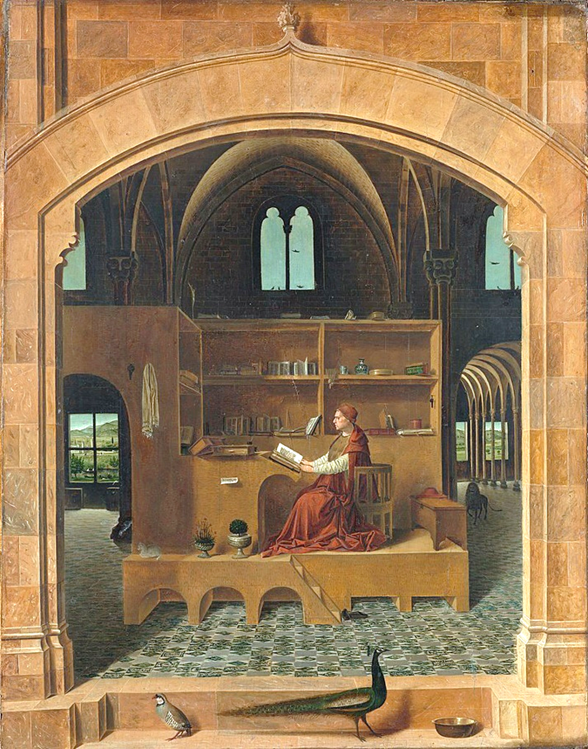
This print is of a work by the Renaissance painter Antonello da Messina and was sent to me in a box of discarded items after the death of a distant relative. So, in 1978 we found a place to hang it in our home. There is a story here that I may share in a future posting. But, for the present, I should mention only that I was surprised to see a similar though different painting in the Arts Section of the New York Times last December.

This is Saint Augustine in his study, painted by Vittore Carpaccio through a fifteenth century lens depicting a fifth century scene.
Augustine is writing a letter to fellow theologian, Jerome. Augustine is unaware that Jerome had just died, and later tells us that he was bathed in a visionary light and heard the voice of Jerome chastising him for his intellectual pride. It was a surprise for me to learn about the connection between the two theologians and to recognize the similarity between the da Messina print in our home and the Carpaccio image in the New York Times.
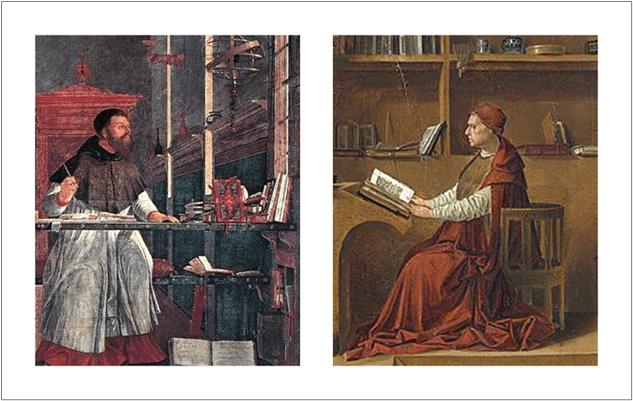
As I continued reading the newspaper, another painting by de Messina generates a new stream-of-consciousness reflection:

Here we have Carpaccio’s Flight into Egypt painted in 1550. The sense of danger and urgency is subordinated, as often is the case in renaissance painting, to enhance the incidental detail. But it wasn’t the virgin’s intricate brocade nor the finely executed landscape that drew my attention. Rather, I noticed the donkey humbly doing its job. I was reminded of another painting.

Jesus is now an adult and there is the donkey doing its job. The triumphal entry into Jerusalem days before the Last Supper is described in the four Gospels and this painting by a close friend is his rendition of that event.
Geoff was a priest and a mystic and, at the time he painted the entry into Jerusalem, he lived in radical poverty in a single room attached to a small church in a slum outside Port Elizabeth, South Africa. The walls of the little church and part of the ceiling were filled with his murals, including the image shown above. Geoff, who stayed and ministered at the parish for eight years until his death in 1987, once said: “If this had been a smart church, I wouldn’t have started painting on the walls.”
And, for some unknown reason, I’m reminded of Don Quixote
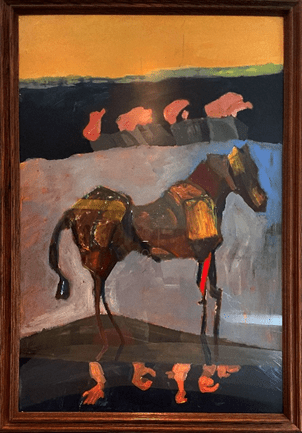
I’m reminded of Don Quixote and his squire, Sancho Panza, whose donkey’s name was Dapple. Although the subject of the painting above by artist friend Susan Weiner isn’t Dapple, nor even a donkey, it somehow reminds me of Don Quixote.

Here is Picasso’s rendition of Dapple on the left above.
And as we think about my friend Geoff and his church murals and as we think about Picasso and Dapple, we are reminded of Guernica and the Middle East, perhaps.
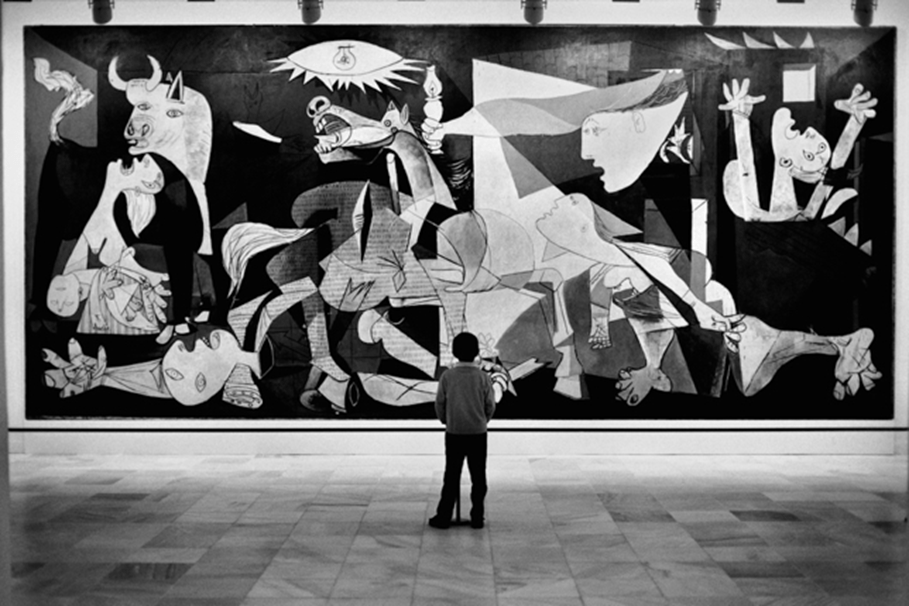
A child admiring Guernica by Pablo Picasso at the Reina Sofia Museum
Painted in 1937 in response to the Nazi’s devastating bombing on the Basque town of Guernica during the Spanish Civil War, the mural shows the tragedies of war and the suffering it inflicts upon individuals. It is regarded as Picasso’s most famous work.
I can’t help contrasting Picasso’s image with the mystic’s mural.
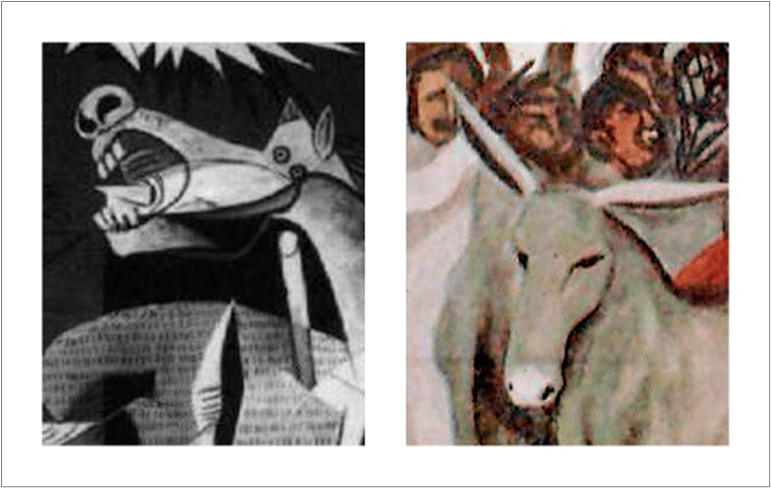
They portray polar opposites, horror and joy, even in their equine characterizations. And so it is today, perhaps.

It’s interesting where a casual glance at the Art Section of the New York Times can take one.

Five artists. Four men and a woman who were gifted, not only in applying a medium to a base, but in telling a story about themselves and their environment.
 The Final Stretch
This is so interesting. I was particularly moved by the work by Geoffrey Goodwin on the walls of that small church. A good series of associations. Thank you.
LikeLike