Mahler Revisited

Left: Mango Tree & Music Right: Lilian, South Africa, 1972

Resurrection

My girlfriend liked Mahler,
his second symphony:
She listened to it often, so I did too.
It made her think of the child she lost.
It made me think of her,
so I bought the record for myself
and played it looking out of my
apartment window at a mango tree.
I thought, ‘this is the only place in the
universe where Mahler’s music floats
among the branches of a mango tree.’
The Resurrection
is what they call the Second.
These long years later,
I listen to it, and every time
I feel her pain,
and watch the mangos
as they slowly ripen.

Fifty-two years later:

Left: Severance Hall, Cleveland. Right: Lilian viewing Mahler score

The Cleveland Orchestra owns the only complete, original, handwritten score of Gustav Mahler’s Symphony no. 2. Mahler wrote it between 1888 and 1894 in his characteristically bold musical script, mainly in intense black ink, with some parts in brown or violet. It is a working manuscript with inserted leaves, corrections, deletions, and revisions. It was purchased by Herbert Kloiber, a trustee of the Cleveland Orchestra, for about $6 million in 2016 and donated to the orchestra.
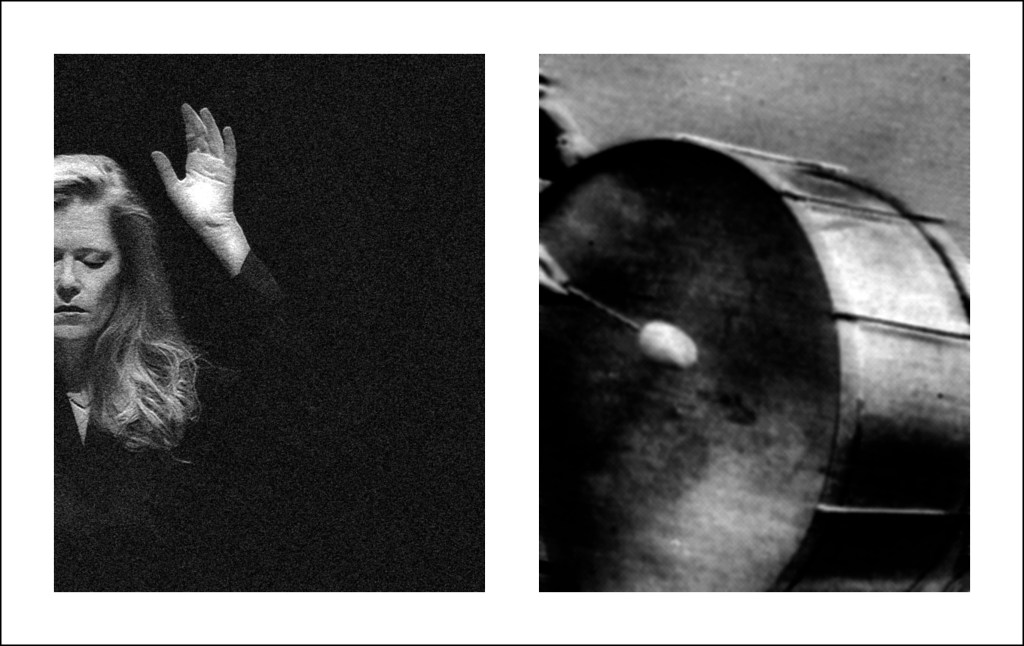
The Silence

I attended a concert recently.  The program theme was Death and Transfiguration and included works by Richard Strauss, Haydn and Claude Vivier, a French- Canadian composer. His work, ‘Lonely Child’, was particularly absorbing. I was interested in the reaction of a friend who rose to his feet to applaud the performance. He hadn’t read the program notes and knew little about Claude Vivier. His reaction, it seems, was triggered purely by the music. My reaction was also very positive, but due in large measure to my awareness of Vivier’s biography and what he was trying to express. Was it the sonic complexity, the sound that was simultaneously both dissonant and melodic that appealed to Larry?  Or might it have been the part of the composition when single thunderclaps of the bass drum punctuated protracted silent periods?

In my diptych above, the conductor, Barbara Hannigan, raises her arm holding a silence in the concert hall for an uncomfortable length of time.

Then she flicks her wrist and there is a crash from the bass drum.

Then there is another long silence. One could hear a pin drop in the hall. 

This is the complete antithesis of the earlier crowding and jamming of melodic and dissonant frequencies and timbres.

There is another thunderclap. Another long silence and now the audience is fully under Vivier’s control, captivated by the silence between sounds.

The bass drum reverberates again.

Is this the end, the audience wonders? Is this the last breath, the last gasp like that of a dying person who slowly takes leave? Hannigan keeps her arm raised, Are we on the verge of eternal silence? 

Vivier described Lonely Child as a long song of solitude. Is this where it ends? But no, the intervals between the beat of the bass drum start growing shorter until they fade away altogether and we hear the higher pitch reverberation of the Japanese Rin Gong or ‘singing bowl’ and the tension dissipates. In the pre-concert talk we heard about the frequency proximity of C to C#. In the performance, we experienced distance through the absence of any frequency between the beats of the bass drum. And somehow this distance resonated within our psyche and we leapt to our feet unable to articulate quite why.

Vivier, I think, would be happy to know that his music was appreciated without the listener having to explain.