Thoughts about a goldfinch

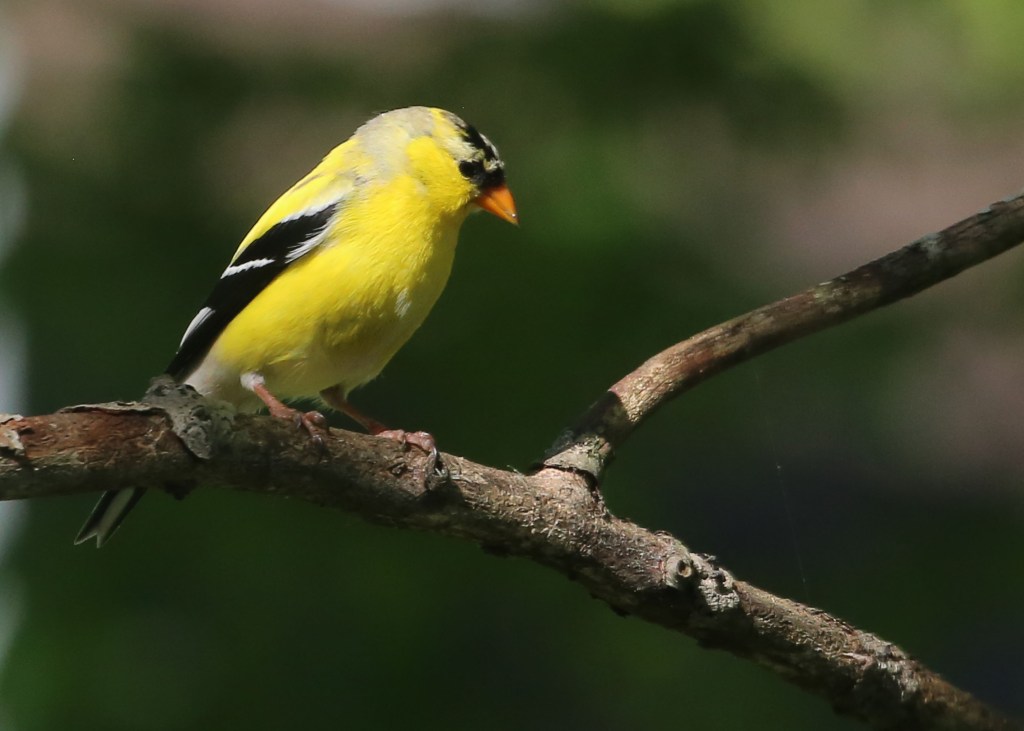
The American goldfinch (Spinus tristis) is a small North American bird in the finch family.

If one lives in a place long enough, one begins to recognize seasonal cycles among some of the bird species that visit the garden each year. Many of us associate the goldfinch with the brightly colored male, the yellow bird that shows up in the spring.
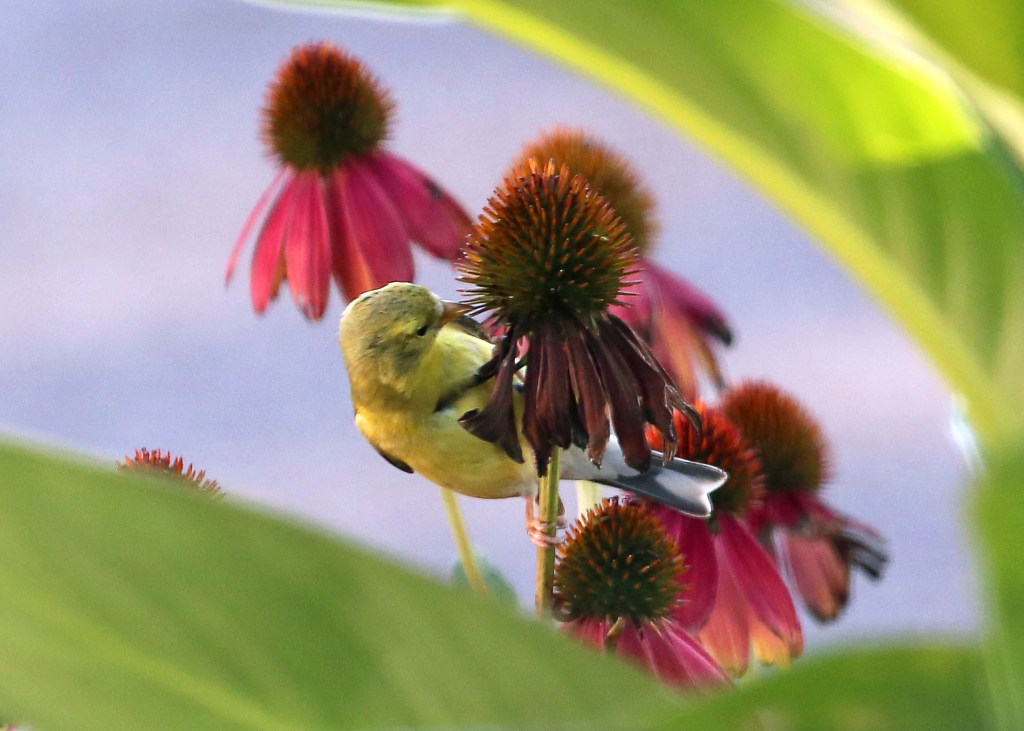
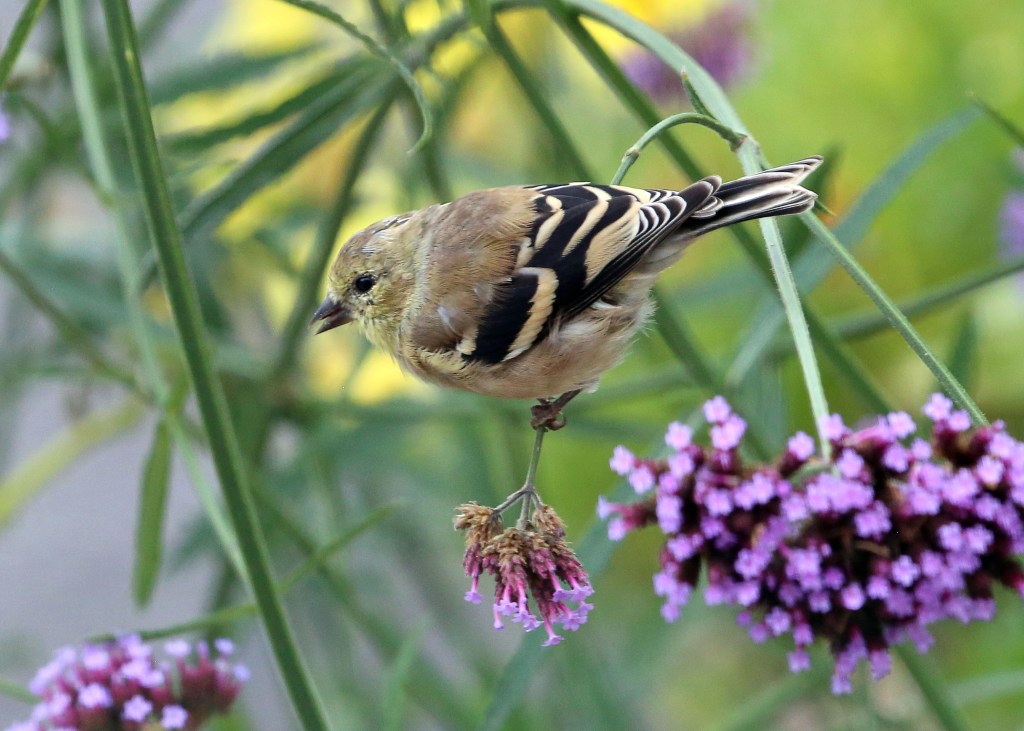
For me, I think of the paler birds feeding on seeds in our flower garden before they leave for the winter. The image above evokes a feeling of anticipated nostalgia because, as we observe it, we remember it will not last.

But we remember the goldfinch clinging to plant stems in our garden last year.

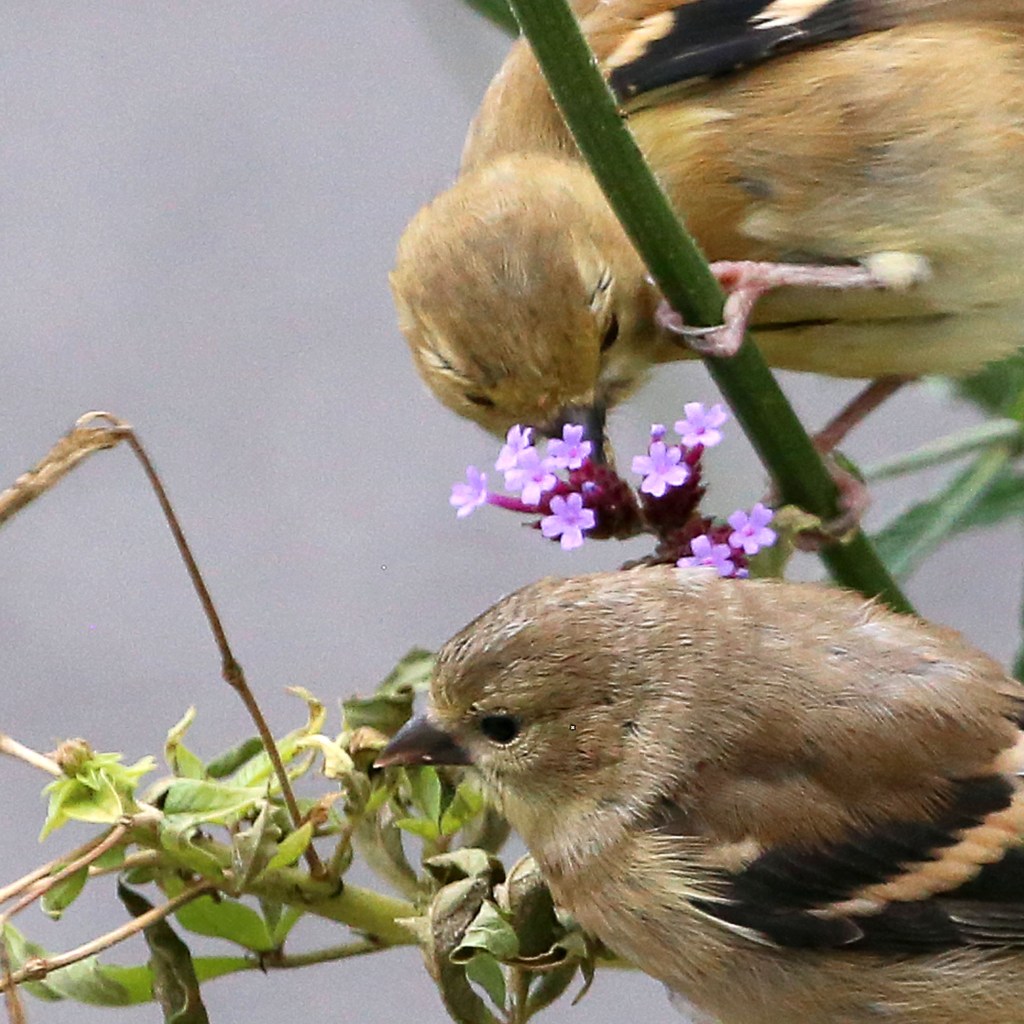
And we remember their acrobatic movements, sometimes hanging upside-down to reach the seed in the remains of a flower, sometimes pulling off the petals to reach the ovary of the flower exposing the seed. Often sharing their activity with other goldfinch.

And, as I watch the birds swaying on a flower stalk, I remember a circus performance at a book fair in Tucson, Arizona, more than ten years ago. And now I recognize the acrobat as a goldfinch.

And I look across the room and see the cushion that Lilian made, and I again recognize the bird.


And I remember a short poem I wrote:

The Scientist

I heard a scientist so teach,
We crawled from slime onto the beach,
Our home the grey soup sea:
But not content to stay that way,
By Darwin we were led astray,
Reborn as chimpanzees.

On this the scientist holds fast:
Its back to dust in the great At Last;
No trumpet will be heard.
Why is it then that we look higher
With such absurd ingrained desire
To fly as if a bird?

And I remember watching a lesser goldfinch flying down to a bird bath in our Arizona garden.

Poetry at times gives way to science,
In almost speechless awe
At the sheer computing capability
That directs this bird, this drone, to fly.
Sensors seamlessly streaming
Ten thousand bits of data
To its blazing CPU that is
Something less than thimble size.
Data processed in an instant,
Firing commands that guide
The flight in swooping arcs,
Never for one moment pausing
In that speed of light tango
Of messages received and sent;
Searching for the shimmer
Of two hydrogen atoms
Covalently bonded
To a single oxygen atom
That, in its pre-programmed
DNA-lodged algorithm,
Spells water:
And this, more than all
The galaxies in night’s dark sky,
Takes my breath away:
The nervous birdbath landing
Of a Lesser Finch.

Art and Artifacts at Home

The second in a series looking around our home at the paintings and objects we have picked up over the years, not because they are of any particular value other than that we enjoy them.

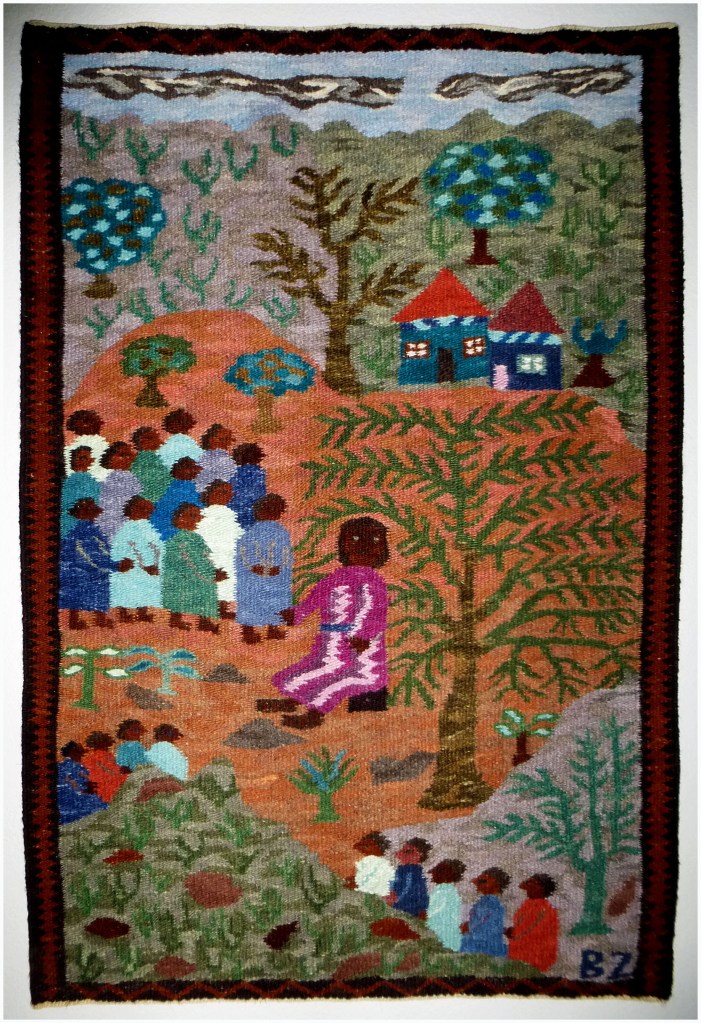
Jesus and His Disciples, Karakul wool, 165cm x 106 cm, Beatrice Zwane 1988 (est)

We bought this large tapestry in South Africa in 2002. All that we knew about the artist was that her name was Beatrice Zwane and that the weaving had been created at the Evangelical Lutheran Church Art and Craft Centre in Rorke’s Drift, South Africa, a place where a battle between British forces and Zulu warriors had taken place in 1879.


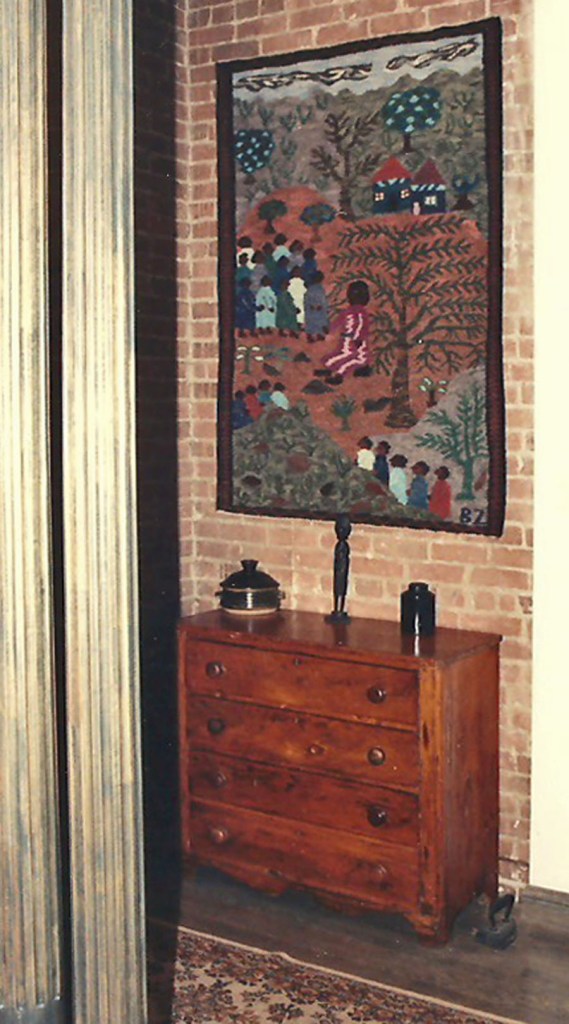
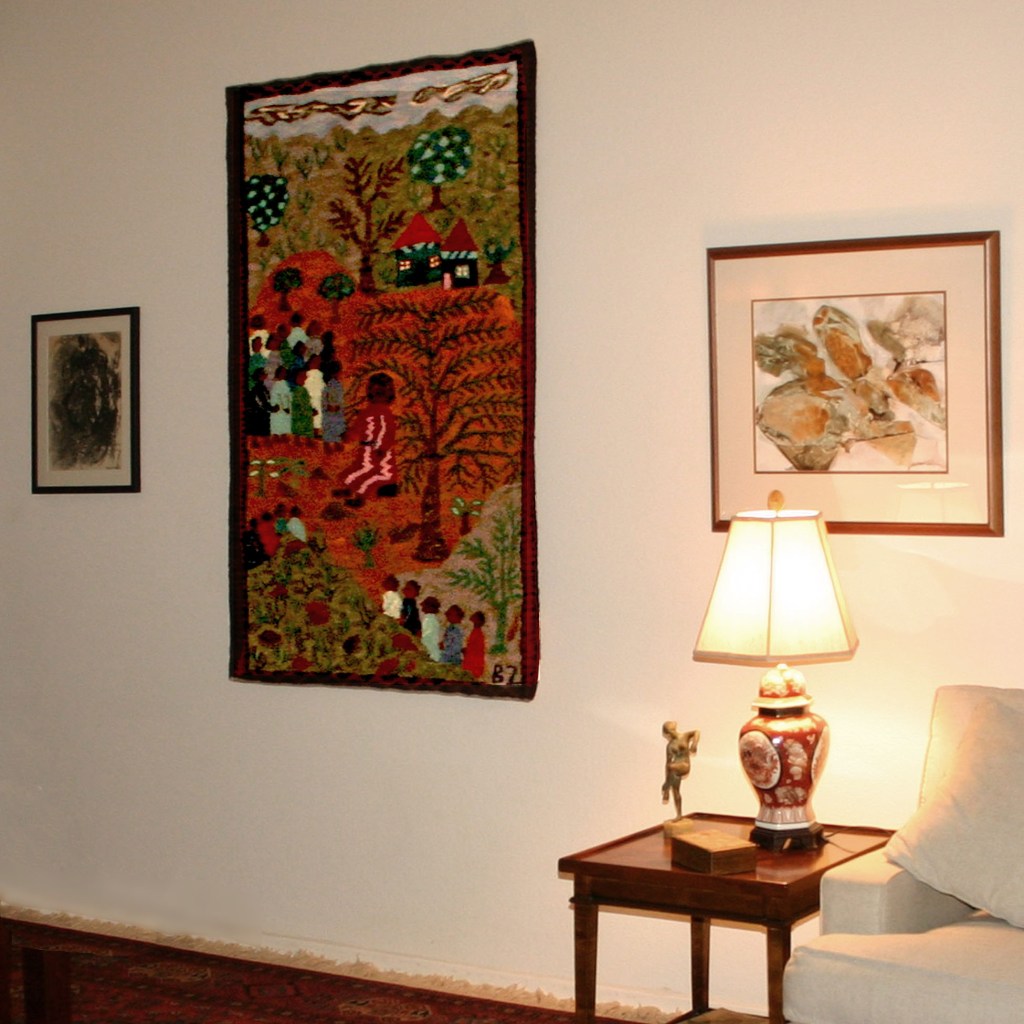
The tapestry has hung in our homes over twenty-two years, first in Montreal as seen in the photograph below, then in Arizona and later in Ohio.

The Evangelical Lutheran Church Art and Craft Centre at Rorke’s Drift, Natal, was established in 1962 and had a significant impact on the development of South African art and craft in the 1960s and 1970s. The Centre, a result of a unique and successful venture in cross-cultural art and craft production, combined Swedish technical assistance with traditional African design and skill. Yet, when the works by marginalized women artists in Africa were exhibited at the National Museum in Stockholm in 1970, they were dismissed as the fruits of Swedish cultural imperialism and naive artistic minds. The woven tapestries are now little known in South Africa and largely forgotten in Sweden. It is not surprising, then, that I wasn’t able to find any substantive information about Beatrice Zwane on the internet.

The above image of an attachment to the back of Zwane’s tapestry tells one as much as there is to know about this or any other of her works.

In the following photograph of the tapestry hanging in our Arizona home several years ago, there is a strange coincidence:

The blurry image in a black frame to the left of the tapestry is the work of another artist who studied at the Rorke’s Drift Art and Craft Center, George Msimang.

Untitled ink & charcoal, George Msimang, circa 1965

George Msimang was born in Durban, South Africa in 1948. Like Beatrice Zwane, he studied at the Evangelical Lutheran Art and Craft Centre, Rorke’s Drift. Afterwards, he was offered a study grant by the Italian government. He went to Rome twice, once to the Accademia di Belle Arti where he spent a period from 1971 to 1975 and another year in 1986 at the Accademia di Belle Arte, Perugia. His work challenged the social and economic imbalances in the Apartheid system. He died of pneumonia at age fifty-six.

Thanks to the Art and Craft Center at Rorke’s Drift, both George and Beatrice were given the opportunity to develop and express their artistic talent when South Africa’s education policies under Apartheid denied them the opportunity to advance their craft. It is debatable whether or not their talent is appreciated to the extent that it should be. Certainly, neither artist would be able to earn a living wage if one looks at current valuations of their work. But we are grateful.

Art and Artifacts at Home

The first in a series looking around our home at the paintings and objects we have picked up over the years, not because they are of any particular value other than that we enjoy them.

Snowy Pasture – Ink & wash – Margaret Taussig 1990

For many years, we spent a few weeks of summer in a two-hundred-year-old house beside a small lake in Canaan, New Hampshire where the artist created this image. Margaret lived a few minutes down Canaan Street where she had a studio.

The ‘ink wash’ technique that Margaret used here dates back to the Tang dynasty of China ((618–907). East Asian writing on aesthetics is generally consistent in stating that the goal of ink and wash painting is not simply to reproduce the appearance of the subject, but to capture its spirit. The American artist, Arthur Wesley Dow (1857–1922) wrote this about the technique: “The painter… put upon the paper the fewest possible lines and tones; just enough to cause form, texture and effect to be felt. Every brush-touch must be full-charged with meaning, and useless detail eliminated. Put together all the good points in such a method, and you have the qualities of the highest art”.

Notice the distant turkey vulture in the snowy sky and other signs of life: Deer tracks through the opening in the fence. A presence, a living spirit, can be sensed in the cold snow-covered pasture.

This is where Canaan is, a very small village among the hills, mountains, valleys and lakes in New Hampshire

And here is the front porch of the house where, sometimes with Margaret Taussig, we would sit in the evenings looking out at the fields on the other side of Canaan Street.

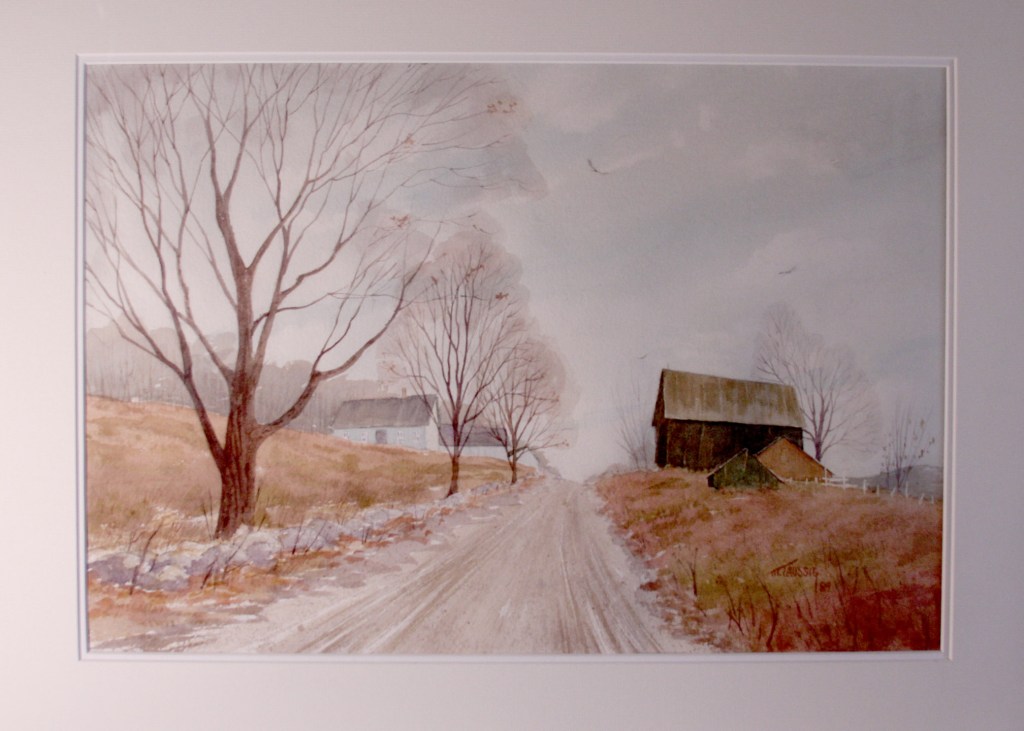
Here is another painting by Margaret, a watercolor that captures the sensibility of the place in Autumn.

In this image, an unpaved road passes through what might originally have been a family farm dating back to the late 1700’s when the area was first settled. The stone wall on the left is typical of New Hampshire farms when, at the turn of the century, farmers were urged to replace temporary wooden fences with rock walls. A pair of turkey vultures circle in the grey autumn sky, a common feature in Taussig’s paintings and a species of vulture that breeds in New Hampshire.

This oil depicts a scene typical of the view we had from the house on Canaan Street. The scene, priceless for us because of the memories it evokes. The painting for sale on Etsy for $68.

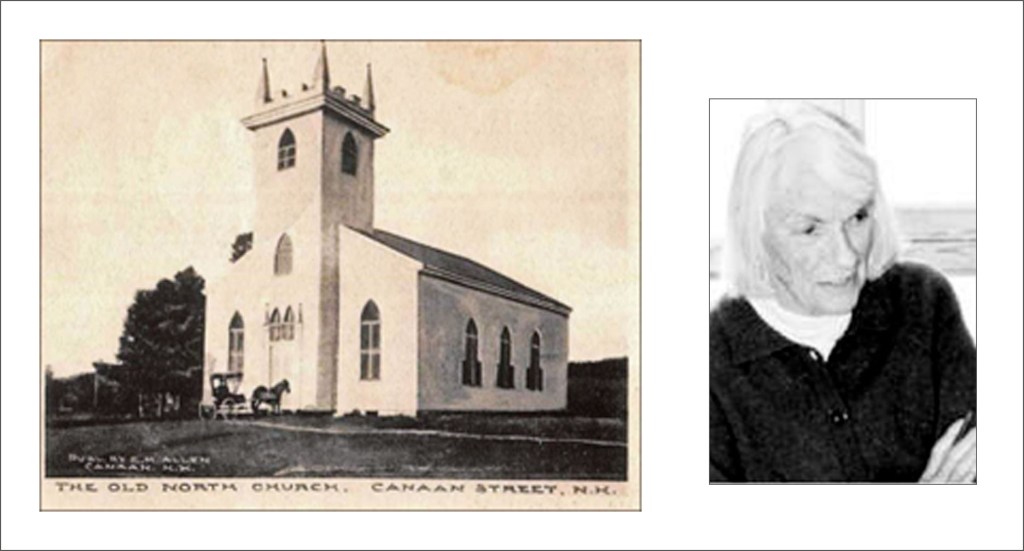
Margaret Taussig died twenty-five years ago.

A memorial gathering was held at the Old North Church on Canaan Street near the old cemetery where her mother is buried.

Margaret’s presence is felt when we look at the two paintings in our home and, in her memory, I manipulated the painting I found on Etsy with an overlay of a Joe Pie weed to evoke a sense of spirit rising from the earth across the road on Canaan Street

Summer Pairings

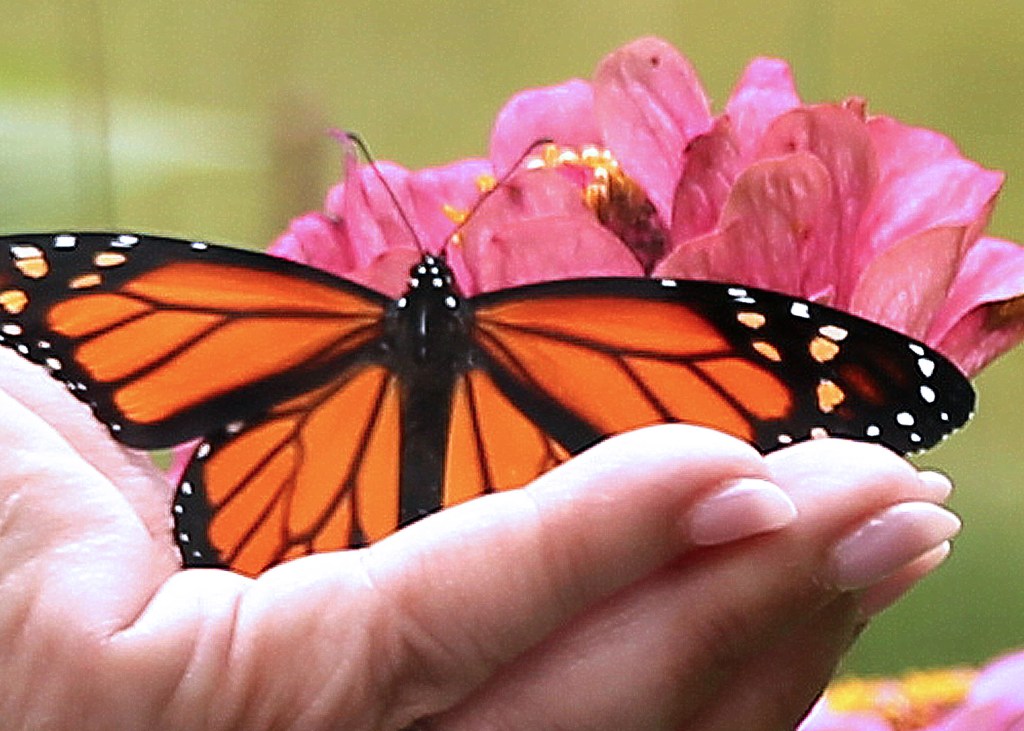
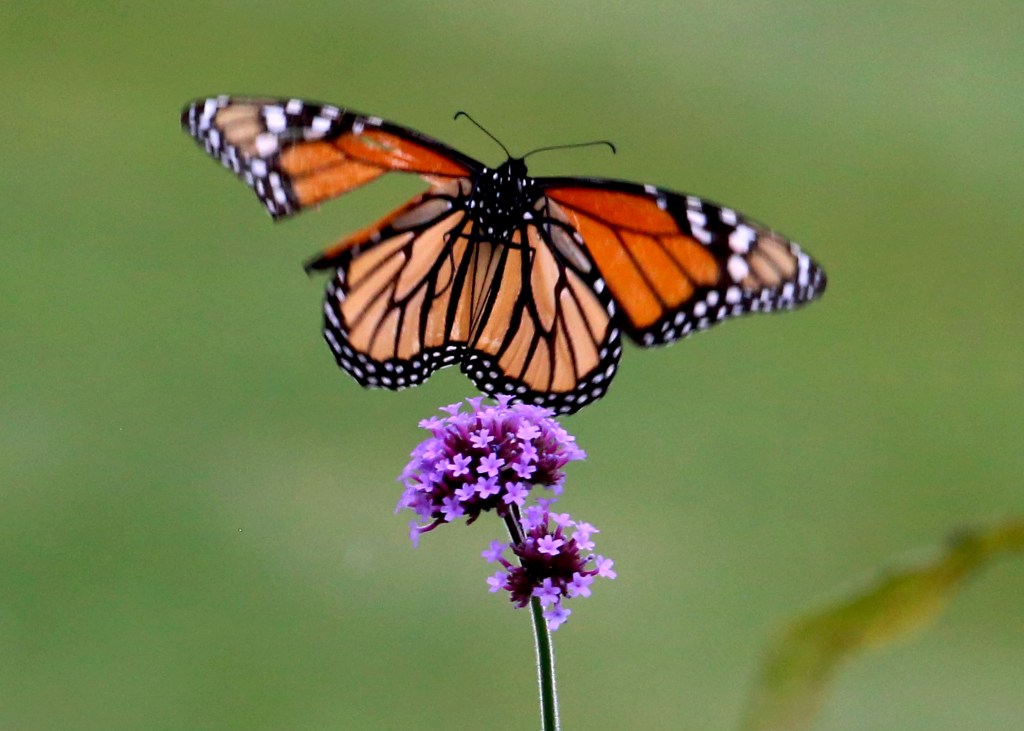
Here is the first Monarch to visit our garden this year. It was a welcome surprise because the numbers of Monarch butterflies are dwindling. They have started migrating from their breeding grounds in Canada on a long journey through the US to Mexico, often covering fifty to a hundred miles per day, reaching their destination near early November.

Several tornados touched down in Northeast Ohio yesterday, yet the butterfly shown above survived to replete its store of energy by extracting nectar from verbena flowers in our garden. The damaged wing is likely a result of the storm.

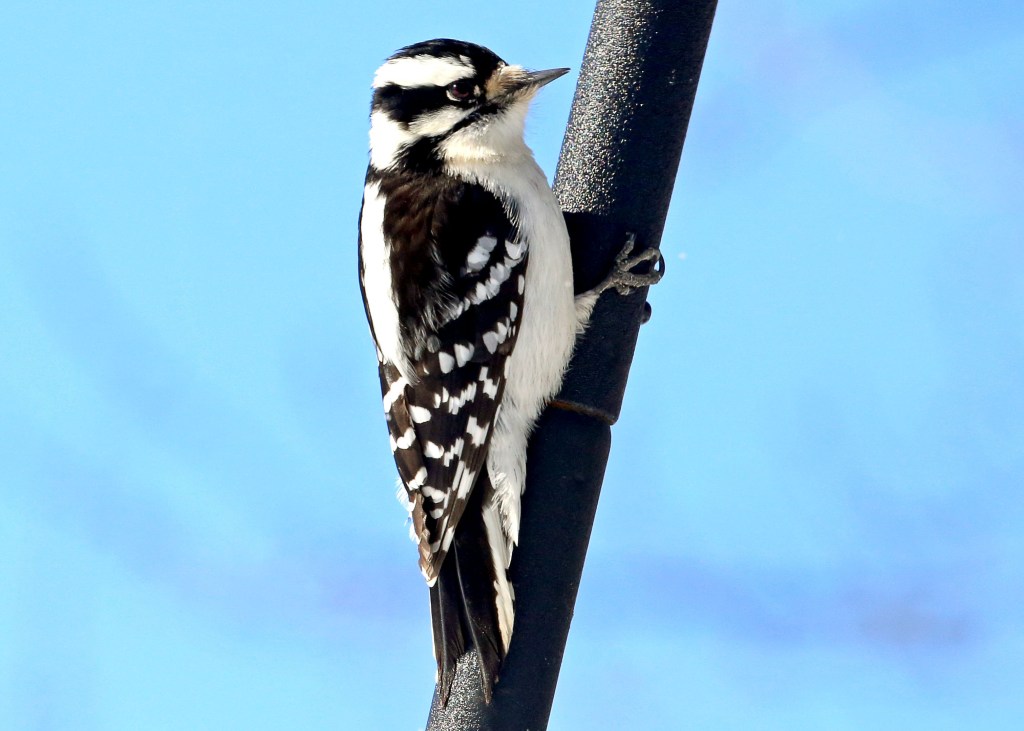
Another pair of reliable visitors are woodpeckers who come to feed on suet in our feeders. The first image is that of a Downy Woodpecker, the smallest species of woodpecker in North America.

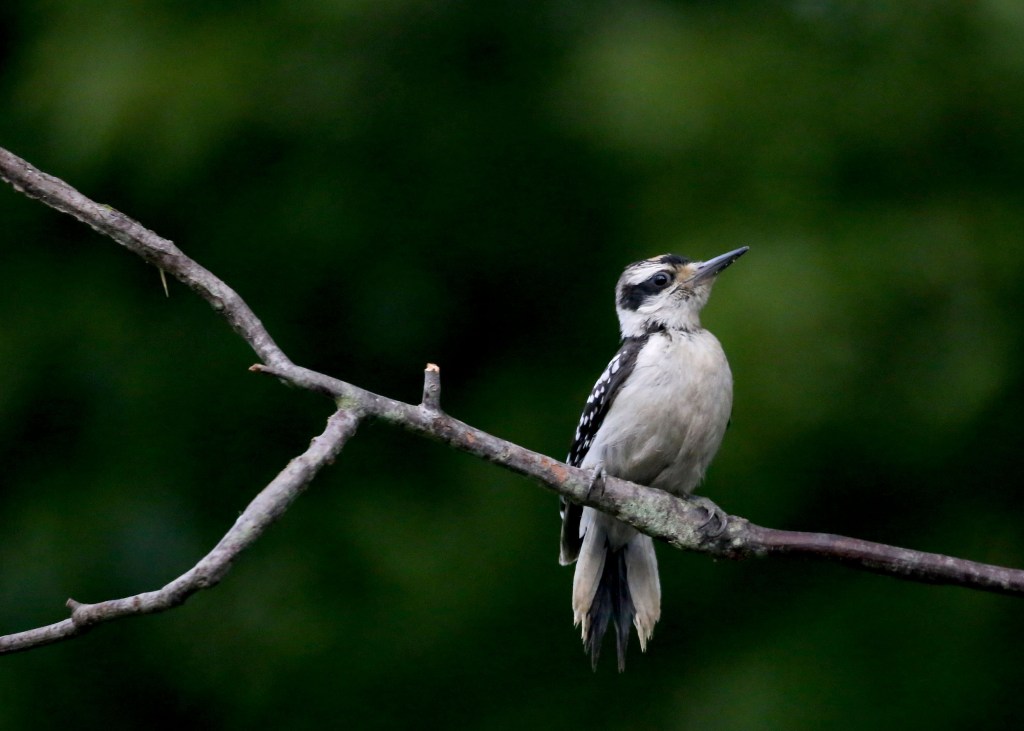
The second image is that of the larger Hairy Woodpecker that gets its name from the long, thread-like white feathers that run down the middle of its black back. Like the smaller Downy it is at home at the edge of forests such as the one behind our home.

Another summer pairing in our garden is Cosmos, the familiar annual with colorful, daisy-like flowers in the sunflower family that sit atop long, slender stems. They attract birds, bees and butterflies to the garden.

Another variety of Cosmos is a tall plant with semi-double and double flowers ruffled in a variety shades – violet, lavender, white, and cream.

As I walk under the old oak tree behind the house or the tall red maple in the front, I’m reminded by some mushrooms of the microscopic network of fungus interwoven with the tree roots below the surface.

Mushrooms that I see above ground are the fruit of the fungus just below the surface. Generally, the fungus feeds on dead organic matter like rotten wood, returning its constituent matter to the soil. Its fruit, the mushrooms, are a reminder of the complex neuronal system of the tree roots just below the surface that live in partnership with fungi.

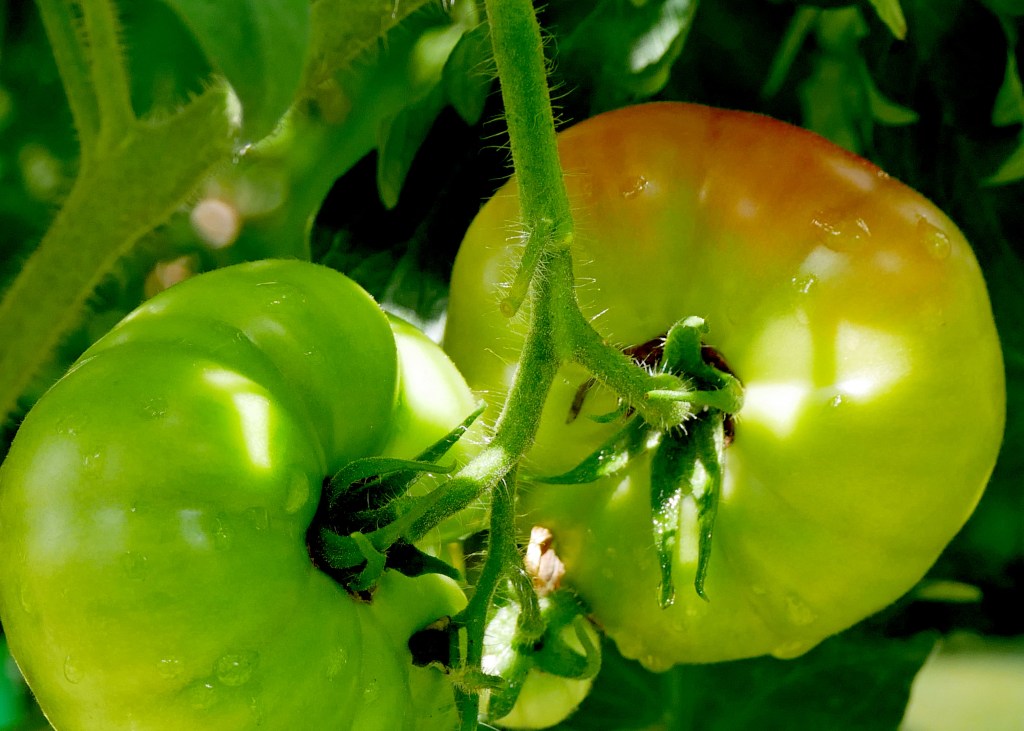
A final pairing on today’s walk around the house: Two tomatoes in a pot, green but turning red: A sign of many more warm summer days to come.

The Philosopher as Artist

Photographic and Philosophical Musings

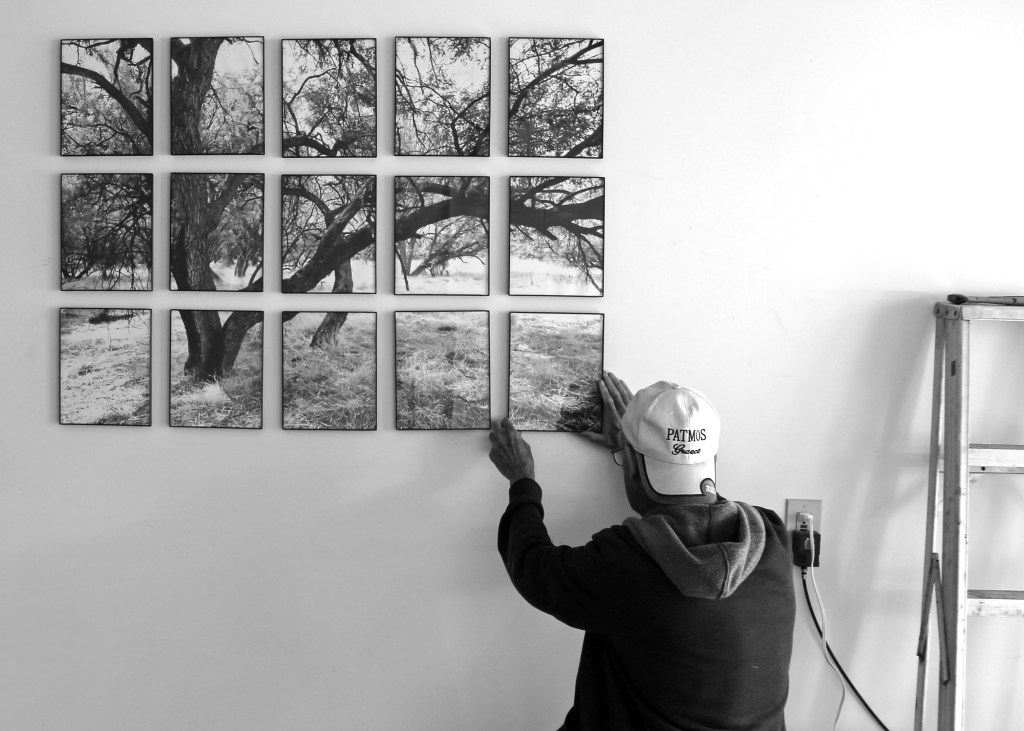
“Silently welcomed home” is how I describe the experience of returning to a grove of mesquite trees and being present among them in the Sonoran Desert of Southern Arizona. A camera marks the occasion.


Later, after selecting one of the images, I crop it into a visual matrix of fifteen smaller images, print and frame them, then mount them on a wall.

The effect seems quite pleasing.

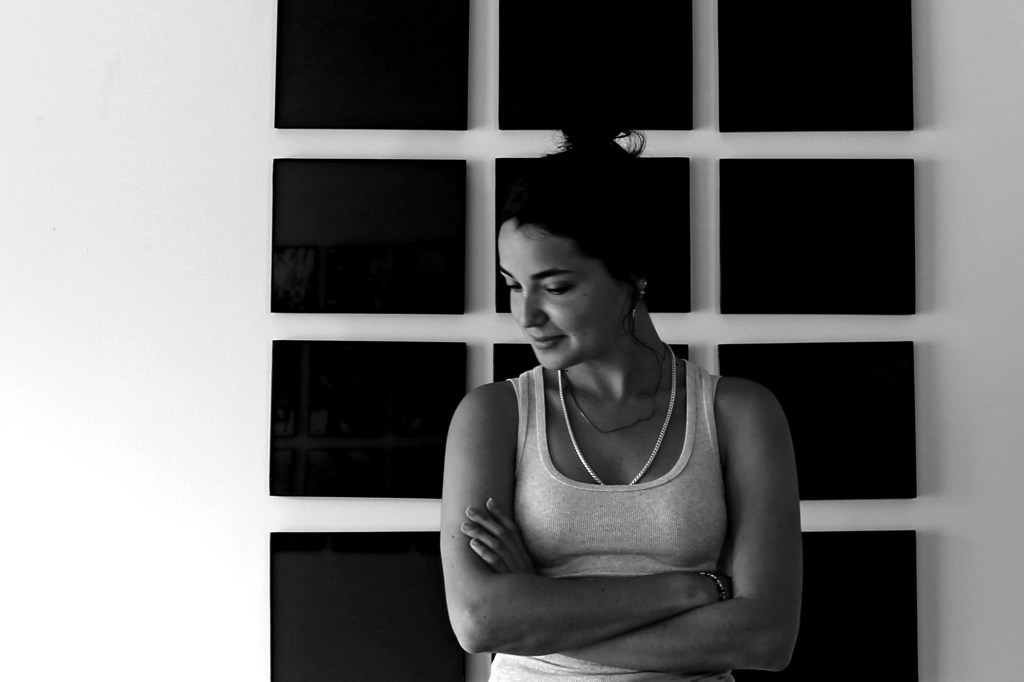
But, tiring of ‘realism”, I remove the photographs from the frames, leaving only the black cardboard mounting boards, change the orientation from vertical to horizontal, and hang the installation in our entrance hall.

By eliminating any surface image, I frustrate any attempt to see an underlying reality other than a void. Somehow, this new installation gives voice to the futility of any attempt in art to express the inexpressible, to express any underlying reality.

Western thought is based on the idea of center – an origin, a truth, an ideal form, an immovable mover, an essence, a God which guarantees all meaning: Art, words, and language serve as signs mediating this original, irreducible object. The French philosopher, Jacques Derrida, takes exception to the assumption that signs are capable of referring accurately to a transcendent reality that exists outside of language. For Derrida, there is no knowledge of ‘reality’, but only symbolized, constructed experience. Abstract or non-objective art seeks to uncover a signified transcendent by erasing signifiers and discovering pure form.


There are fifteen frames in my installation, underscoring the view of philosopher Jean-Francois Lyotard that meta-narratives with their claims to Truth are crumbling and are being replaced by smaller, heterogenous local narratives, narratives that cannot lay claim to any such knowledge.
If art is about surface and the paradox of an underlying unreachable reality, then by eliminating the surface in empty frames, the viewer is faced with the ambiguity of confronting a void.

To emphasize the paradox, I decided to hang the work in a virtual gallery challenging the viewer to question what is real.


The objects depicted in the lower right frame are duplicate images of a woman pushing a shopping cart in her unwitting search for the transcendent which, of course, is happiness.

But we can’t escape the illusion of our experienced reality, so I asked my granddaughter to pose in front of the installation. She willingly obliged, or so it seemed to me,

Oranges

Oranges fresh from our orange tree in Arizona

There is something about picking oranges each year until there are none left, except a few that are too high to pick, that puts one in a contemplative frame of mind.

” Ambrosia” or Nectar of the Gods is how Lilian describes our morning orange juice

I would often walk out to the orange tree in our side yard and pick four or five of the fruit to squeeze for Lil and myself. I was struck by the fact that the juice, still cold from the night air, was still living in its cellular processes. Up until a few minutes earlier, it had been absorbing water, sugar and other nutrients through the trunk; organic compounds from its leaves; and reliant upon the millions of delicate, microscopic root hairs underground that wrap themselves around individual grains of soil and absorb moisture along with dissolved minerals. A process of respiration was constantly underway in the tree’s cells absorbing CO2 and releasing the by-product of photosynthesis, oxygen, into the atmosphere. As I stood beside the tree, I was struck by the likelihood that I was inhaling atoms released through its leaves. And, as the tree released oxygen, carbon dioxide, and moisture, it sucked up large amounts of water from the ground. And the moisture came from the same sources upon which I relied to live; water from the underground aquafer as well as the Central Arizona Project, a 336-mile aqueduct that diverts water from the Colorado River to cities and farms in Southern Arizona. We are also united by our need for nutrients: Chemical elements such as sodium, potassium, chlorine, calcium, iron, magnesium, manganese, and phosphorus that come ultimately from the soil and pass up the food chain from plants to humans. There is more to the orange tree that vitamin C.
And, as I sipped my morning juice, I thought of an evolutionary chain going back fifteen million years when citrus plants diverged from a common ancestor and I realized that, in the great sweep of evolution and human history, it was only yesterday that the Spanish Conquistadors introduced oranges to North America. I wonder if they tasted the same.

An orange in our Ohio supermarket

I noticed the label on an orange in the nearby supermarket. A sunny day came to mind with the image of an orange tree in South Africa where we lived and the image of a person picking the fruit then magically handing it over to us. A sharp citrus aroma escaped as Lil cut into the skin. She offered me a wedge and I had to acknowledge that it was extraordinarily sweet. Nearly as moist and sweet as our Arizona oranges. Curious about the label on the fruit, an internet search revealed that PLU#3156 referred to a refrigerated shipping container on a ship off the coast of Cape Town.

Oranges as commodities

The refrigerated containers were filled with oranges that had been picked a thousand miles to the north. They had been packed, not gently by hand into small wooden boxes, but by robotic arms in an automated warehouse the size of a football stadium, then chilled to a temperature just below freezing and loaded with 750 other containers onto the ship. They were stacked five high on the deck, then transported eight-thousand miles on a three-week voyage to Philadelphia where, together with other containers they would be shipped to dozens of distribution centers across the US. one of which is in Grove City, Ohio, where cartons of oranges would be loaded into trucks and distributed to supermarket locations throughout the state including our local store.

As I peel the perfect four-week-old South African orange, I’m reminded of our years in Jamaica:

Despite its mottled appearance and difficulty to peel with a knife, the Jamaican orange is sweet and juicy, and typically sucked rather eaten. And I remember the rough, bumpy-skinned Ugli fruit, the Jamaican Tangelo, a cross between a mandarin orange and a grapefruit with a sour-sweet taste.

Did we miss our morning juice from our years in Canada?

In Canada when fresh oranges were expensive, our daily source of vitamin C was reconstituted frozen orange juice concentrate. Yes, we were getting our vitamin C but, at the sensory level, there was no organic connection. The organic connection with the fruit in South Africa was restored during our years after Canada in Jamaica.

But the mind keeps returning to Arizona:

Through the kitchen window

Taken from outside our home during a hot summer night in Tucson, the image holds out the promise of a new day when the oranges in the bowl will be squeezed to link us closely to our environment. And so it goes.

The Question

Thoughts on an early morning walk

As one ages, one seems to turn increasingly inwards: Catching images from the past that fall like confetti in a random scattering of faces, places, shapes and colors, tastes, smells and sounds. And I wonder about the purpose of it all, about the purpose of my life and the lives of parents, grandparents, siblings, nephews and nieces as images of them float by; lives so full, marked by pain and pleasure, fear and fulfilment, boredom and excitement; lives once so important to them yet gone, seemingly in an instant. Gone like the birds that built their nest in the vine outside our window last spring and gone like their chicks who survived to repeat the cycle. Gone like the squirrels and chipmunks urgently storing food for winter.

And I remember catechism classes taught by my teachers, the Irish Christian Brothers in Pretoria where the Jacarandas bloomed each spring: “Why did God make you?” “God made me to know, love and serve Him in this world and be happy with him forever in the next.” There wasn’t a question in the catechism asking why God made sparrows. So, I don’t know the answer to a question that wasn’t asked. And the Christian Brothers came to South Africa from Ireland in 1897, interlopers, about the same time Jacaranda trees were imported from Brazil. Interlopers. And the bees still buzz among the Jacaranda blossoms and the school is now coeducational and multi-racial, and the Christian Brothers have gone, and my grandfather who once was a Christian Brother died seventy-eight years ago. And the question remains: “To what end? For what purpose? And does any of this matter; not in the abstract, but to MY wife, to MY children, or to anyone? And should I apologize for using the possessive MY? Is anything MINE? I remember my Irish grandfather, though I scarcely knew him. Those who knew him well – his wife the tennis-playing homemaker, his father the farmer, his mother whose place was in the kitchen, his sons, a lawyer and a doctor, his brother, the well-known cleric who sent him shamrock from Ireland each March– all have died, while I remain the last embodiment of a memory that is all that is left of him. When I die, all memory will be gone as if he never existed. And the bees whose habitat is at risk will still buzz among the Jacaranda blossoms in Pretoria for a while to come. Which will be the first to end, the sound or the memory? Does it matter?

Does it matter? This, perhaps, is the most important question. And, as my early morning walk ends, it is a comfort to suddenly realize that the answer doesn’t matter.

Love Sonnet for a daughter

Lake Ontario shore, 2007

When summer joy has been in short supply
and cloudy days outnumber all the rest,
is it some lingering loss, a love denied,
or sun’s sad absence puts us to the test?
Perhaps no longer have we a claim on bliss,
our once new loves since lost with passing time
and youth’s achievements hidden in the mist
of long-forgotten days like last year’s wine.
But something sadder still is cause of pain
if joy of those we love is our joy’s measure:
It’s love itself our loved one cannot find
that makes us settle for more modest pleasure:
A cup of tea, some melody, a gentle frame of mind,
a prayer our love by love one day is found.

Ten years later, an answer to prayer. And the sun still shines.

Weekend Music

Some student musicians were kind enough to visit our community during a local music festival and play for us. It was a perfect way to spend a summer afternoon, and a reassuring message about the hard work, talent and generosity of many young people today.

Then I saw a young man in the audience in front of me scrolling on his iPhone. “Oh no,” I thought. “This is a sad commentary on the youth of today.” Then I looked more closely:

He was following the score. My faith was restored.

Earlier that weekend, I had read a blog post that beautifully described a fig tree. A folksong about a walnut tree came to mind, a memory of at least ten years ago, and I spent a lot of time trying to find it on the internet. Success! Here are Luciano and Fernando Pavarotti singing La Giana with the Rossini Chorale of Moderna in 1990.

The Song of a Bird

Perhaps one shouldn’t write about the song of a bird. Certainly not a poem. The birdsong is enough.

And yet, I’m compelled to share my early morning experience, walking under the trees in the half-light before sunrise last spring under the dark shapes of maple, oak, and fir. I couldn’t see any birds but I heard them, above and on the sides. Different sounds, males calling females and birds claiming their territory. For a moment I was pulled into another world. A world bursting with joy and with life.

I had my phone with me and I photograph the sky as if to say, “I see you”. Then I recorded the birds singing, as if to say “I hear you.” There was a magic dialogue.

The phone then analyzed the sounds and gave me a report. The spell was broken. Technology should have no place in the contemplative experience, at least not for this eighty-two-year-old.