Looking Up Looking Down

Left: M31, Spiral Galaxy in Andromeda       Right: Gastropod exoskeleton, Sanibel Island

Seashells are the exoskeletons of mollusks such as snails, clams, and oysters. They have three distinct layers and are composed mostly of calcium carbonate with only a small quantity of protein. These shells, unlike typical animal structures, are not made up of cells.

I picked up the shell shown above on Sanibel Island. It is the exoskeleton of a gastropod, more commonly known as a snail, and is part of a large taxonomic class within the phylum Mollusca. The class includes many thousands of species of sea snails, as well as freshwater snails, limpets, and land snails, second only to the insects in overall number. The fossil history of this class goes back about 500 million years. There are 611 families of gastropods known, of which 202 are extinct and appear only in the fossil record. They are the most highly diversified class of mollusk with 60,000 to 80,000 living species.

Often, I look up and marvel at the Milky Way, its 400 billion stars, and the galaxies beyond, the faint smudge of Andromeda. Today, I look down and marvel at the beauty of a very small part of the Milky Way: The delicate exoskeleton of a snail.

Calm is the soul that is emptied of all self,
In the eternal moment of co-inherence.
A happiness within you – but not yours.

Dag Hammarskjöld

A Meditation in May

On the right:
Lilian picked four peony blossoms from the bush outside the bedroom window and put them in a vase. I photographed them against the backdrop of flowers in the bush from which they had been picked. I could not remember ever having taken a similar photograph before.

On the left:
Quite by accident, I came across this earlier photograph. It shows the peony blossoms outside the window although, because the image is intentionally indistinct, the flowers could just as well be inside the window. The photograph was taken almost a full year before the second photograph on the right.

Does not remembering the earlier image mean that one is living in the moment? Then, some loss of memory can be good.

The image on the right is delicate, almost fragile. That is how life sometimes is. On the left, the image is dark and indistinct but, if we look carefully, we see how the sunlight has caught the top of the flowers. We, too, are sometimes caught by passing light.

I now remember that the peony is an early bloomer: An early splash of color in an otherwise still green garden. And I remember that it doesn’t last long. It is here in the moment and then it’s gone. Like us.

Mahler Revisited

Left: Mango Tree & Music Right: Lilian, South Africa, 1972

Resurrection

My girlfriend liked Mahler,
his second symphony:
She listened to it often, so I did too.
It made her think of the child she lost.
It made me think of her,
so I bought the record for myself
and played it looking out of my
apartment window at a mango tree.
I thought, ‘this is the only place in the
universe where Mahler’s music floats
among the branches of a mango tree.’
The Resurrection
is what they call the Second.
These long years later,
I listen to it, and every time
I feel her pain,
and watch the mangos
as they slowly ripen.

Fifty-two years later:

Left: Severance Hall, Cleveland. Right: Lilian viewing Mahler score

The Cleveland Orchestra owns the only complete, original, handwritten score of Gustav Mahler’s Symphony no. 2. Mahler wrote it between 1888 and 1894 in his characteristically bold musical script, mainly in intense black ink, with some parts in brown or violet. It is a working manuscript with inserted leaves, corrections, deletions, and revisions. It was purchased by Herbert Kloiber, a trustee of the Cleveland Orchestra, for about $6 million in 2016 and donated to the orchestra.

View from the house

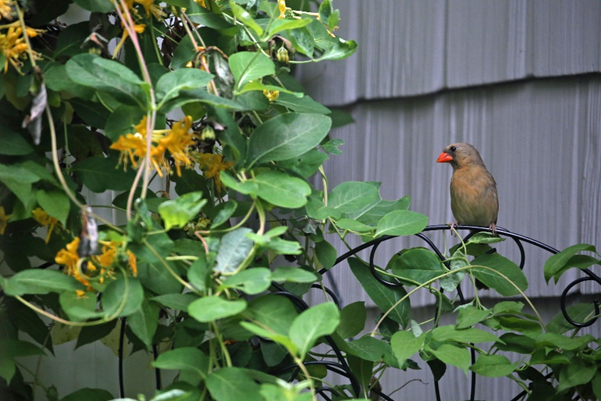
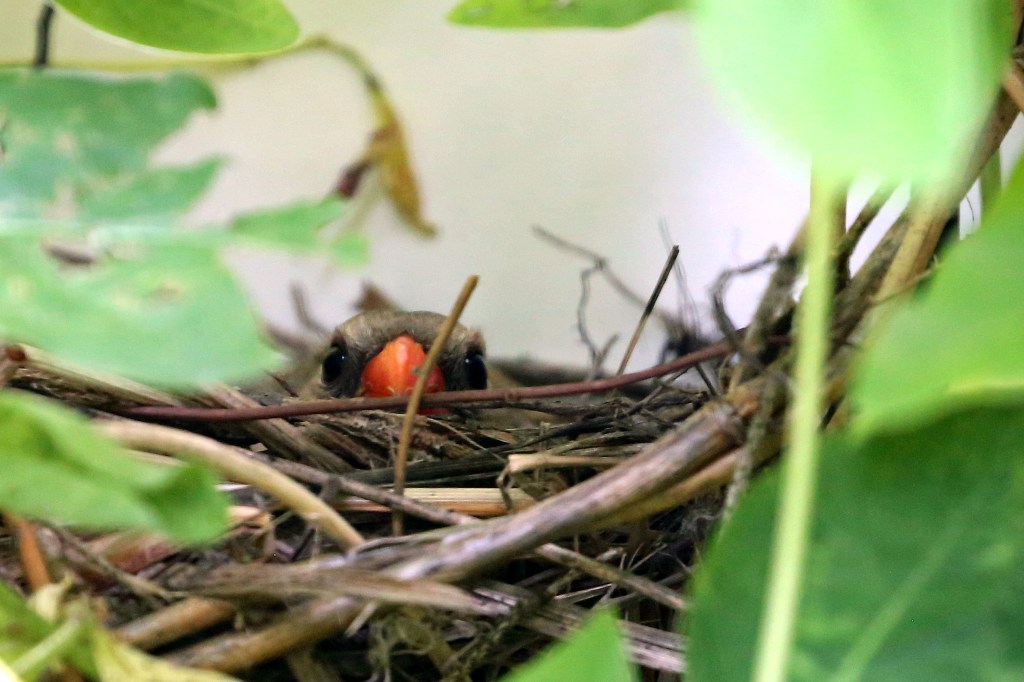
Once or twice every few weeks, I record something in my View from the House file. Just a few lines. Sometimes, it might just be a cloud, or a full moon shining through the branches of an oak in winter, or workers on the street. Yesterday, I wrote about the female cardinal feeding her chicks.

Mid-morning, a female cardinal flies in and out of its nest in the trumpet vine outside the sunroom window. There are three chicks, not yet ready to fly.

In the early evening, a snapping turtle struggled up the small embankment from the creek behind the house. As the creek would soon be dry now that the rain has ended, I carried it down to a nearby pond where it scrambled into the vegetation in the shallow waters. Snapping turtles are territorial by nature. Something to think about as the turtle disappeared from view.

Mother

Eighty years ago, my mother dedicated me to Our Lady of Perpetual Succour whose icon is on the left. In the Eastern Orthodox Church iconography, the image is known as the “Virgin Theotokos of the Passion.” This 15th century Byzantine portrayal of Mary has been housed in Rome since 1499.

I bought the Zulu sculpture on the right more than forty years ago during the Apartheid era. It isn’t a joyful sculpture of mother and child but, instead, a sad image of the oppressed. One can only gaze at it, speechless.

And now we have Gaza, Syria, Sudan, Ukraine, Haiti and more. Men killing women and children.

As I look out the window, a bird, a female cardinal, sits safely in her nest patiently waiting for her eggs to hatch.

Starting Here

Starting here, what do you want to remember?
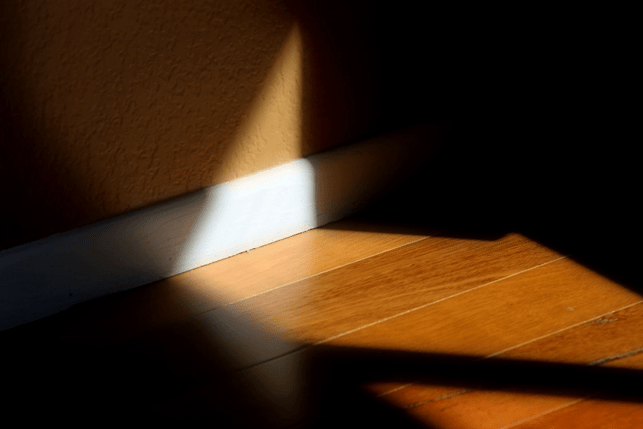
How sunlight creeps along a shining floor?
What scent of old wood hovers, what softened
sound from outside fills the air?

Will you ever bring a better gift for the world
than the breathing respect that you carry
wherever you go right now? Are you waiting
for time to show you some better thoughts?

When you turn around, starting here, lift this
new glimpse that you found; carry into evening
all that you want from this day. This interval you spent
reading or hearing this, keep it for life –

What can anyone give you greater than now,
starting here, right in this room, when you turn around?

William Stafford (from The Way It Is)

Mirage

Chiffon sheers moved gently
in the high-rise heat
that summer afternoon.
I watched them breathe
as you lay sleeping.

They spoke to me then,
as now, softly curling
like ocean waves
whose ebb and flow
mark the pulse of time,
whispering, now, now.

The drapes still float,
softly billowing in their
gossamer choreography:
A timeless waltz, endlessly
moving to life’s rhythm.

Rising and falling, they
silently sway, a seductive
invitation to dance
time’s pas de deux
when past and present
become forever now.

The Silence

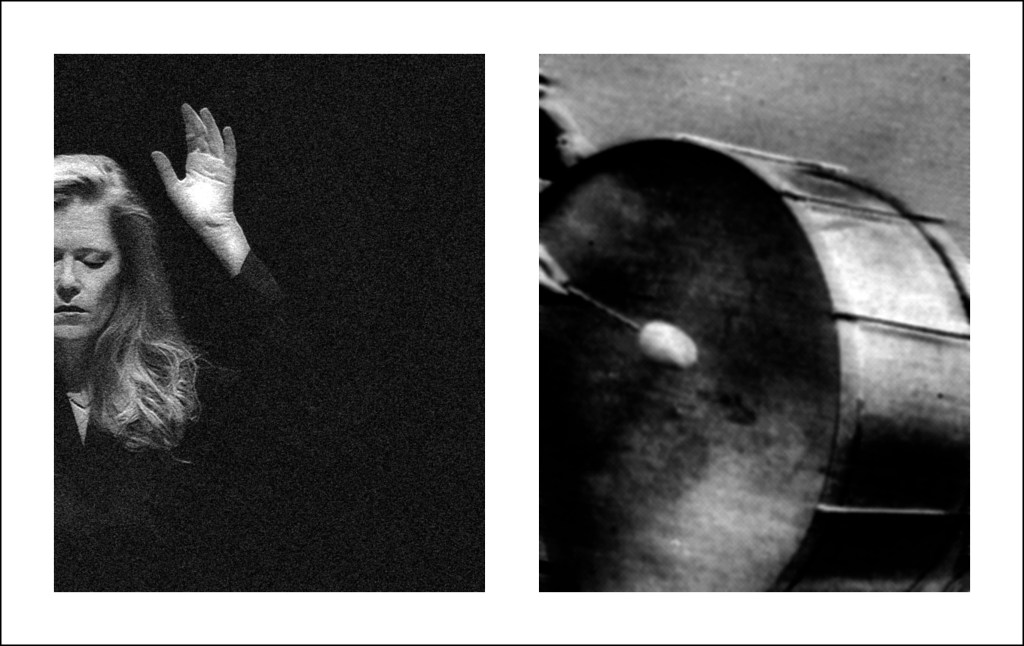
I attended a concert recently.  The program theme was Death and Transfiguration and included works by Richard Strauss, Haydn and Claude Vivier, a French- Canadian composer. His work, ‘Lonely Child’, was particularly absorbing. I was interested in the reaction of a friend who rose to his feet to applaud the performance. He hadn’t read the program notes and knew little about Claude Vivier. His reaction, it seems, was triggered purely by the music. My reaction was also very positive, but due in large measure to my awareness of Vivier’s biography and what he was trying to express. Was it the sonic complexity, the sound that was simultaneously both dissonant and melodic that appealed to Larry?  Or might it have been the part of the composition when single thunderclaps of the bass drum punctuated protracted silent periods?

In my diptych above, the conductor, Barbara Hannigan, raises her arm holding a silence in the concert hall for an uncomfortable length of time.

Then she flicks her wrist and there is a crash from the bass drum.

Then there is another long silence. One could hear a pin drop in the hall. 

This is the complete antithesis of the earlier crowding and jamming of melodic and dissonant frequencies and timbres.

There is another thunderclap. Another long silence and now the audience is fully under Vivier’s control, captivated by the silence between sounds.

The bass drum reverberates again.

Is this the end, the audience wonders? Is this the last breath, the last gasp like that of a dying person who slowly takes leave? Hannigan keeps her arm raised, Are we on the verge of eternal silence? 

Vivier described Lonely Child as a long song of solitude. Is this where it ends? But no, the intervals between the beat of the bass drum start growing shorter until they fade away altogether and we hear the higher pitch reverberation of the Japanese Rin Gong or ‘singing bowl’ and the tension dissipates. In the pre-concert talk we heard about the frequency proximity of C to C#. In the performance, we experienced distance through the absence of any frequency between the beats of the bass drum. And somehow this distance resonated within our psyche and we leapt to our feet unable to articulate quite why.

Vivier, I think, would be happy to know that his music was appreciated without the listener having to explain.

Arrested by Beauty

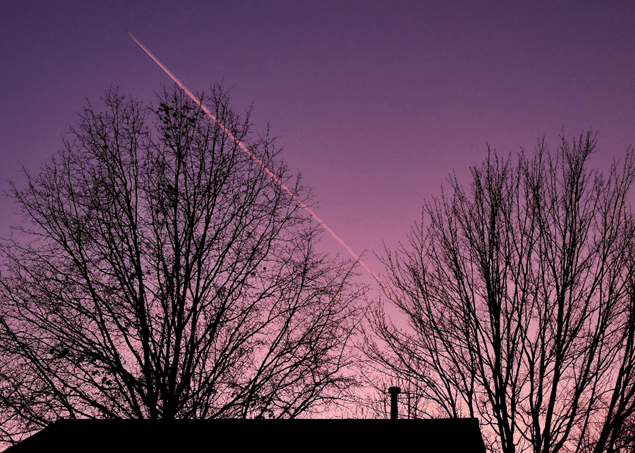
I had an abscess around the root of an upper molar and the pain was intense for several days until an endodontist came to the rescue. Despite the pain, while walking back to the house from the mailbox in the darkening of evening, I noticed the pink contrail of a passing jet. The image was so striking, I dashed indoors to get my camera. It’s interesting how beauty can arrest one; how, for a few minutes, a pink line across a purple sky can anesthetize one.