Something White

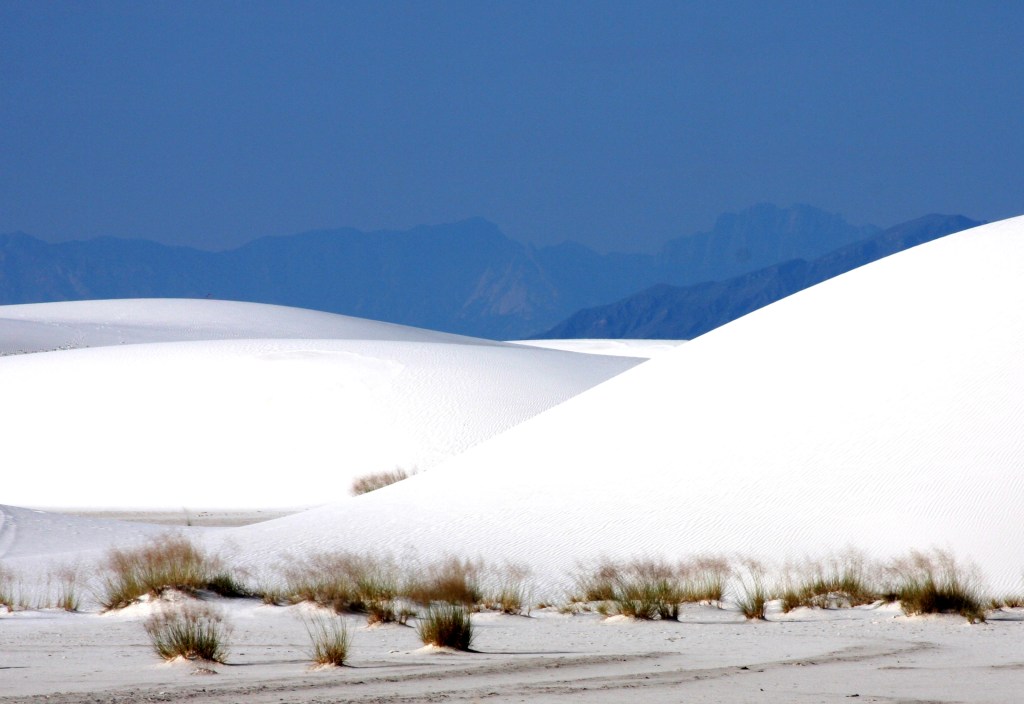
My previous post focused on the color blue, so this image provides a nice transition from blue to this post’s subject, something white. The photograph was taken in White Sands National Park in New Mexico and is completely surrounded by White Sands Missile Range. The white material in the photograph consists of gypsum crystals, and the dune field is the largest of its kind on earth. Fossilized footprints found here are dated to the earliest arrival of humans in North America around 20,000 years ago.
For some, the color white is a symbol of innocence, purity and peace. It is ironic and sad that this beautiful place is surrounded by a missile range where instruments of war are tested.
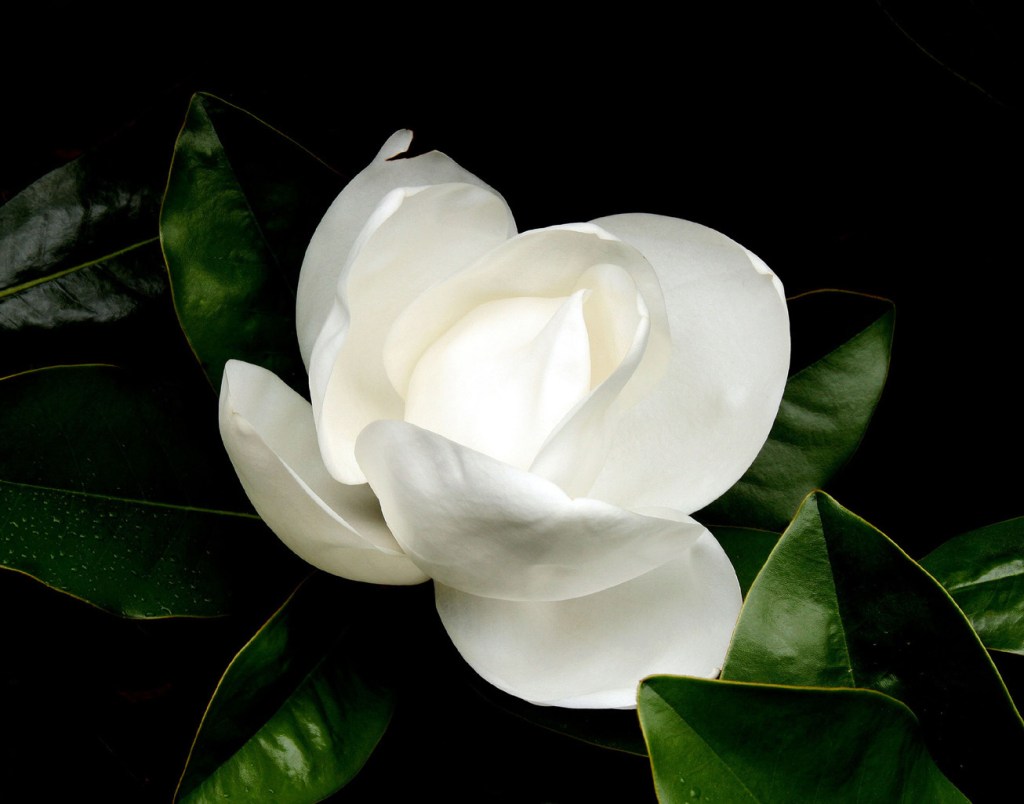
This Gardenia blossom surprised me as I walked past a small tree in the Louisville Zoological Gardens. Native to Asia, Gardenias were introduced to the southern United States in the 18th century but are relatively uncommon in Kentucky. The last time I had seen one was in the 1960’s in South Africa. To make sure that this was a Gardenia, I stepped closer to smell it. Yes, the intoxicating fragrance confirmed that this was the real thing. The scent of the flower plays an important part in attracting pollinators especially at night, appealing to nocturnal insects like moths who are also attracting to the white flowers discernible in the dark.
Is the image just a pretty photograph, or does it remind you of a time and place? Can you remember the fragrance?

Snow is actually translucent or clear because it is made of ice. But, because of the crystalline nature of ice, when light is reflected off the ice crystals, it breaks up and all the colors of the spectrum shine equally. Our eyes perceive all these colors colliding as white. The philosophical and scientific moral of the story is that things are not always as they appear, but in the case of snow let us embrace the appearance.
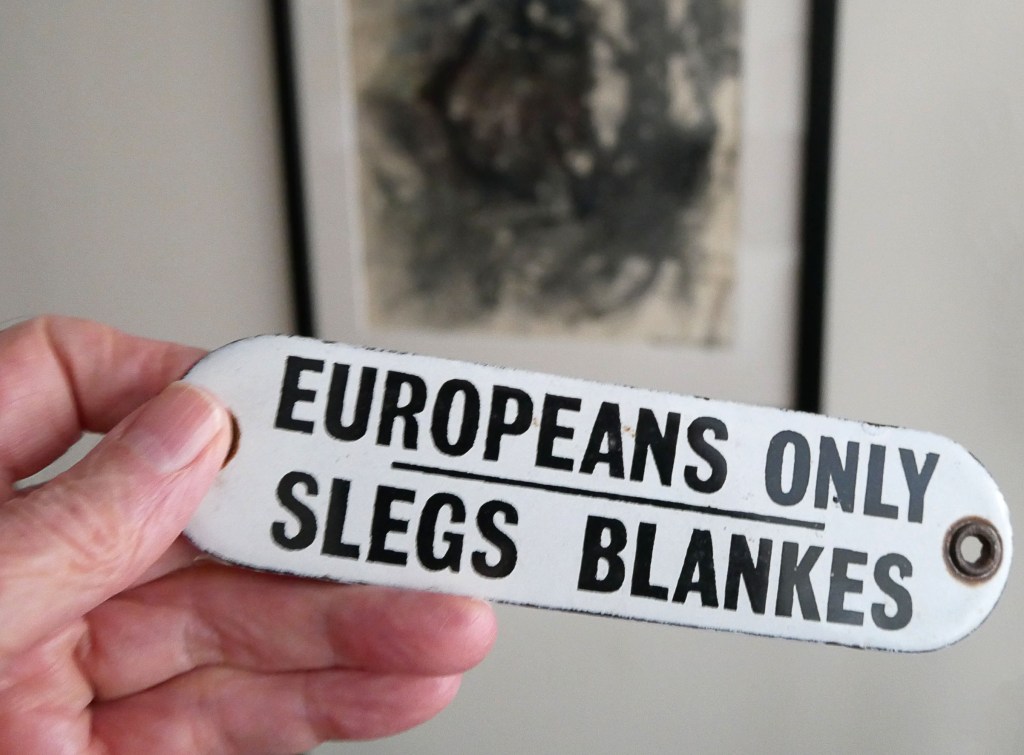
What does this little sign have to do with Something White? Well, the lacquered white base on which the black letters are printed is white. The hand that holds the sign is White. The second line is written in Afrikaans. Translated, it reads “Whites Only”. That’s how things were in South Africa before the end of apartheid. Our small group of anti-apartheid activists removed these signs from park benches in the city, an inconsequential gesture that may not have even been noticed. But there are times when one cannot remain silent. This was a beginning.
Living at peace with our Whiteness is not always easy.

Here is Lucy who brought much happiness to Lilian and me during our retirement. We have been “dog people” for most of our lives with canine members of our family that include golden retrievers, labradors, border collies, spaniels, and an assortment of mixed breeds. But it was Lucy who stole our hearts. Maltese dogs have a rich history that dates back over 2,500 years, originating on the island of Malta. They were popular in ancient Greece and Rome (catuli melitaei) and were even linked to the goddess Venus who was said to have kept them as pets. We like to think that Lucy is now with Aphrodite on Mount Olympus.
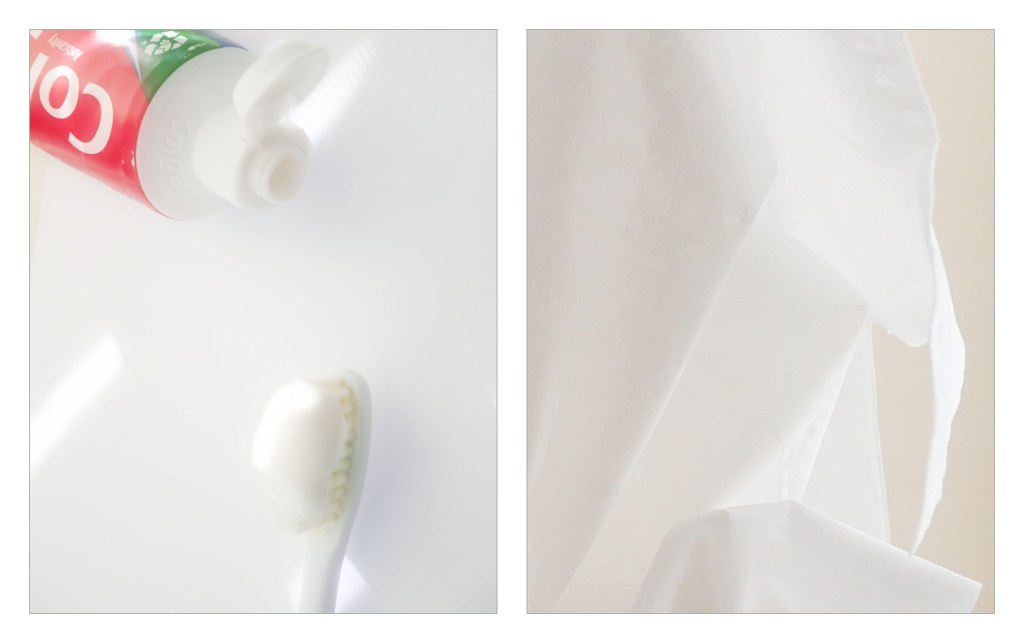
When one starts to think about white, a person becomes more conscious of it in our everyday lives. In the diptych above we see toothpaste and facial tissue. In much of Africa, the word for toothpaste is “Colgate” and in the United States and Canada, the word for facial tissue is “Kleenex”. Good examples of metonymy, the phenomenon that occurs when a brand name is so widely recognized that it is used in place of the product itself.
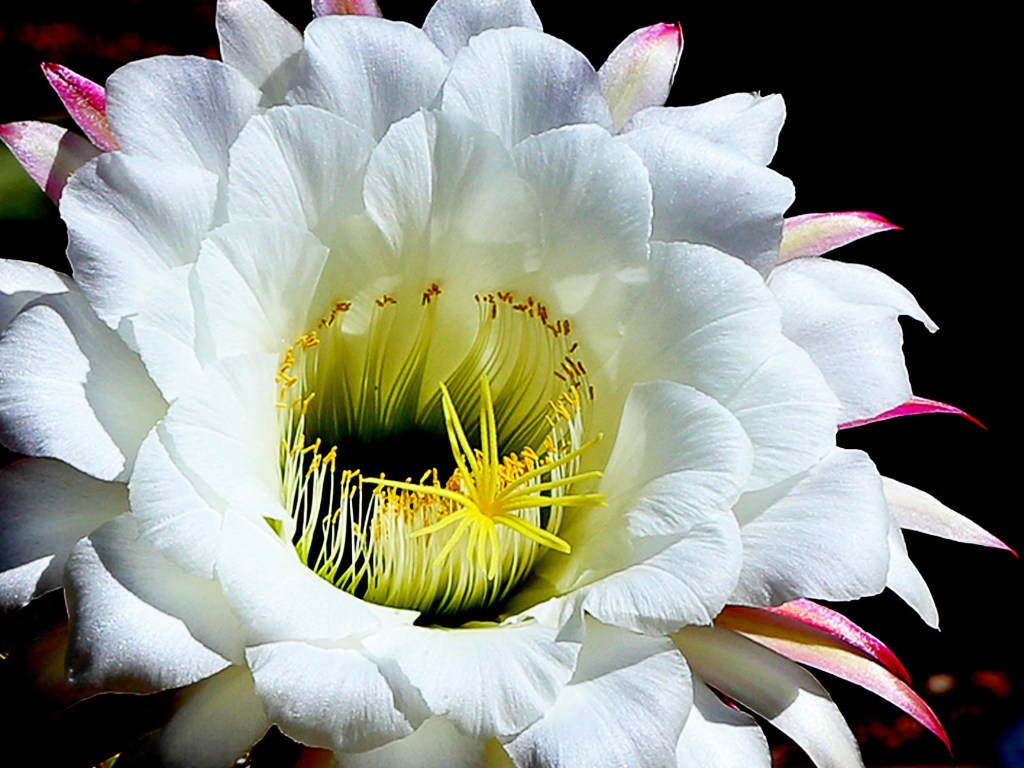
This flower can teach us something. It is the Trichocereus Candicans, also known as the Argentine Giant, native to Argentina. It thrives in arid climates and full sun, so it wasn’t surprising that it bloomed in our Sonoran Desert home. It is a night flowering species and although it blooms for only two days, it leaves an indelible impression. May our two-day lifespan leave its own beautiful mark.
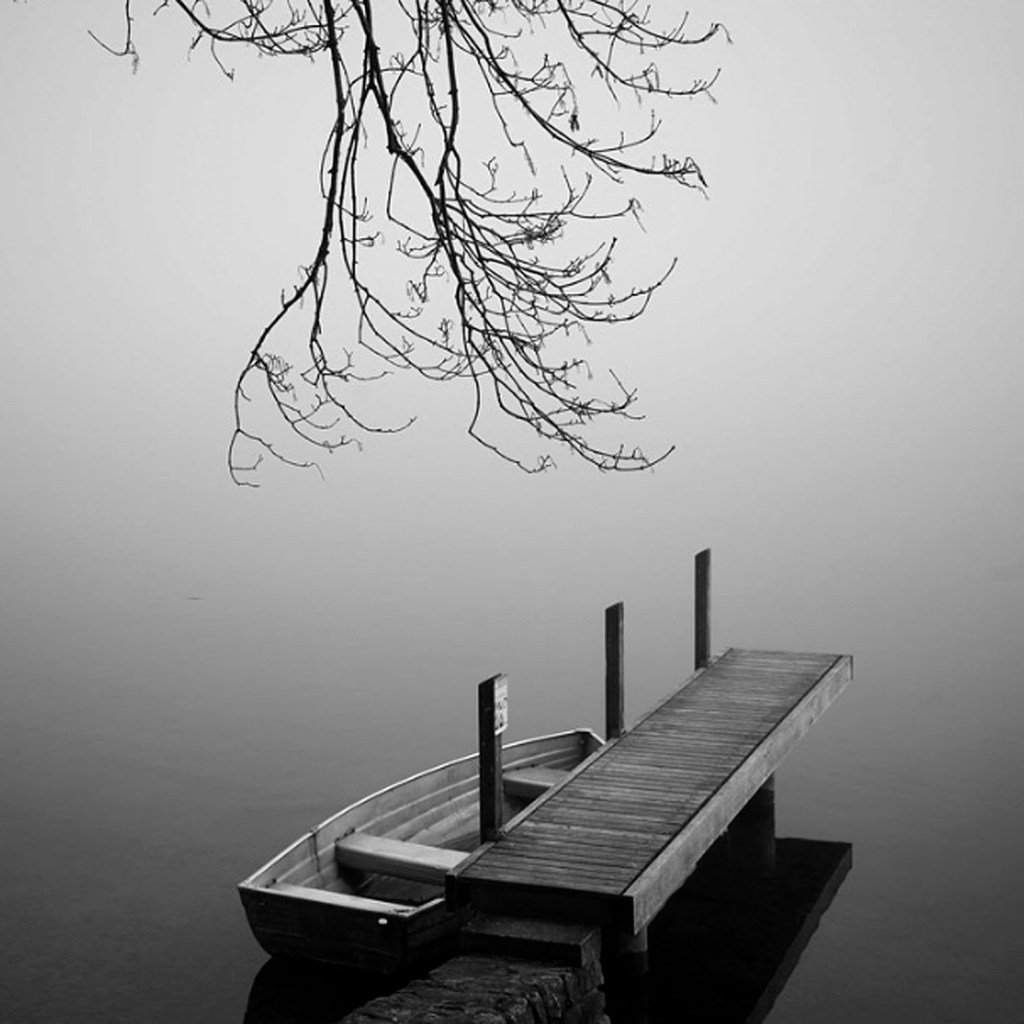
At the End

Photo: Mauro Manca

Step into the boat.
No, you don’t need to bring anything with you.
You can leave your things behind.
Your pictures, books, clothes;
Even your phone.
Your shoes.
The plastic glass of apple juice with a bent straw.
You don’t need to bring anything with you,
Not the sun warming your face,
Nor the rain, softly falling on your hair,
Nor dreams of the ocean,
And your special places.
You don’t need to bring any of that with you,
Nor anyone.
Not your children.
Nor even your wife.
Let the memories and the music
Of days when you were young
Disappear into the nothingness,
Like the sigh and sudden emptiness
In the bed where you no longer lie.
Leave them weeping there.
Come, hold my hand.
Step into the boat.

The Philosopher as Artist

Photographic and Philosophical Musings

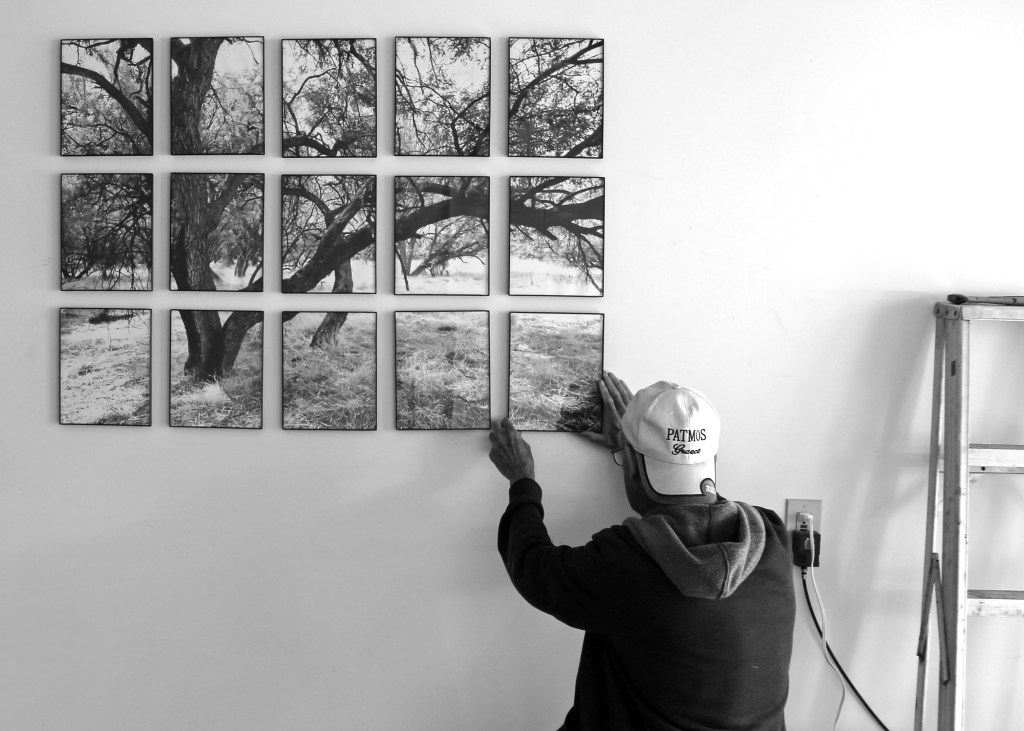
“Silently welcomed home” is how I describe the experience of returning to a grove of mesquite trees and being present among them in the Sonoran Desert of Southern Arizona. A camera marks the occasion.


Later, after selecting one of the images, I crop it into a visual matrix of fifteen smaller images, print and frame them, then mount them on a wall.

The effect seems quite pleasing.

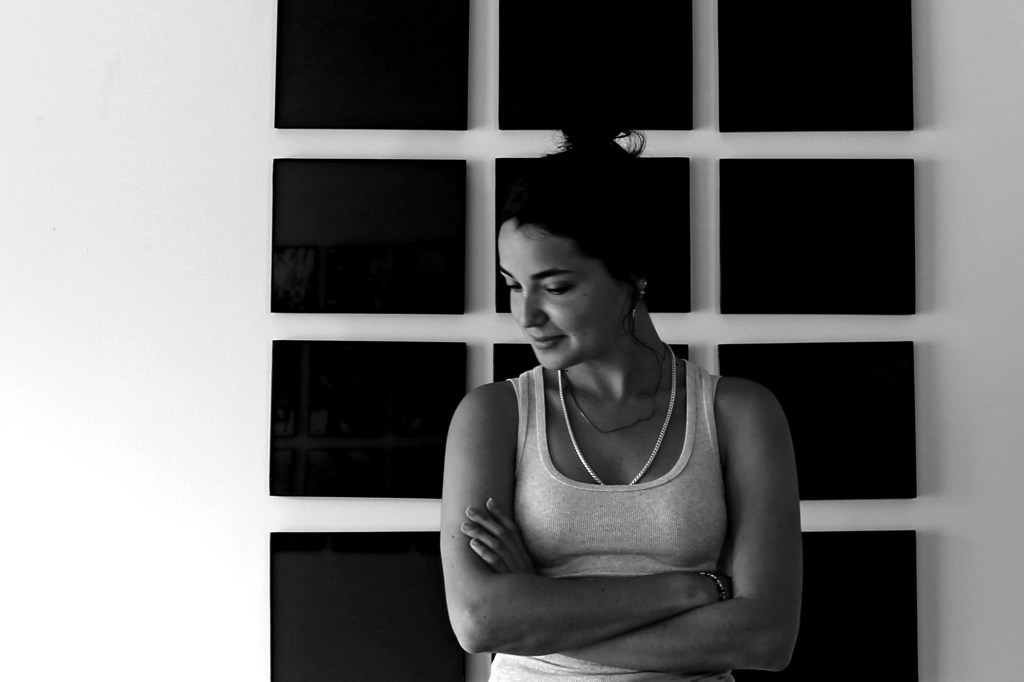
But, tiring of ‘realism”, I remove the photographs from the frames, leaving only the black cardboard mounting boards, change the orientation from vertical to horizontal, and hang the installation in our entrance hall.

By eliminating any surface image, I frustrate any attempt to see an underlying reality other than a void. Somehow, this new installation gives voice to the futility of any attempt in art to express the inexpressible, to express any underlying reality.

Western thought is based on the idea of center – an origin, a truth, an ideal form, an immovable mover, an essence, a God which guarantees all meaning: Art, words, and language serve as signs mediating this original, irreducible object. The French philosopher, Jacques Derrida, takes exception to the assumption that signs are capable of referring accurately to a transcendent reality that exists outside of language. For Derrida, there is no knowledge of ‘reality’, but only symbolized, constructed experience. Abstract or non-objective art seeks to uncover a signified transcendent by erasing signifiers and discovering pure form.


There are fifteen frames in my installation, underscoring the view of philosopher Jean-Francois Lyotard that meta-narratives with their claims to Truth are crumbling and are being replaced by smaller, heterogenous local narratives, narratives that cannot lay claim to any such knowledge.
If art is about surface and the paradox of an underlying unreachable reality, then by eliminating the surface in empty frames, the viewer is faced with the ambiguity of confronting a void.

To emphasize the paradox, I decided to hang the work in a virtual gallery challenging the viewer to question what is real.


The objects depicted in the lower right frame are duplicate images of a woman pushing a shopping cart in her unwitting search for the transcendent which, of course, is happiness.

But we can’t escape the illusion of our experienced reality, so I asked my granddaughter to pose in front of the installation. She willingly obliged, or so it seemed to me,

Oranges

Oranges fresh from our orange tree in Arizona

There is something about picking oranges each year until there are none left, except a few that are too high to pick, that puts one in a contemplative frame of mind.

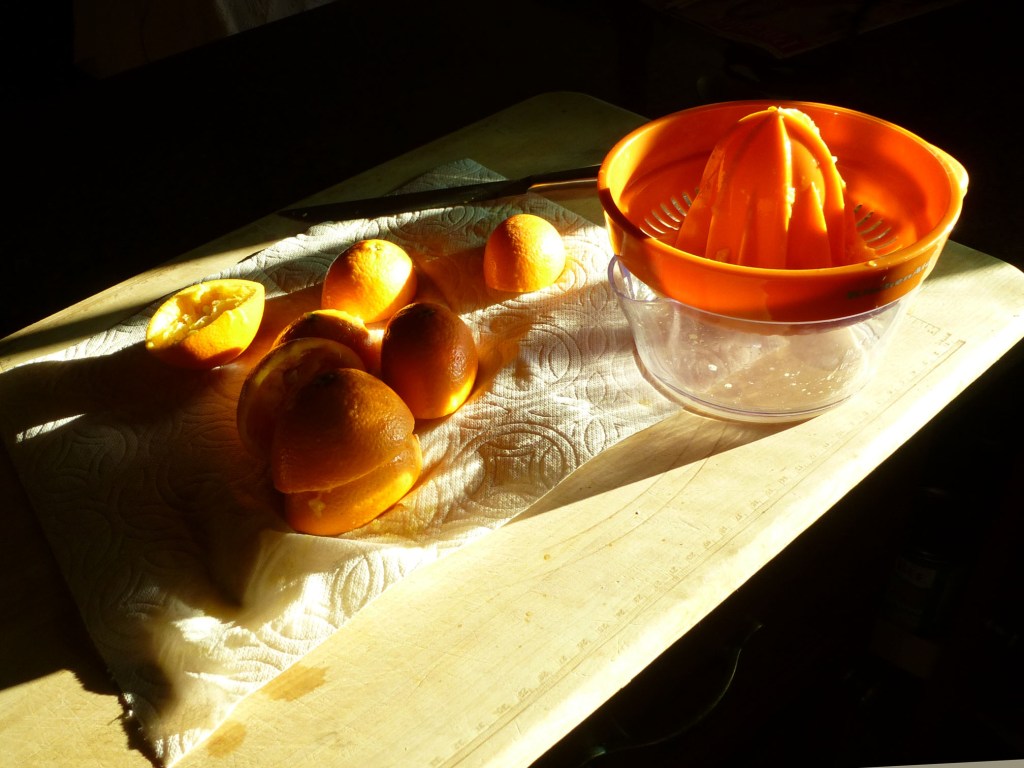
” Ambrosia” or Nectar of the Gods is how Lilian describes our morning orange juice

I would often walk out to the orange tree in our side yard and pick four or five of the fruit to squeeze for Lil and myself. I was struck by the fact that the juice, still cold from the night air, was still living in its cellular processes. Up until a few minutes earlier, it had been absorbing water, sugar and other nutrients through the trunk; organic compounds from its leaves; and reliant upon the millions of delicate, microscopic root hairs underground that wrap themselves around individual grains of soil and absorb moisture along with dissolved minerals. A process of respiration was constantly underway in the tree’s cells absorbing CO2 and releasing the by-product of photosynthesis, oxygen, into the atmosphere. As I stood beside the tree, I was struck by the likelihood that I was inhaling atoms released through its leaves. And, as the tree released oxygen, carbon dioxide, and moisture, it sucked up large amounts of water from the ground. And the moisture came from the same sources upon which I relied to live; water from the underground aquafer as well as the Central Arizona Project, a 336-mile aqueduct that diverts water from the Colorado River to cities and farms in Southern Arizona. We are also united by our need for nutrients: Chemical elements such as sodium, potassium, chlorine, calcium, iron, magnesium, manganese, and phosphorus that come ultimately from the soil and pass up the food chain from plants to humans. There is more to the orange tree that vitamin C.
And, as I sipped my morning juice, I thought of an evolutionary chain going back fifteen million years when citrus plants diverged from a common ancestor and I realized that, in the great sweep of evolution and human history, it was only yesterday that the Spanish Conquistadors introduced oranges to North America. I wonder if they tasted the same.

An orange in our Ohio supermarket

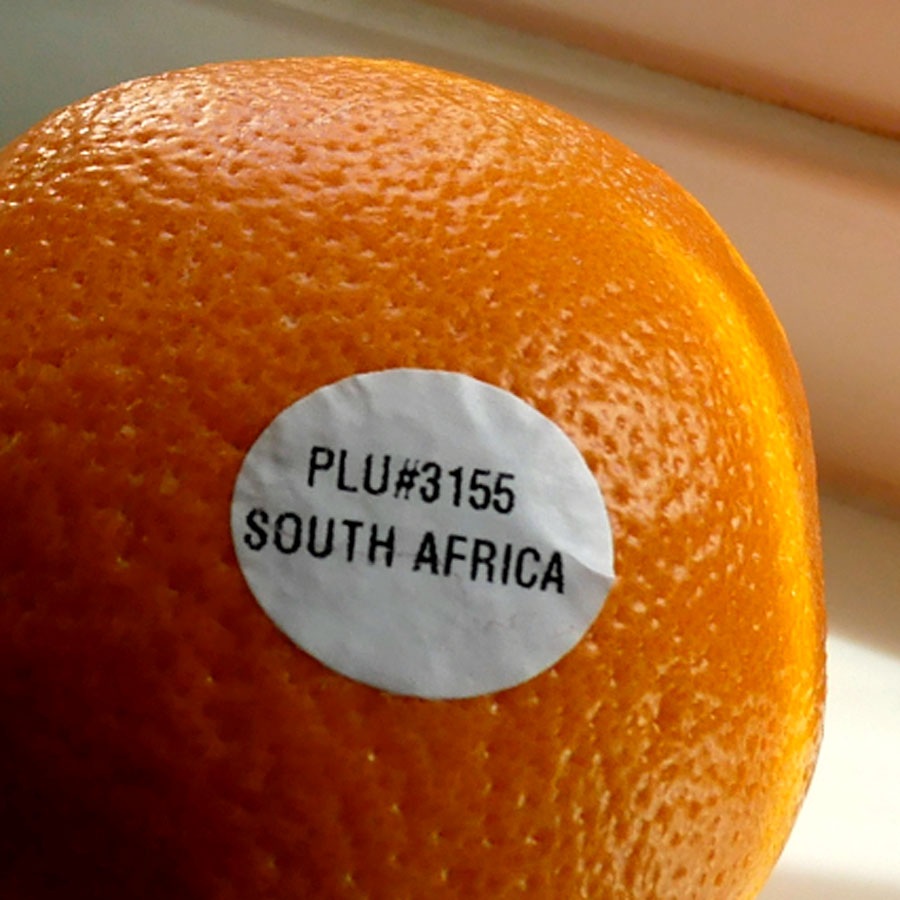
I noticed the label on an orange in the nearby supermarket. A sunny day came to mind with the image of an orange tree in South Africa where we lived and the image of a person picking the fruit then magically handing it over to us. A sharp citrus aroma escaped as Lil cut into the skin. She offered me a wedge and I had to acknowledge that it was extraordinarily sweet. Nearly as moist and sweet as our Arizona oranges. Curious about the label on the fruit, an internet search revealed that PLU#3156 referred to a refrigerated shipping container on a ship off the coast of Cape Town.

Oranges as commodities

The refrigerated containers were filled with oranges that had been picked a thousand miles to the north. They had been packed, not gently by hand into small wooden boxes, but by robotic arms in an automated warehouse the size of a football stadium, then chilled to a temperature just below freezing and loaded with 750 other containers onto the ship. They were stacked five high on the deck, then transported eight-thousand miles on a three-week voyage to Philadelphia where, together with other containers they would be shipped to dozens of distribution centers across the US. one of which is in Grove City, Ohio, where cartons of oranges would be loaded into trucks and distributed to supermarket locations throughout the state including our local store.

As I peel the perfect four-week-old South African orange, I’m reminded of our years in Jamaica:

Despite its mottled appearance and difficulty to peel with a knife, the Jamaican orange is sweet and juicy, and typically sucked rather eaten. And I remember the rough, bumpy-skinned Ugli fruit, the Jamaican Tangelo, a cross between a mandarin orange and a grapefruit with a sour-sweet taste.

Did we miss our morning juice from our years in Canada?

In Canada when fresh oranges were expensive, our daily source of vitamin C was reconstituted frozen orange juice concentrate. Yes, we were getting our vitamin C but, at the sensory level, there was no organic connection. The organic connection with the fruit in South Africa was restored during our years after Canada in Jamaica.

But the mind keeps returning to Arizona:

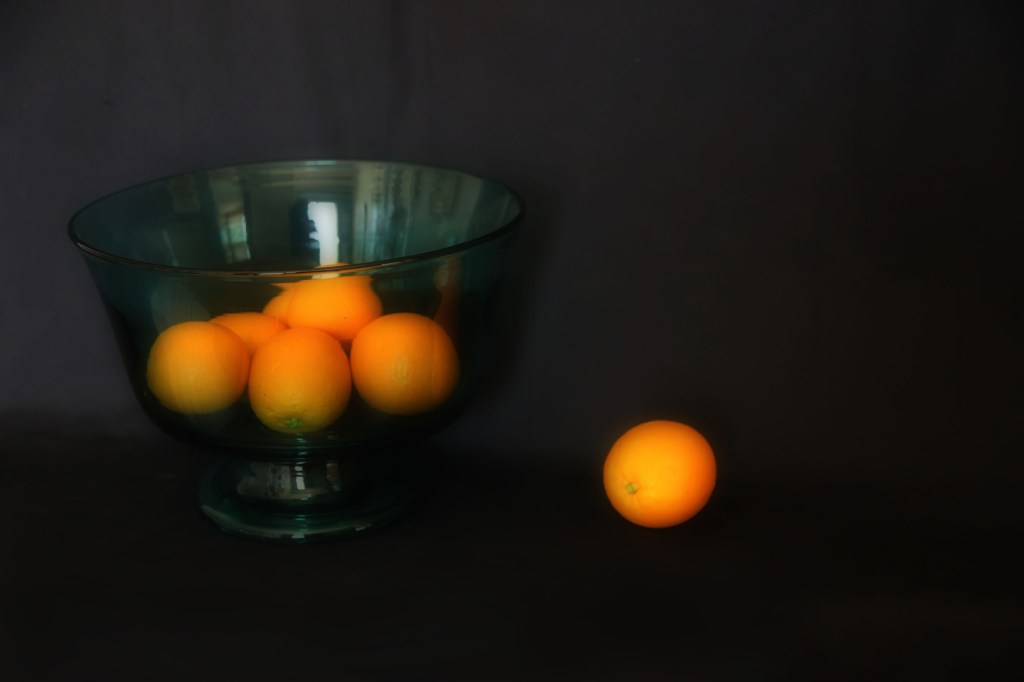
Through the kitchen window

Taken from outside our home during a hot summer night in Tucson, the image holds out the promise of a new day when the oranges in the bowl will be squeezed to link us closely to our environment. And so it goes.

The Question

Thoughts on an early morning walk

As one ages, one seems to turn increasingly inwards: Catching images from the past that fall like confetti in a random scattering of faces, places, shapes and colors, tastes, smells and sounds. And I wonder about the purpose of it all, about the purpose of my life and the lives of parents, grandparents, siblings, nephews and nieces as images of them float by; lives so full, marked by pain and pleasure, fear and fulfilment, boredom and excitement; lives once so important to them yet gone, seemingly in an instant. Gone like the birds that built their nest in the vine outside our window last spring and gone like their chicks who survived to repeat the cycle. Gone like the squirrels and chipmunks urgently storing food for winter.

And I remember catechism classes taught by my teachers, the Irish Christian Brothers in Pretoria where the Jacarandas bloomed each spring: “Why did God make you?” “God made me to know, love and serve Him in this world and be happy with him forever in the next.” There wasn’t a question in the catechism asking why God made sparrows. So, I don’t know the answer to a question that wasn’t asked. And the Christian Brothers came to South Africa from Ireland in 1897, interlopers, about the same time Jacaranda trees were imported from Brazil. Interlopers. And the bees still buzz among the Jacaranda blossoms and the school is now coeducational and multi-racial, and the Christian Brothers have gone, and my grandfather who once was a Christian Brother died seventy-eight years ago. And the question remains: “To what end? For what purpose? And does any of this matter; not in the abstract, but to MY wife, to MY children, or to anyone? And should I apologize for using the possessive MY? Is anything MINE? I remember my Irish grandfather, though I scarcely knew him. Those who knew him well – his wife the tennis-playing homemaker, his father the farmer, his mother whose place was in the kitchen, his sons, a lawyer and a doctor, his brother, the well-known cleric who sent him shamrock from Ireland each March– all have died, while I remain the last embodiment of a memory that is all that is left of him. When I die, all memory will be gone as if he never existed. And the bees whose habitat is at risk will still buzz among the Jacaranda blossoms in Pretoria for a while to come. Which will be the first to end, the sound or the memory? Does it matter?

Does it matter? This, perhaps, is the most important question. And, as my early morning walk ends, it is a comfort to suddenly realize that the answer doesn’t matter.