There was a sadness in the cadence of her voice. Her name was ‘Beauty’ and she calmly explained to the radio interviewer that in her line of business, risks are very real, but she had children, five to feed and hungry, and there wasn’t any money, or food for that matter, in beautiful Zimbabwe.
I changed channels, to the music station where Robert Schumann’s dreamy piano piece, Kinderszenen, Scenes from Childhood, brought his Moscow audience to tears. I thought of Beauty.
Back in the interview, she talked softly about her desperate business. It was booming across the border where migrant men settled by the hundreds in squamous squatter camps, their despair only deferred by a futile hope for something better.
But for many, the only comfort was in Beauty’s one-woman house-of-joy where, in the sadness of it all, they shared a longing for home and families across the sluggish, silt-filled Limpopo.
I changed channels again. Horowitz was still playing Schumann the seventh piece now, the gentle Traumerei. It can make you weep.
Beauty’s interview pulled me back as if with clutching fingers refusing to let go. The matter-of-fact exchange masked something deeper as she sustained a self-possessed dignity, unexpected in a prostitute-come-lately.
The interviewer politely probed: What were her hopes and dreams? The question hung unanswered, suspended in breathless air like some dark cloud heavy before rain.
I attended a concert recently. The program theme was Death and Transfiguration and included works by Richard Strauss, Haydn and Claude Vivier, a French- Canadian composer. His work, ‘Lonely Child’, was particularly absorbing. I was interested in the reaction of a friend who rose to his feet to applaud the performance. He hadn’t read the program notes and knew little about Claude Vivier. His reaction, it seems, was triggered purely by the music. My reaction was also very positive, but due in large measure to my awareness of Vivier’s biography and what he was trying to express. Was it the sonic complexity, the sound that was simultaneously both dissonant and melodic that appealed to Larry? Or might it have been the part of the composition when single thunderclaps of the bass drum punctuated protracted silent periods?
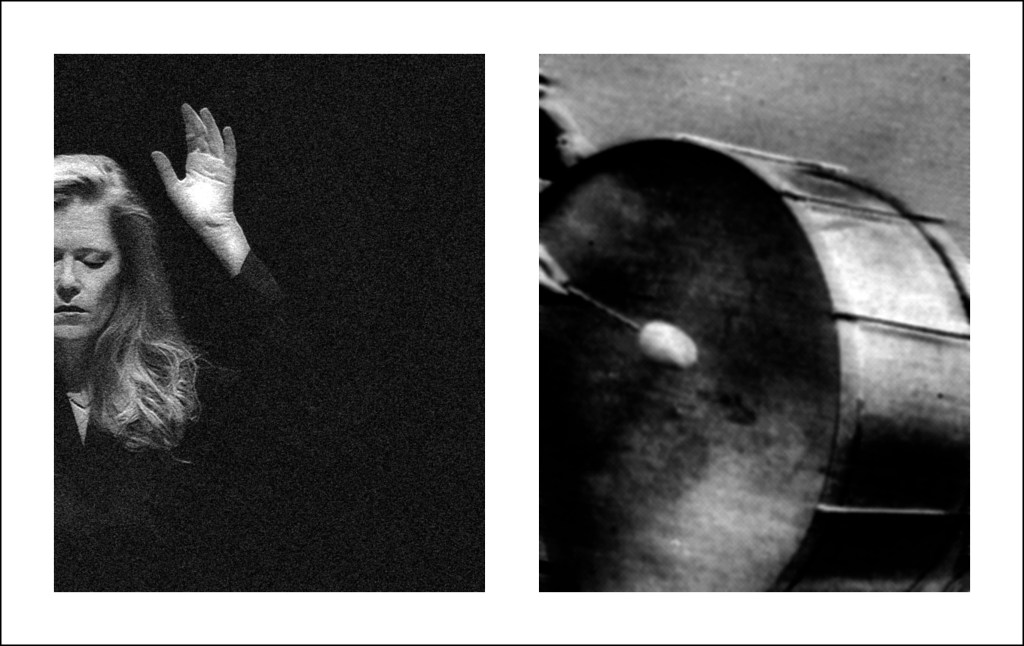
In my diptych above, the conductor, Barbara Hannigan, raises her arm holding a silence in the concert hall for an uncomfortable length of time.
Then she flicks her wrist and there is a crash from the bass drum.
Then there is another long silence. One could hear a pin drop in the hall.
This is the complete antithesis of the earlier crowding and jamming of melodic and dissonant frequencies and timbres.
There is another thunderclap. Another long silence and now the audience is fully under Vivier’s control, captivated by the silence between sounds.
The bass drum reverberates again.
Is this the end, the audience wonders? Is this the last breath, the last gasp like that of a dying person who slowly takes leave? Hannigan keeps her arm raised, Are we on the verge of eternal silence?
Vivier described Lonely Child as a long song of solitude. Is this where it ends? But no, the intervals between the beat of the bass drum start growing shorter until they fade away altogether and we hear the higher pitch reverberation of the Japanese Rin Gong or ‘singing bowl’ and the tension dissipates. In the pre-concert talk we heard about the frequency proximity of C to C#. In the performance, we experienced distance through the absence of any frequency between the beats of the bass drum. And somehow this distance resonated within our psyche and we leapt to our feet unable to articulate quite why.
Vivier, I think, would be happy to know that his music was appreciated without the listener having to explain.
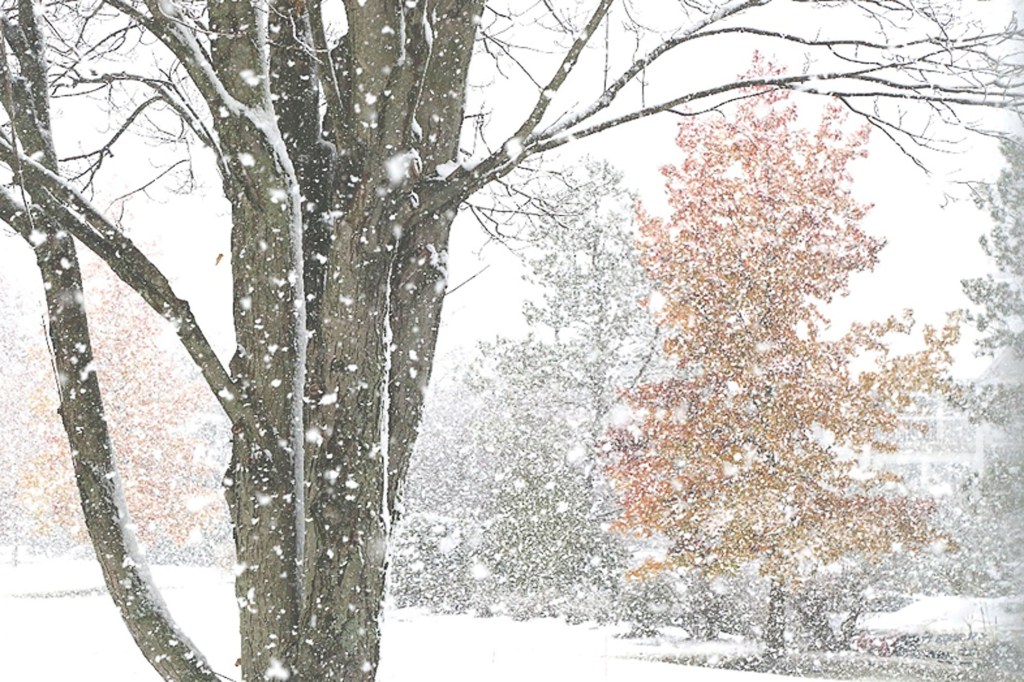
The time will come When I will remember Standing at the kitchen window With a bowl of cereal Looking out at softly falling snow. The now will be then And make the heart ache.
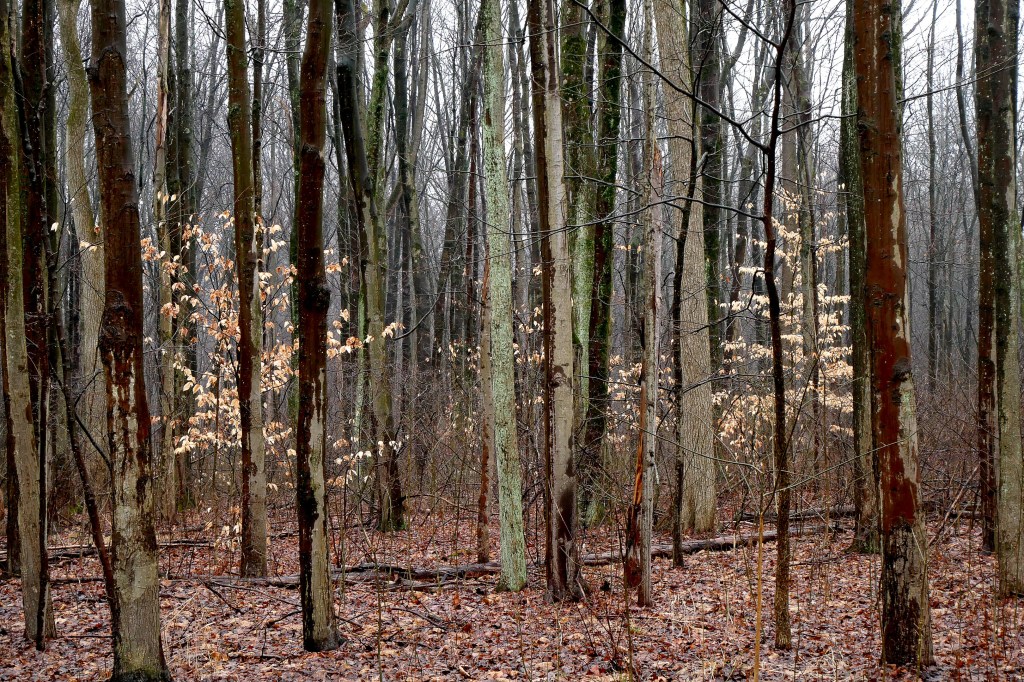
Over the years, I have wondered why it is that so many of us are drawn to nature. I think of my own experiences of entering a forest, climbing a mountain, wading into the ocean, and the strange sense of presence, of being taken into, of being embraced, that overtakes one. Discreet experiences come to mind: Walking slowly in a forest of balsam fir and deciduous trees in the Laurentian mountains of Quebec; Pausing among a cluster of mesquite and acacia trees in the Sonoran Desert; Walking through a grove of whispering pine overlooking the Indian Ocean in South Africa; Climbing up into a tall Syringa tree in Pretoria; Ambling along a dirt road under a line of Blue Gums in Australia; Climbing the treeless Beenoskee mountain above Ireland’s Lake Annascaul; Joining the Buckeye Trail not far from our Hudson home to stroll among, hickory, maple, beech and pine.
Ours is largely an anthropocentric culture, one that views humankind as separate from and superior to nature; a perspective that views non-human entities such as animals, plants and minerals as resources for us to use. It is a culture marked by the impulse to dominate. And, in our daily lives, we are caught up in a struggle between the urge to dominate and resistance to being dominated. And, somehow, this drive has a dehumanizing effect. That is why perhaps, when we enter the forest, we abandon this destructive dichotomy to find a peaceful harmony at one with nature: A non-verbal awareness.
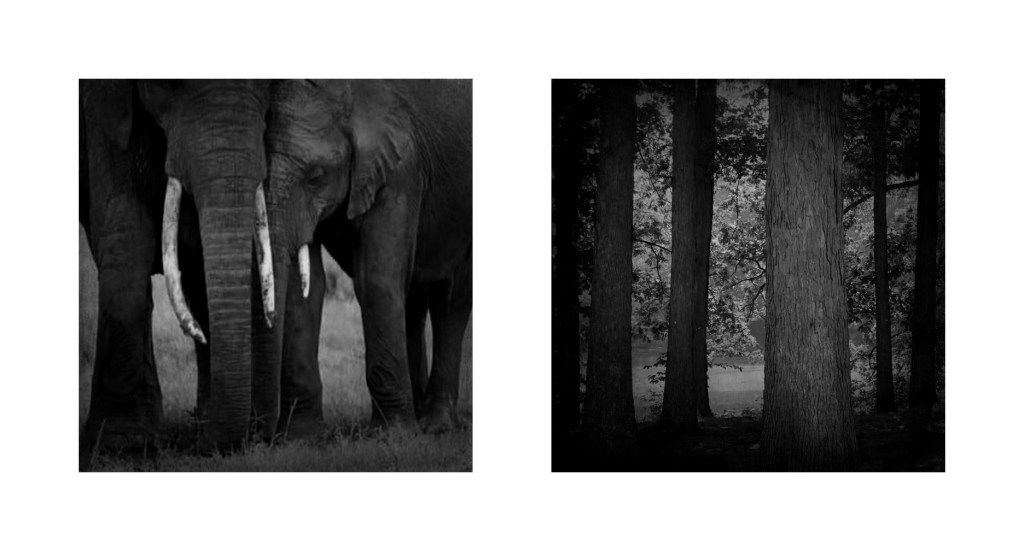
In a recent New York Times opinion piece, ‘In the Shelter of a Weeping Beech,’ Jesse Wegman wrote about his mother who “loved all trees, but this weeping beech was her favorite. It’s hard to describe the experience of being in its presence, but she tried. In the journal she kept while she was sick, she wrote that the tree appeared to her ‘as a herd of elephants huddled together, pressing their massive bodies together, with their trunks entwined.’
Only a few months earlier, I had a similar experience standing in a grove of oak trees and tried to capture it by creating the photographic diptych displayed above. I then wrote some poetic narrative to accompany the image. Here it is:
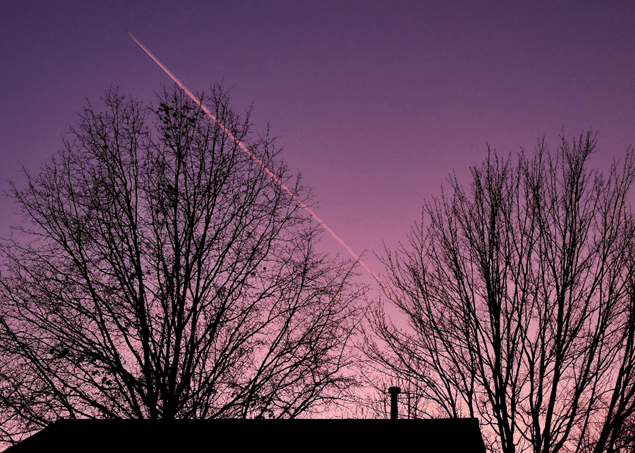
I had an abscess around the root of an upper molar and the pain was intense for several days until an endodontist came to the rescue. Despite the pain, while walking back to the house from the mailbox in the darkening of evening, I noticed the pink contrail of a passing jet. The image was so striking, I dashed indoors to get my camera. It’s interesting how beauty can arrest one; how, for a few minutes, a pink line across a purple sky can anesthetize one.
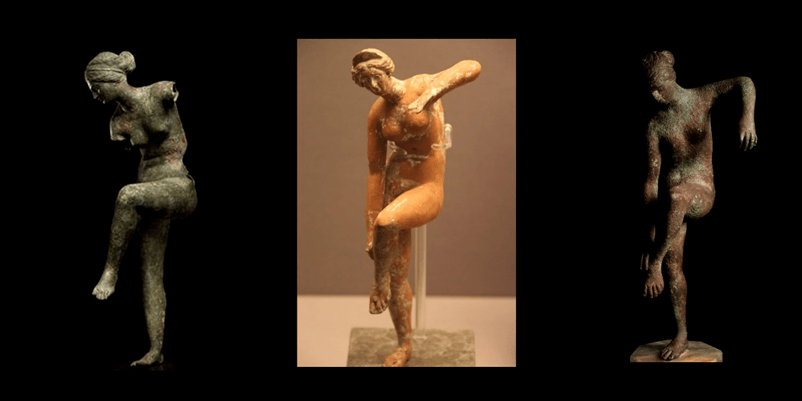
The original was probably the small terracotta sculpture in the center that is now in the British Museum and dates back more than 2200 years. The bronze on the left, also in the British Museum, is an equally old copy. Our little statue is a fine art reproduction and, although there must have been hundreds produced around the time we bought it, the beauty of the original is faithfully conveyed.
We were quite poor at the time and we sacrificed lunch to help pay for our Aphrodite. Weeks later, she was the only beautiful presence in the scrubby little furnished apartment above a convenience store that was our first rented home upon arriving in Canada.
She was wrapped, packed, transported and unpackaged fourteen or fifteen times as we moved from apartment to house after Sarah’s birth, then from city to city in Canada and, later, to Jamaica where she watched our armed robbery but was herself left unscathed. Then to the United States to watch the children grow, then bid farewell to Adrian as he left home for university. Back to Ontario and then Quebec, only to return to Ohio before a final move to the Southwest where you might think she is quite out of place. Is love ever out of place?
We are in the process of throwing things out or giving them to Goodwill: Things like a shell collection, kids’ old toys, children’s drawings, vases, books, photographs, souvenirs from trips and so on; a large conch that an early girlfriend held against my ear so that I could hear the ocean surf; things we have been carting around for decades, subliminally keeping memories alive. Some things, notably family photographs, are spare and kept in a box of family archives. As I look through them, I realize that I can still breathe life into those moments caught by the camera, but when we die, their lives that have been sustained by our memories will end more finally than before. When there are no more people alive who ever knew mom or dad, it will almost be as if they had never existed. I look at a photograph of them in their early thirties punting on the river Cam in Cambridge together with Sue and Bob McSherry. I remember mom and dad telling me about the experience and about dad’s days as a student there: I look at the McSherrys and can almost hear them talking and laughing. I see them all grow and age. Now they are gone. We hang on to the pictures. But the time will come when the photographs won’t mean anything to anyone. They will be tossed out and with them the lives of those we strangely keep alive.
Collections
In the process of clearing out, we had to make difficult decisions to get rid of boxes of toys, collectibles, documents and souvenirs that we had accumulated over forty years.
My collection of wine corks was the first to go. I had started collecting these corks twenty-five years ago in Canada when I started paying attention to wine. The corks told a story: Many were from bottles of Bordeaux: Medoc was my favorite. Some Grand Cru Classe from famously regarded appellations, many from good vintage years. The corks reflected the world of wine producing countries: Australia, New Zealand, Argentina, Chile, South Africa, Italy, Germany, Spain, France, Portugal and even Canada and the United States. And for most of the corks, memories of the taste of the wine, and the circumstance under which the wine was purchased. The corks were carted around from home to home, saved for who knows what. Now they’re gone. I still have a collection of wine labels tucked in between the pages of a book on wine. One day the book will be thrown out.
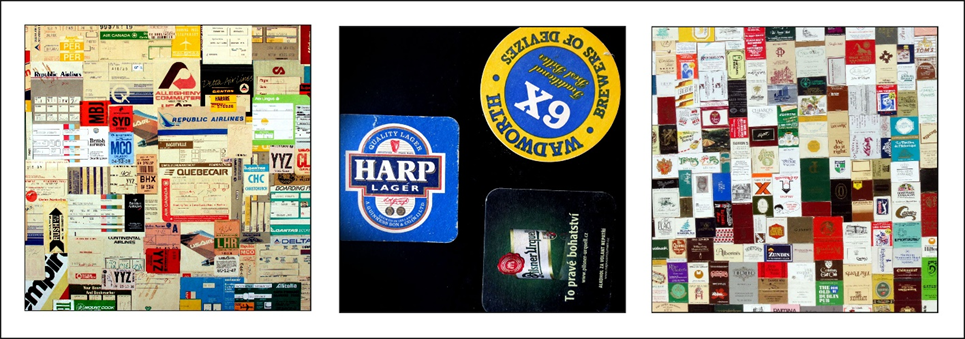
I should mention in passing that I also had a collection of beer coasters that I threw out a few months ago. The difference between the coasters and the corks is more than the difference between beer and wine. Each coaster was picked up in a pub where I had just enjoyed a beer: Many from English pubs, some from Australia, and several from Canada and the US. I had long harbored a dream that one day I would have a pub bar in the basement of our home. The bar would also feature a collection of matchboxes and boarding passes that I had accumulated around the world during my business travels. The dream now just a dream.
Dunmanus Bay, Ireland
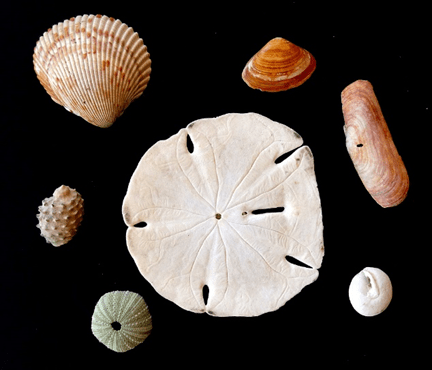
Another collection that I had completely forgotten about was a large box of shells. These too had been carted from home to home, country to country: Shells from the Eastern Cape and Natal in South Africa, a collection from the south coast of Jamaica, and shells from Dunmanus Bay in Ireland. The shells brought back the feel of wet, grainy sand underfoot, the salty feel of the moist air, the warmth and smell of Jamaica, the chill and dampness of Ireland’s southwest coast. In the collection were sun-bleached specimens of coral from Jamaica’s north cost, bringing back memories of family snorkeling inside the reef of Ocho Rios. I threw all of them into the garbage except for the large conch that Maria bought me many years ago in Durban. I donated that together with a box of objet-d’art to the local Goodwill store. Perhaps someone will buy it, someone who knows that if you hold it up to your ear you will hear the sound of ocean surf.
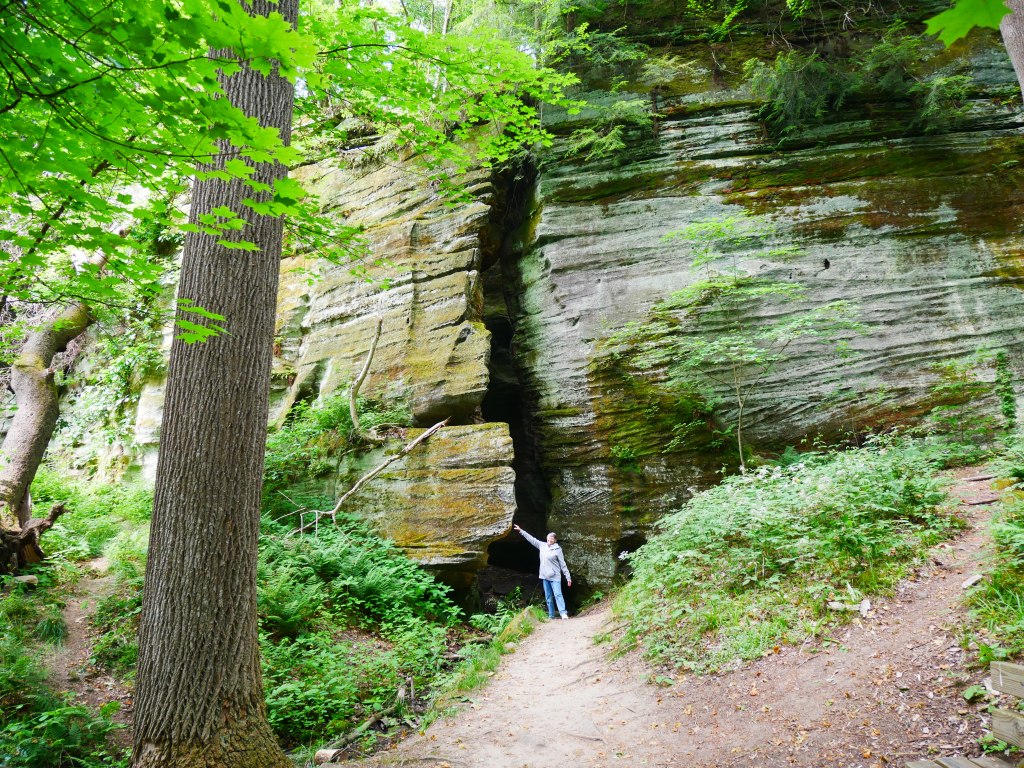
Now that we are in our eighties, and after fifteen years in Southern Arizona, we moved to Ohio to be closer to family . We set out to explore our new surroundings and were surprised to discover some beautiful short hiking trails within fifteen minutes of home. In the photograph above, Lil stands at the entrance to a cave in the sedimentary rock ledges of our local metro-park.
Glacier Cave, Liberty Park
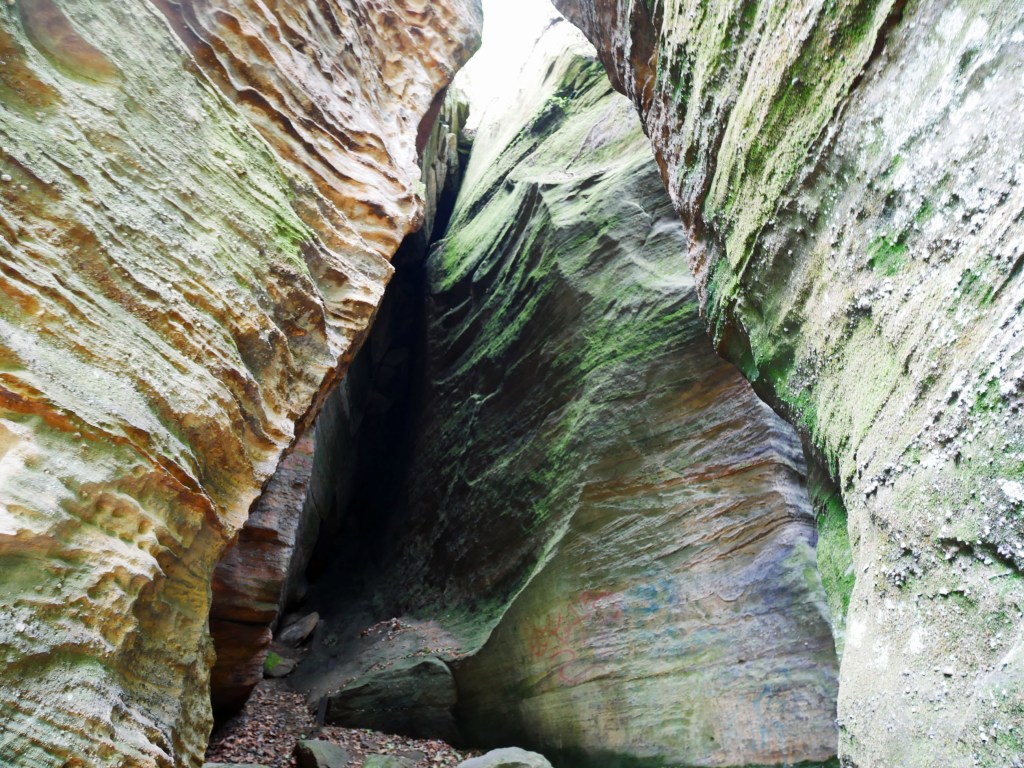
This is one of the many caves that are believed to have been used by American Indians in the area. Ohio’s first people, arrived around 16,000 years ago. They were nomadic hunter-gatherers and chose this area because of its high ground, proximity to water and wetlands and toolmaking resources. Artifacts found in this area indicate that later people used the land for gardening, and frequently changed encampments to precent overhunting and overfishing. Later, fur trade with the French brought the Wyandot, Seneca, and Ottawa Indians to the wetlands in the area to trap beaver and muskrat.
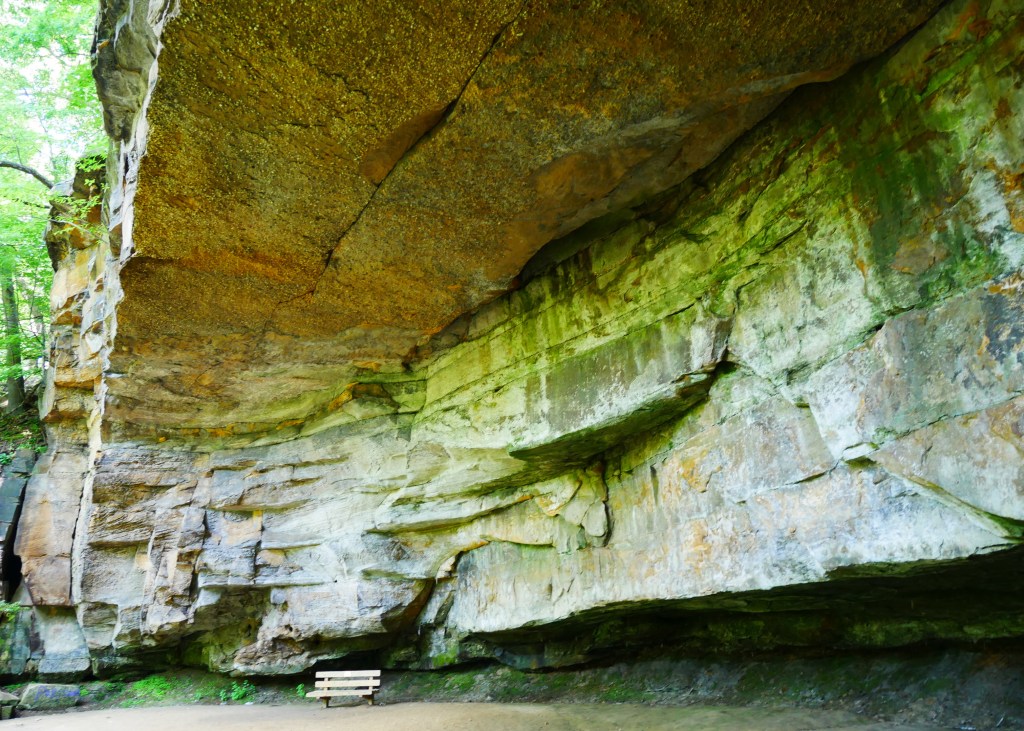
Mary Campbell’s Cave, Grove Trail, Cuyahoga Falls
A plaque nearby reads:
“In Memory of Mary Campbell who in 1759 at the age of twelve years was kidnapped from her home in Western Pennsylvania by Delaware Indians. In the same year these Indians were forced to migrate to this section where they erected their village at the big falls of the Cuyahoga. As a result, Mary Campbell was the first white child on the Western Reserve and this tablet marks the cave where she and the Indian women temporarily lived. Later, in 1764, she was returned to her home.”
While the story of Mary Campbell’s abduction and release some six years later is true, an archeological dig at the cave found no evidence that it had ever been used as a dwelling by American Indians.
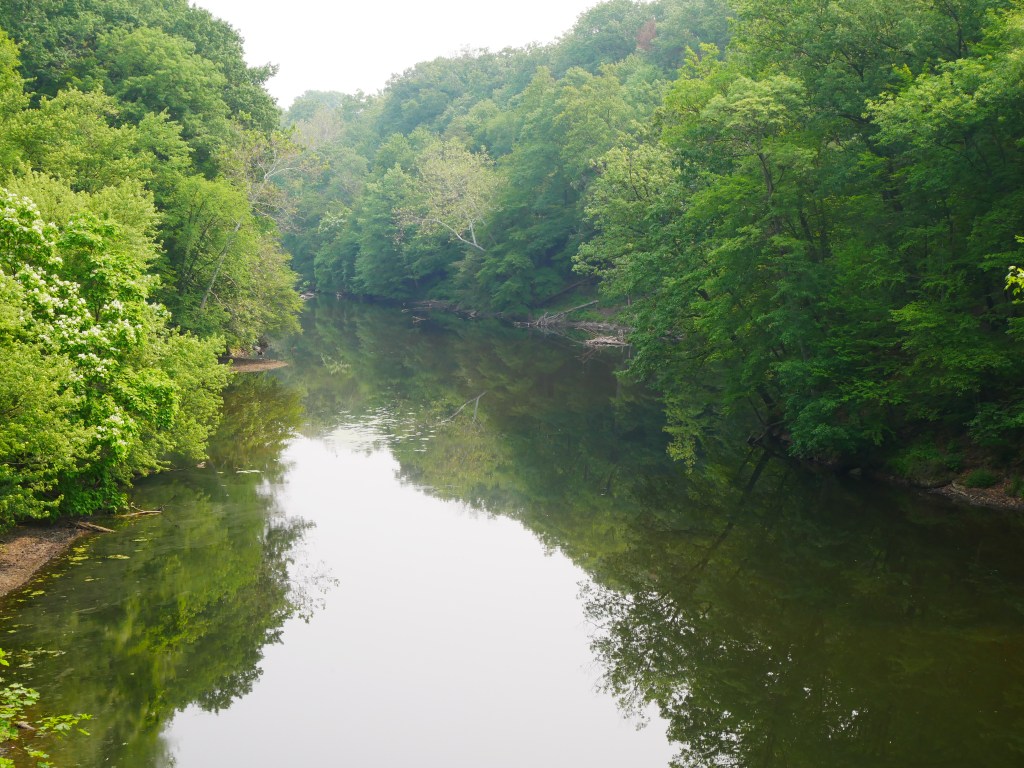
Dammed section of the Cuyahoga River
This view just ustream from Mary Campbell’s Cave won’t last long. The sixty-foot high dam that was constructed a hundred years ago will be demolished this year and the river will return to its normal course and experience improvement in aquatic life.
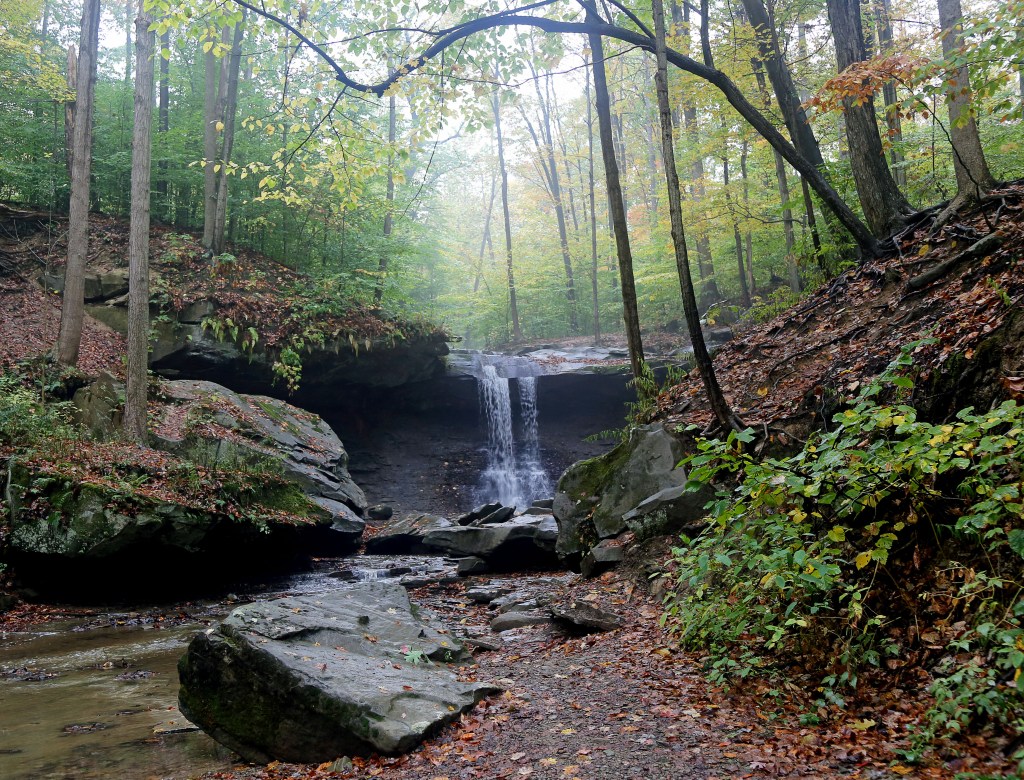
Blue Henn Falls, Cuyahoga Valley National Park
A thirty-minute hike takes us to another beautiful location close to home. The fifteen foot waterfall gets its name from a ferocious bluish chicken that was bred when cock fighting was legal in the US. Legend has it that a local farmer found the carcass of a blue hen in the pool below the falls and named them after it. The Blue Hen chicken is the state bird of Delaware




 The Final Stretch