My girlfriend’s mother wore a yellow housecoat. It took the place of sunlight that never found its way into the block of concrete, they called home: One bedroom and a porch for five, six with me, crammed around the table in the entranceway to talk and drink coffee.
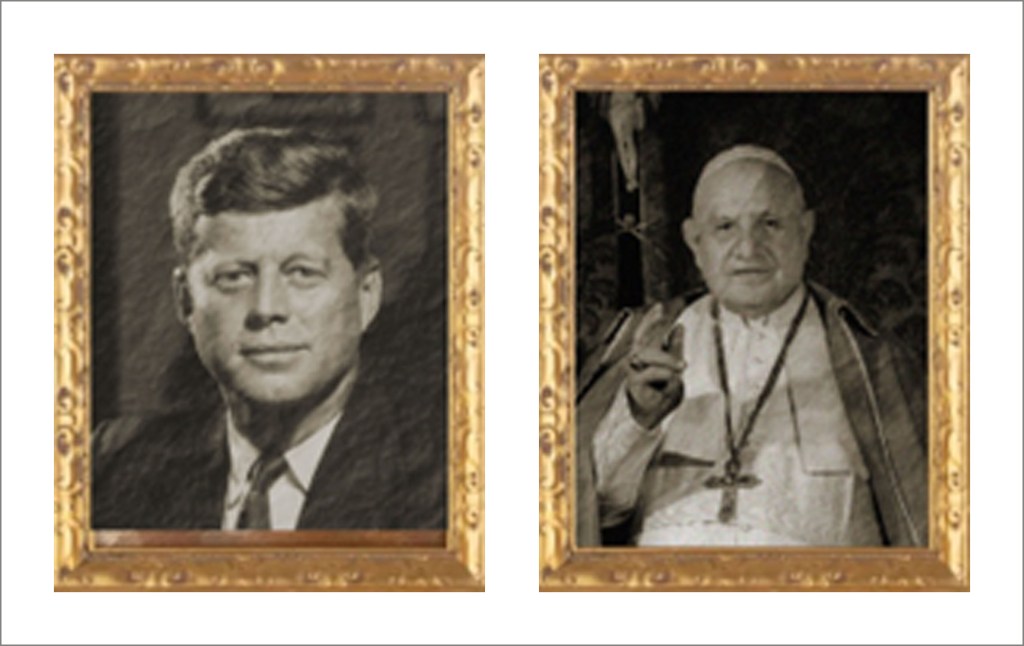
An opening to the living room was blocked by a velvet rope looped between brass poles suggesting you should wait to be seated, but the wait, you knew, would never end. Beyond the barrier, white pile carpeting still bore the imprint of vacuum tracks curving under a polished coffee table decorated with doilies, starched white to match the lampshades, pristine in their protective cellophane. And the sofa, its virginity intact, sat proudly under plastic covers in which it had been delivered six years before. Above hung two photographs, Kennedy and Roncalli, President and Pope.
“They’ll probably never visit”, my girlfriend’s mother said, her housecoat glowing like a priestly garment in her holy of holies. “But if they ever did, I’d be ready.”
The fifth in a series looking around our home at the paintings, prints and objects we have picked up over the years, not because they are of any particular valueother than that we enjoy them
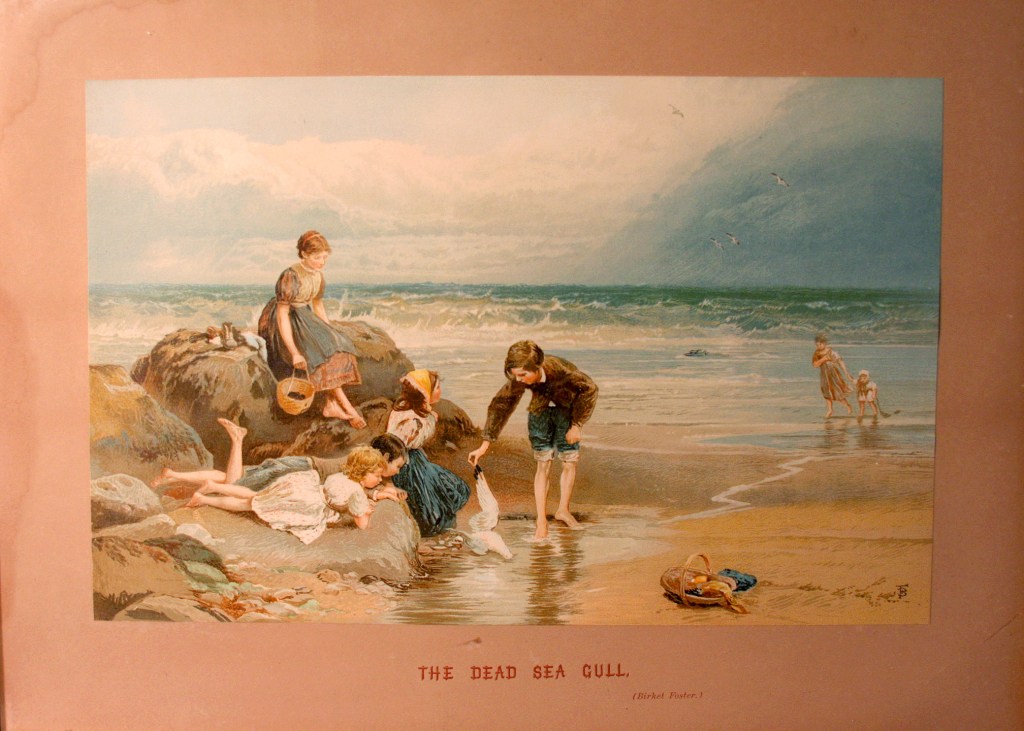
This is a lithograph by Myles Birket Foster (1825 –1899), a British Impressionist. He was one of the most popular watercolor artists of his time, and his idealized, sepia-toned prints and paintings were reproduced on the cover of various magazines and books. The lithograph belonged to one of our grandparents and we found it in a box of discarded items in a storeroom. Dating back to the British colonial era in South Africa, this kind of naturalistic and idealized print was very popular, evoking a sense of connection with England. Lilian and I like it because it evokes memories of our own childhoods on South African beaches more than seventy years ago. We would spend hours wading in the rock pools at low tide, picking up shells and pieces of seaweed, scattering the very small fish that were trapped there when the tide went out, picking up a seagull feather, or chasing a crab: All the time under the watchful eye of a nearby mother. We might as well have been under the watchful eye of Birket Foster as he sketched the scene.
What is it about the ocean that makes such a strong impression on people? In the following diptych a young woman sits on the beach and immortalizes the experience by writing how she feels on the back of the photograph that was taken by her fiancé.
The woman is my mother, and the year is 1940 in Cape Town.
Thirty years later, another diptych:
This is Lilian, fifty years ago.
And now, a triptych:
A granddaughter on the beach in Barbados.
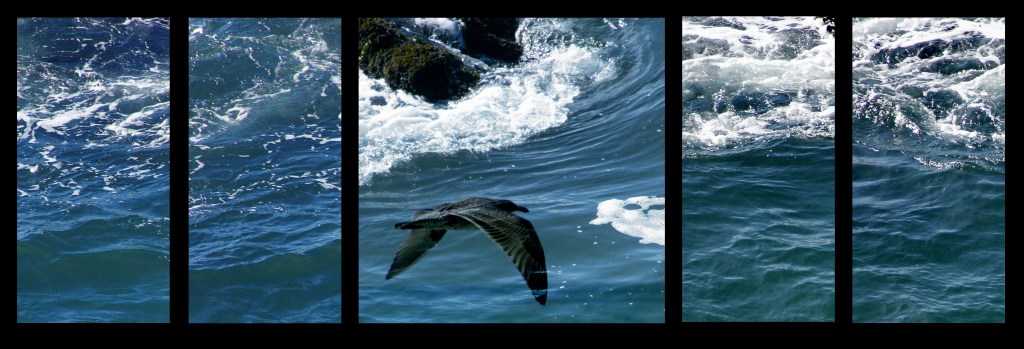
Seventy percent of the earth’s surface is ocean, yet most of us experience it in a personal way with a heightened sense of the here and now. Yet, there is a universality in which we all share. This is illustrated, perhaps, by my five-panel polyptych:
The photographs comprising this polyptych include images of the Pacific, North Atlantic and Indian oceans, as well as the Ionian and Caribbean seas.
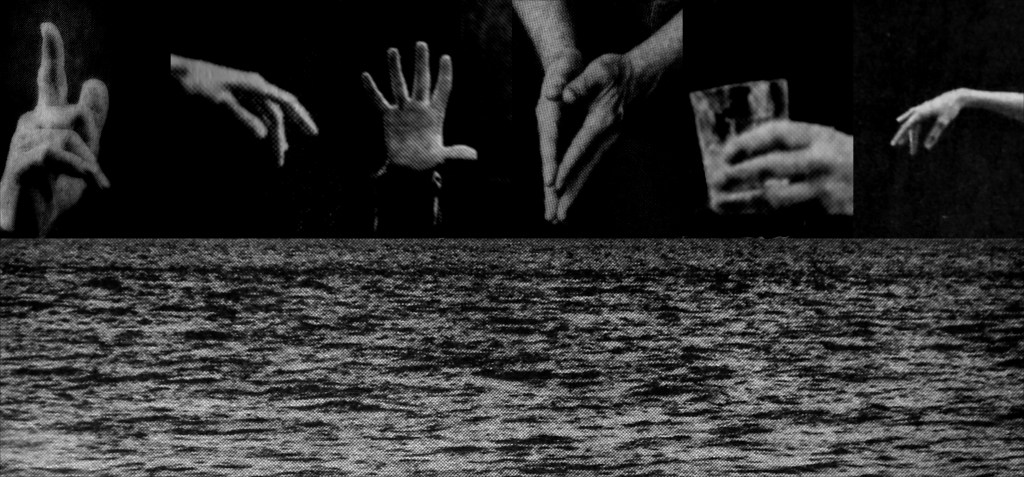
Continuing with the ocean theme, I created the following image using separate images of hands and the ocean that appeared in a single issue of the New York Times. The viewer is naturally free to find any personal meaning that it may evoke:
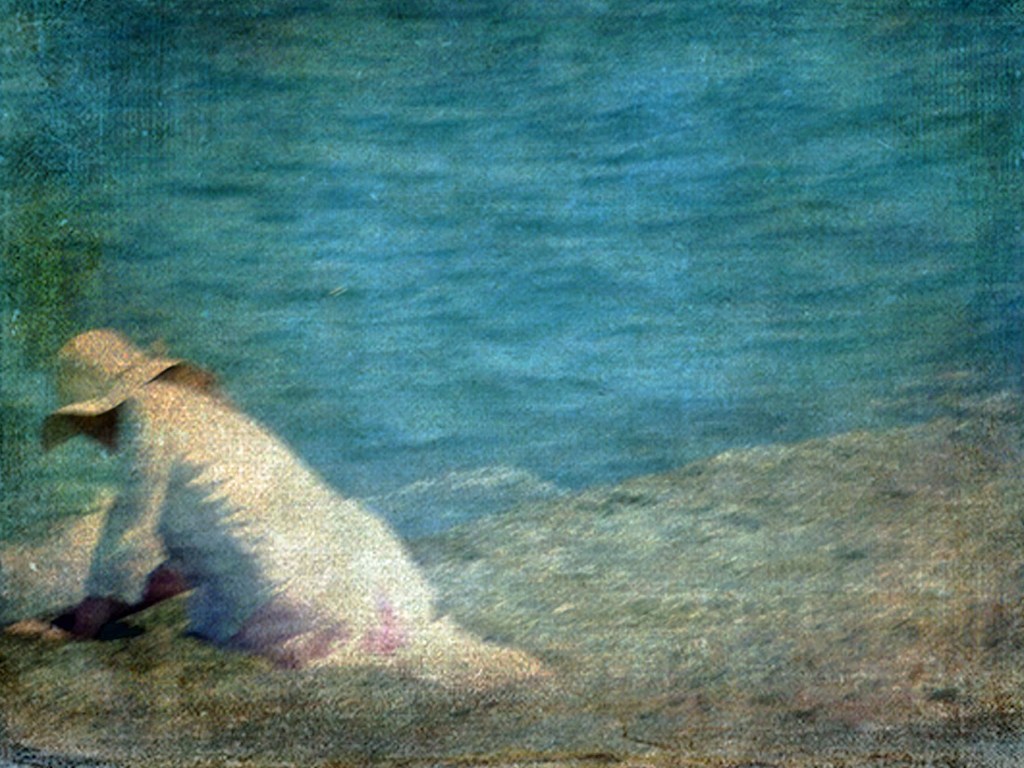
But to return to the more tranquil experience of the ocean, here are two images. The first, a photograph I took and manipulated, not by the ocean but on the shore of Lake Erie, one of the Great Lakes.
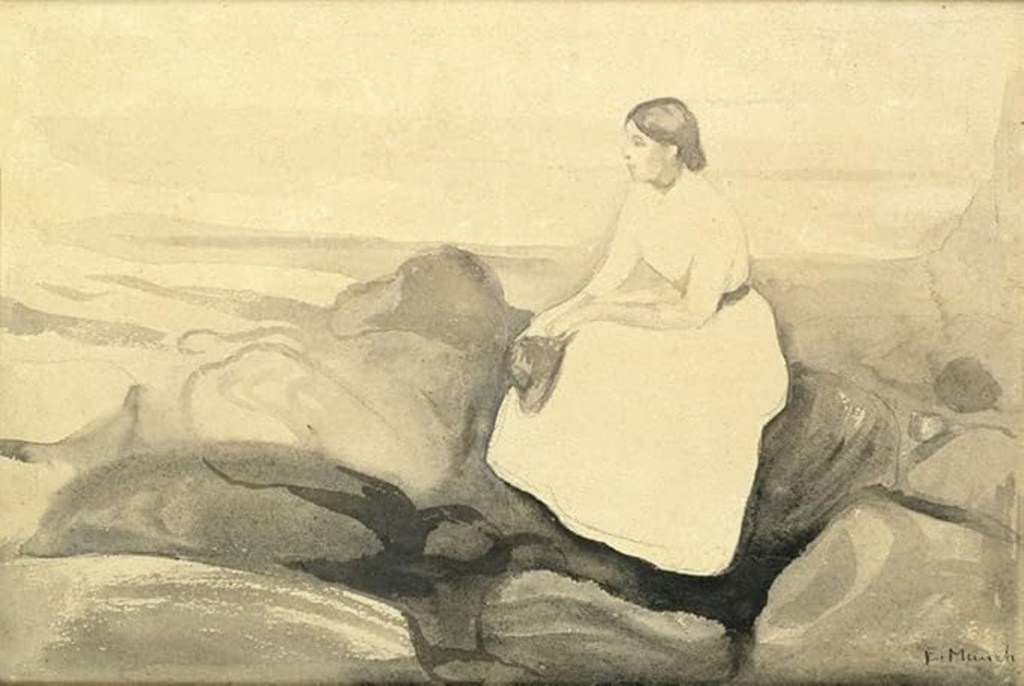
Finally, a drawing by Edvard Munsch of his younger sister, Inger, seated on a rock beside the ocean, an 1889 scene conveying the gentle, contemplative sensibility that we saw in the Miles Foster Birket lithograph with which we started this posting.
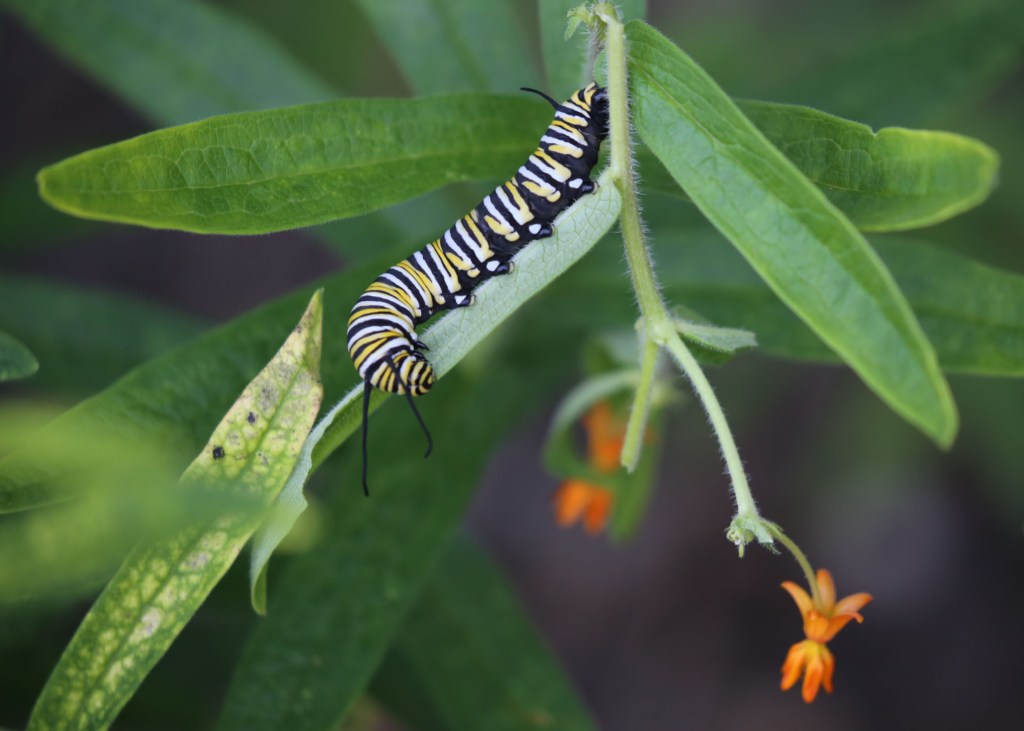
The Monarch Butterfly has laid its eggs, a caterpillar has emerged and has feasted on the Butterfly Weed in the garden. Then it cloaked itself in a green chrysalis out of which a new butterfly emerged two weeks later.
The new butterfly is called ‘imago’ and now has left our garden to join the long migration south.
And the job of the Butterfly Weed (Asclepias tuberosa) is over. All that remains are brown stalks and seed pods that burst open to release their seeds to the wind, seeds that will take root next spring to continue the cycle.
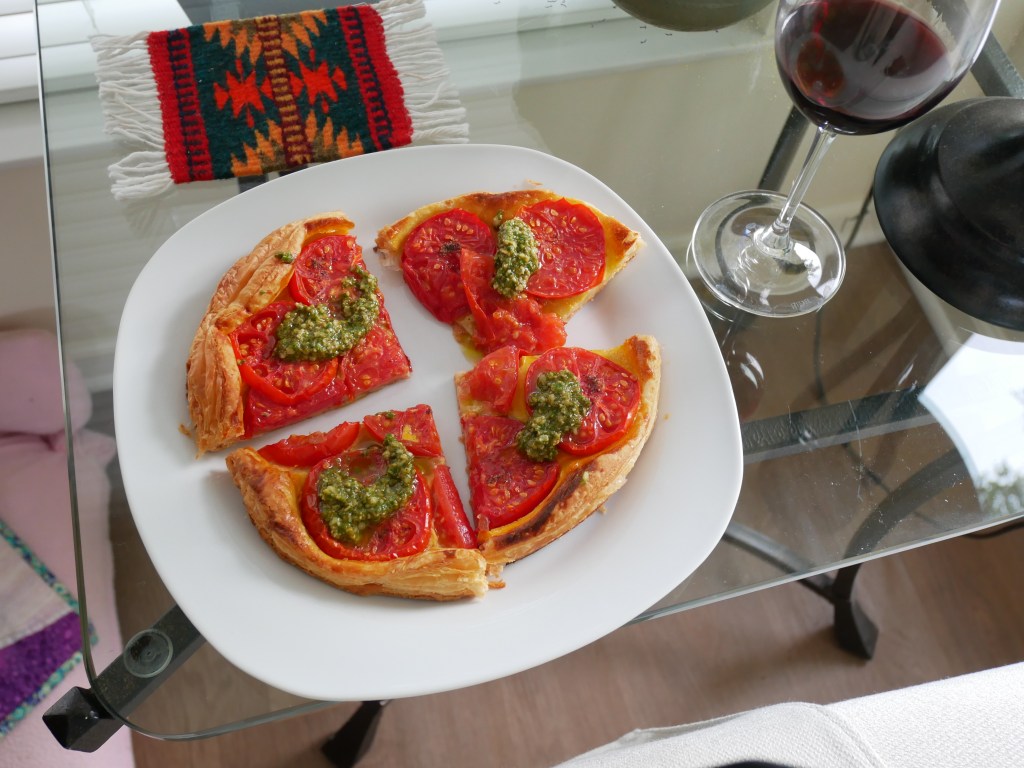
And we pick the last of our tomatoes
There have been so many we’ve had to be creative
And so, we say goodbye to summer with our tomato pie. We are grateful for what nature has given and what it promises for next year, acutely conscious of the human tragedies in which these simple joys and hopes are out of reach.
The fourth in a series looking around our home at the paintings, prints and objects we have picked up over the years, not because they are of any particular valueother than that we enjoy them
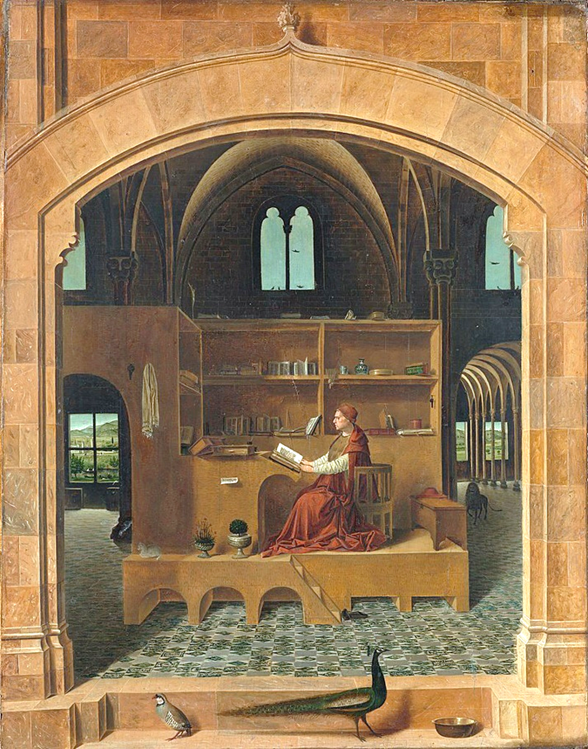
This print is of a work by the Renaissance painter Antonello da Messina and was sent to me in a box of discarded items after the death of a distant relative. So, in 1978 we found a place to hang it in our home. There is a story here that I may share in a future posting. But, for the present, I should mention only that I was surprised to see a similar though different painting in the Arts Section of the New York Times last December.
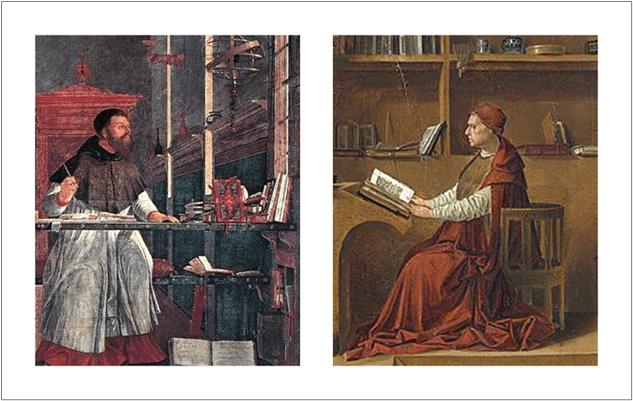
This is Saint Augustine in his study, painted by Vittore Carpaccio through a fifteenth century lens depicting a fifth century scene.
Augustine is writing a letter to fellow theologian, Jerome. Augustine is unaware that Jerome had just died, and later tells us that he was bathed in a visionary light and heard the voice of Jerome chastising him for his intellectual pride. It was a surprise for me to learn about the connection between the two theologians and to recognize the similarity between the da Messina print in our home and the Carpaccio image in the New York Times.
As I continued reading the newspaper, another painting by de Messina generates a new stream-of-consciousness reflection:
Here we have Carpaccio’s Flight into Egypt painted in 1550. The sense of danger and urgency is subordinated, as often is the case in renaissance painting, to enhance the incidental detail. But it wasn’t the virgin’s intricate brocade nor the finely executed landscape that drew my attention. Rather, I noticed the donkey humbly doing its job. I was reminded of another painting.
Jesus is now an adult and there is the donkey doing its job. The triumphal entry into Jerusalem days before the Last Supper is described in the four Gospels and this painting by a close friend is his rendition of that event.
Geoff was a priest and a mystic and, at the time he painted the entry into Jerusalem, he lived in radical poverty in a single room attached to a small church in a slum outside Port Elizabeth, South Africa. The walls of the little church and part of the ceiling were filled with his murals, including the image shown above. Geoff, who stayed and ministered at the parish for eight years until his death in 1987, once said: “If this had been a smart church, I wouldn’t have started painting on the walls.”
And, for some unknown reason, I’m reminded of Don Quixote
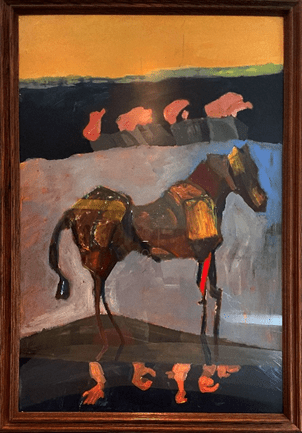
I’m reminded of Don Quixote and his squire, Sancho Panza, whose donkey’s name was Dapple. Although the subject of the painting above by artist friend Susan Weiner isn’t Dapple, nor even a donkey, it somehow reminds me of Don Quixote.
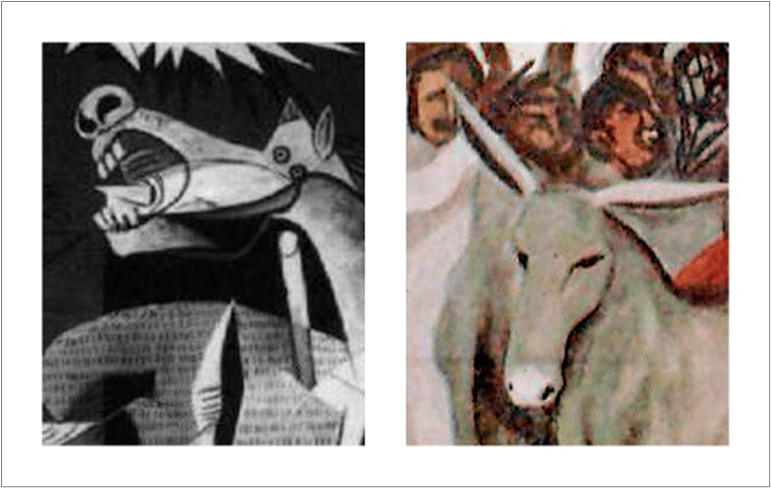
Here is Picasso’s rendition of Dapple on the left above.
And as we think about my friend Geoff and his church murals and as we think about Picasso and Dapple, we are reminded of Guernica and the Middle East, perhaps.
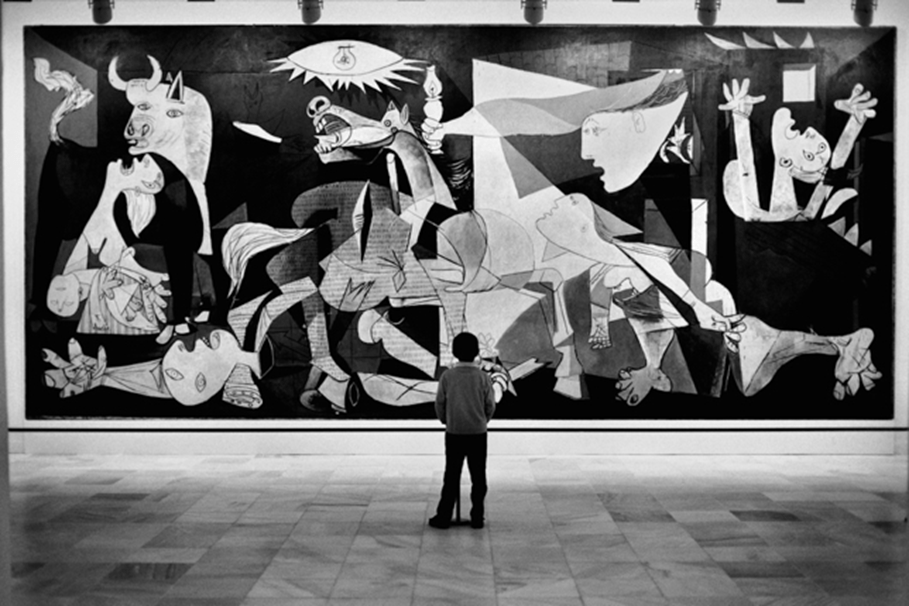
A child admiring Guernica by Pablo Picasso at the Reina Sofia Museum
Painted in 1937 in response to the Nazi’s devastating bombing on the Basque town of Guernica during the Spanish Civil War, the mural shows the tragedies of war and the suffering it inflicts upon individuals. It is regarded as Picasso’s most famous work.
I can’t help contrasting Picasso’s image with the mystic’s mural.
They portray polar opposites, horror and joy, even in their equine characterizations. And so it is today, perhaps.
It’s interesting where a casual glance at the Art Section of the New York Times can take one.
Five artists. Four men and a woman who were gifted, not only in applying a medium to a base, but in telling a story about themselves and their environment.
There was a sense of presence in his room in the nursing unit. He was that kind of person. A big man. His sister and niece were there, agitated. He was awake and partially elevated in his hospital bed. I took his hand and bent over him so he could hear me. We made eye contact. There was recognition in his watery bright blue eyes. “Lil sends her love,” I said. “Be strong, Gene.” He squeezed my hand firmly and held it. After a while, I released my hand and patted his shoulder saying, “I’ll see you tomorrow, Gene.”
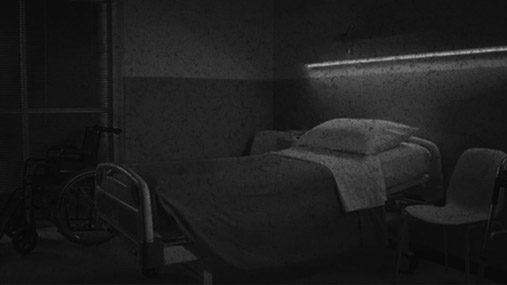
The next day, I went back to the nursing unit expecting to see his family in his room. They had been there all the time over the past few days. I looked in. There was no-one there. The bed was empty. It had been stripped. An empty wheelchair was on the other side of the bed. Someone had opened the window.
The third in a series looking around our home at the paintings and objects we have picked up over the years, not because they are of any particular value other than that we enjoy them.
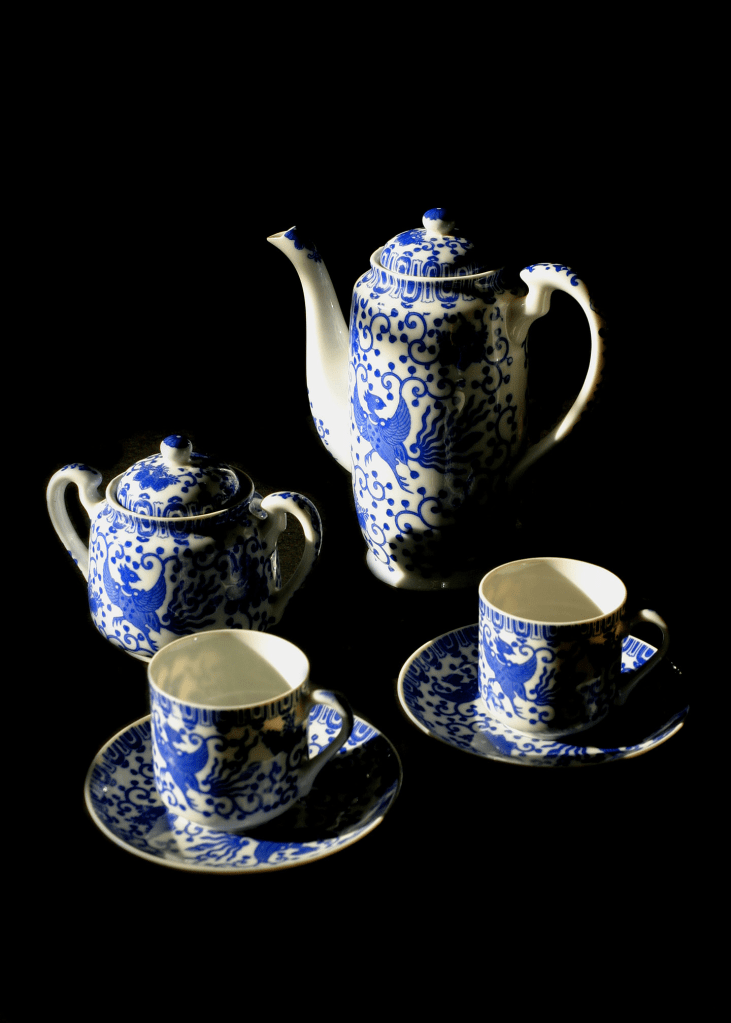
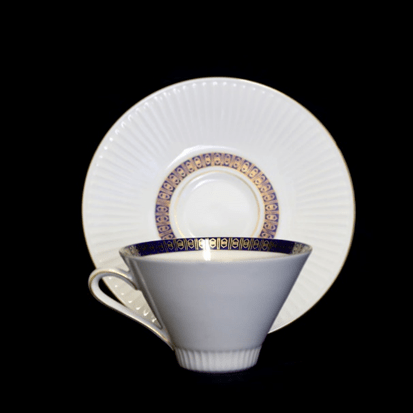
This is the inside of a Japanese made demitasse revealing the image of a geisha. The effect is achieved by different thicknesses of porcelain That allow different amounts of light to pass through the base. The process was invented in France in the 1820s. Lithophanes soon became very popular, and were used for decorative purposes on lampshades, or as panels that were hung on windows.
In Germany, many beer steins were made with lithophanes in the base and, as one finished drinking, lovely images would appear in the bottom of the mug. Later, twentieth- century Japanese potteries began to produce lavishly decorated tea sets using lithophanes. Molds were used to create the different thickness levels and the process of removing the thin moist panels from the molds required a high degree of skill to avoid damaging the intricate details in the image. In addition, any slight impurity in the porcelain clay body showed up when light shone through the material. The number of acceptable finished pieces to come out of the kilns has always been far less than the number that went in. Sometimes, only about 40 percent of the panels survived this process. Production of these teacups which peaked after World War II in Occupied Japan, tapered off in the 1950’s, and few are still being made today.
Today, one can buy vintage lithophane tea sets for less than the price of a bottle of mediocre wine. Yet, we have always valued ours. It was a gift from a patient in the neurological ward of a hospital in South Africa, a gift to Lilian when she worked there in the mid nineteen-sixties. Here’s a photo of her from that time.
Sixty years later, a tea set like this has no monetary value, is not rare, and certainly is no longer in fashion. But it reminds Lilian of a hospital patient, and it reminds me of a time when this set was the most beautiful thing we owned. Although now out of date, it has an intrinsic beauty waiting to be appreciated by someone in the next generation.
In the early 1970’s when, as newly-weds, we arrived in America, my grandmother welcomed her new granddaughter-in-law with another porcelain tea-set, this one made in Germany. And here is the end of her note to Lilian:
“Will you have a cup of tea with me? Love Grandma”.
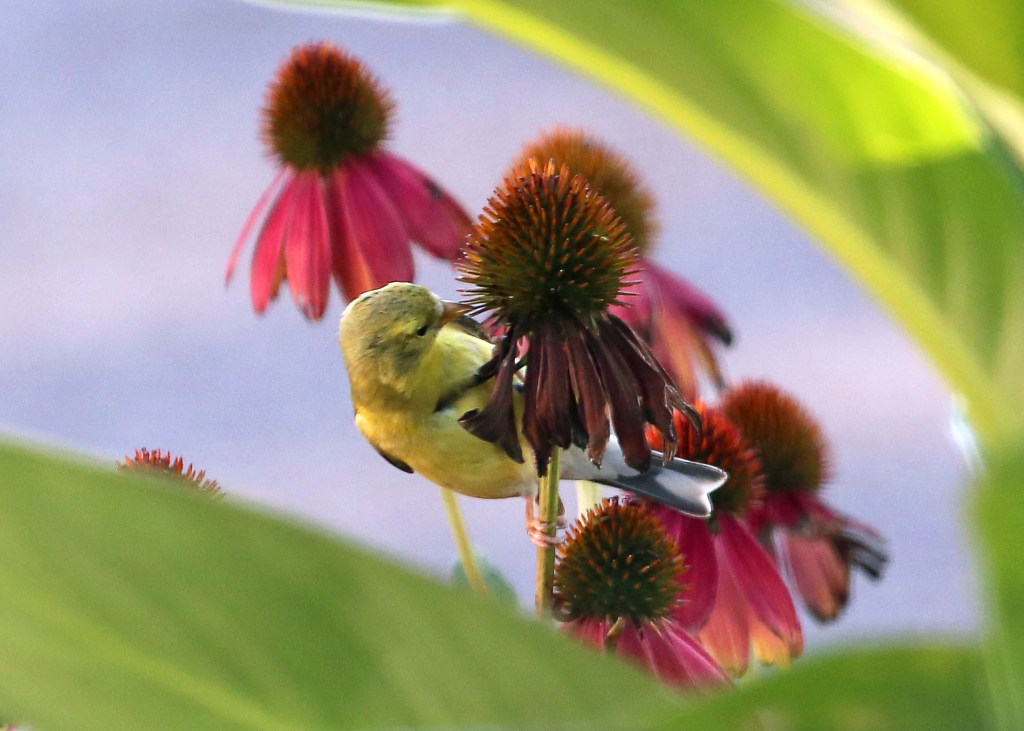
The American goldfinch (Spinus tristis) is a small North American bird in the finch family.
If one lives in a place long enough, one begins to recognize seasonal cycles among some of the bird species that visit the garden each year. Many of us associate the goldfinch with the brightly colored male, the yellow bird that shows up in the spring.
For me, I think of the paler birds feeding on seeds in our flower garden before they leave for the winter. The image above evokes a feeling of anticipated nostalgia because, as we observe it, we remember it will not last.
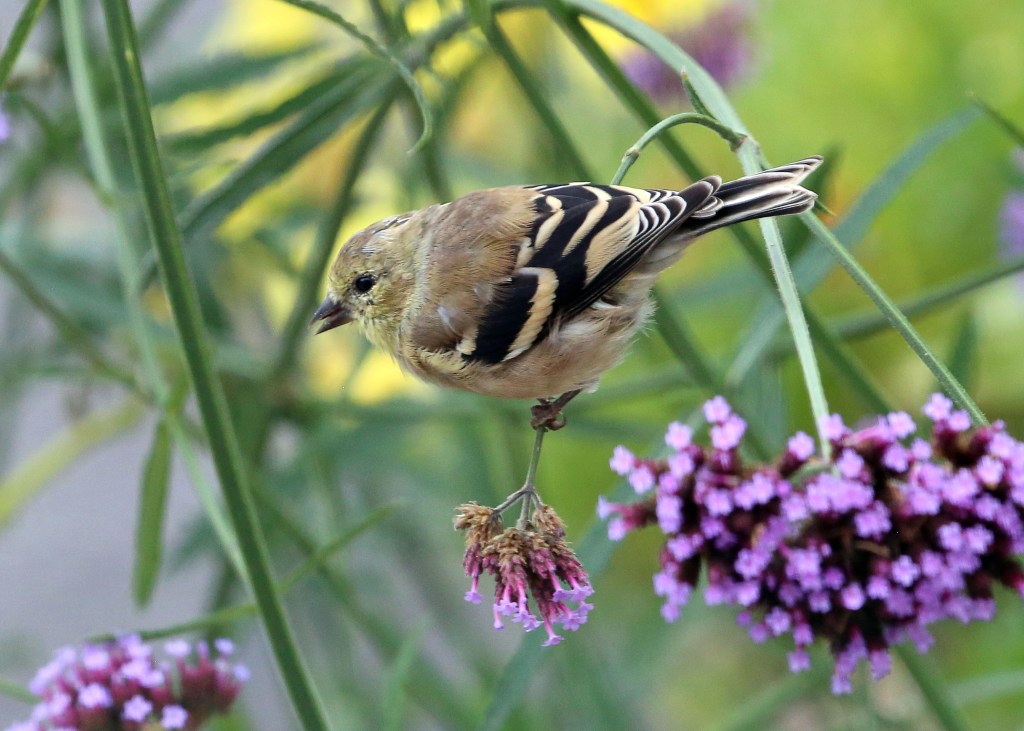
But we remember the goldfinch clinging to plant stems in our garden last year.
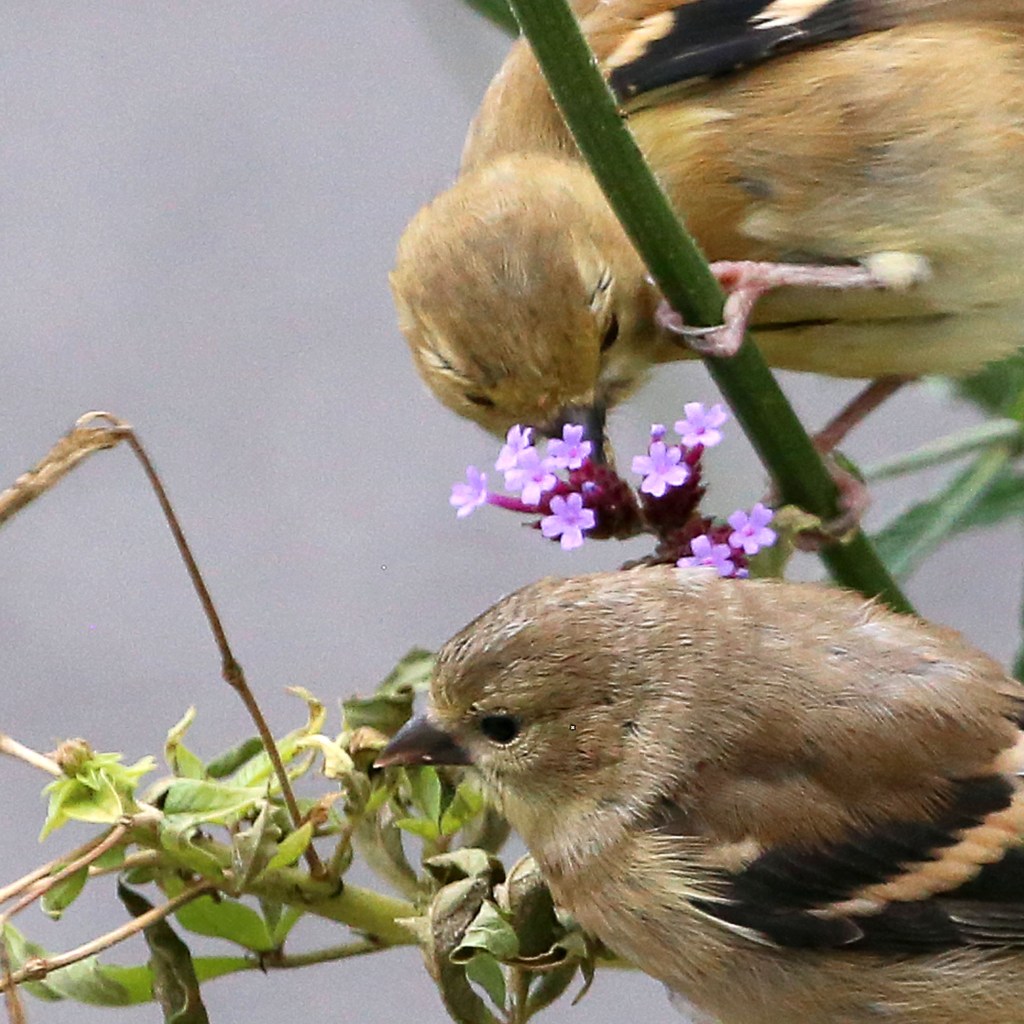
And we remember their acrobatic movements, sometimes hanging upside-down to reach the seed in the remains of a flower, sometimes pulling off the petals to reach the ovary of the flower exposing the seed. Often sharing their activity with other goldfinch.
And, as I watch the birds swaying on a flower stalk, I remember a circus performance at a book fair in Tucson, Arizona, more than ten years ago. And now I recognize the acrobat as a goldfinch.
And I look across the room and see the cushion that Lilian made, and I again recognize the bird.
And I remember a short poem I wrote:
The Scientist
I heard a scientist so teach, We crawled from slime onto the beach, Our home the grey soup sea: But not content to stay that way, By Darwin we were led astray, Reborn as chimpanzees.
On this the scientist holds fast: Its back to dust in the great At Last; No trumpet will be heard. Why is it then that we look higher With such absurd ingrained desire To fly as if a bird?
And I remember watching a lesser goldfinch flying down to a bird bath in our Arizona garden.
Poetry at times gives way to science, In almost speechless awe At the sheer computing capability That directs this bird, this drone, to fly. Sensors seamlessly streaming Ten thousand bits of data To its blazing CPU that is Something less than thimble size. Data processed in an instant, Firing commands that guide The flight in swooping arcs, Never for one moment pausing In that speed of light tango Of messages received and sent; Searching for the shimmer Of two hydrogen atoms Covalently bonded To a single oxygen atom That, in its pre-programmed DNA-lodged algorithm, Spells water: And this, more than all The galaxies in night’s dark sky, Takes my breath away: The nervous birdbath landing Of a Lesser Finch.
The second in a series looking around our home at the paintings and objects we have picked up over the years, not because they are of any particular value other than that we enjoy them.
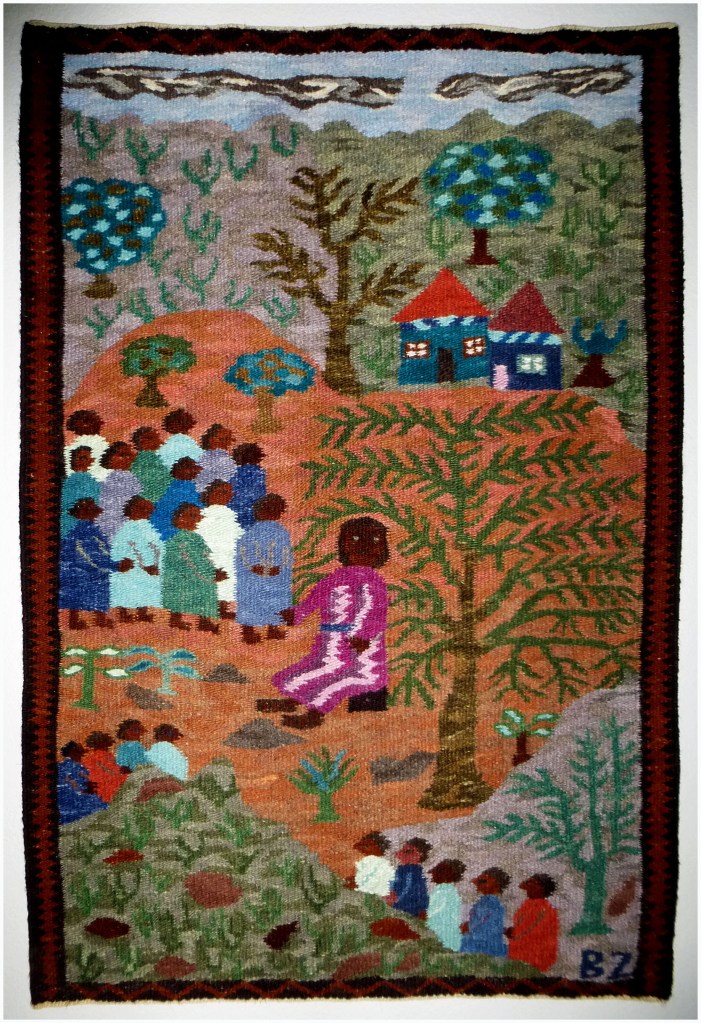
Jesus and His Disciples, Karakul wool, 165cm x 106 cm, Beatrice Zwane 1988 (est)
We bought this large tapestry in South Africa in 2002. All that we knew about the artist was that her name was Beatrice Zwane and that the weaving had been created at the Evangelical Lutheran Church Art and Craft Centre in Rorke’s Drift, South Africa, a place where a battle between British forces and Zulu warriors had taken place in 1879.
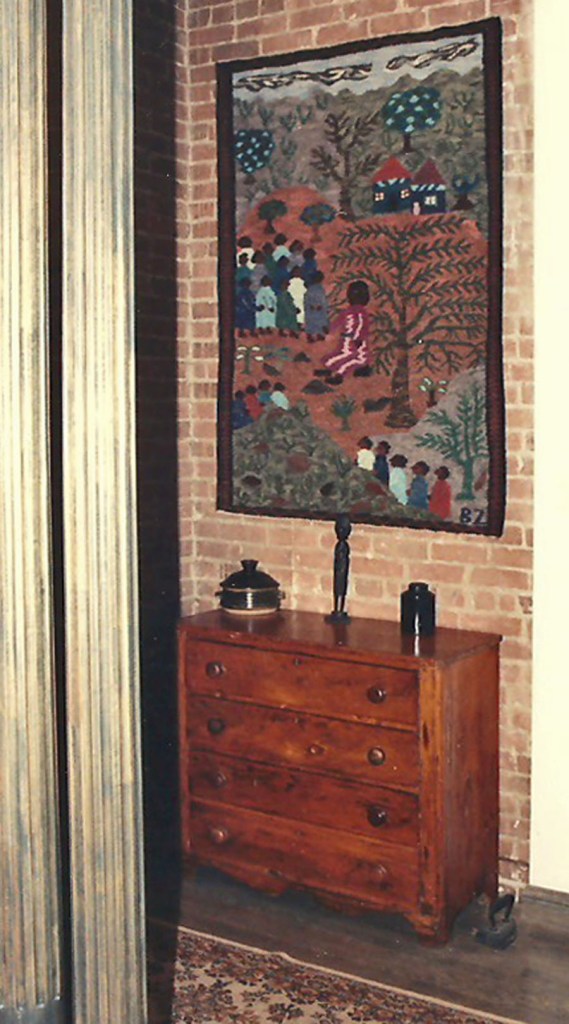
The tapestry has hung in our homes over twenty-two years, first in Montreal as seen in the photograph below, then in Arizona and later in Ohio.
The Evangelical Lutheran Church Art and Craft Centre at Rorke’s Drift, Natal, was established in 1962 and had a significant impact on the development of South African art and craft in the 1960s and 1970s. The Centre, a result of a unique and successful venture in cross-cultural art and craft production, combined Swedish technical assistance with traditional African design and skill. Yet, when the works by marginalized women artists in Africa were exhibited at the National Museum in Stockholm in 1970, they were dismissed as the fruits of Swedish cultural imperialism and naive artistic minds. The woven tapestries are now little known in South Africa and largely forgotten in Sweden. It is not surprising, then, that I wasn’t able to find any substantive information about Beatrice Zwane on the internet.
The above image of an attachment to the back of Zwane’s tapestry tells one as much as there is to know about this or any other of her works.
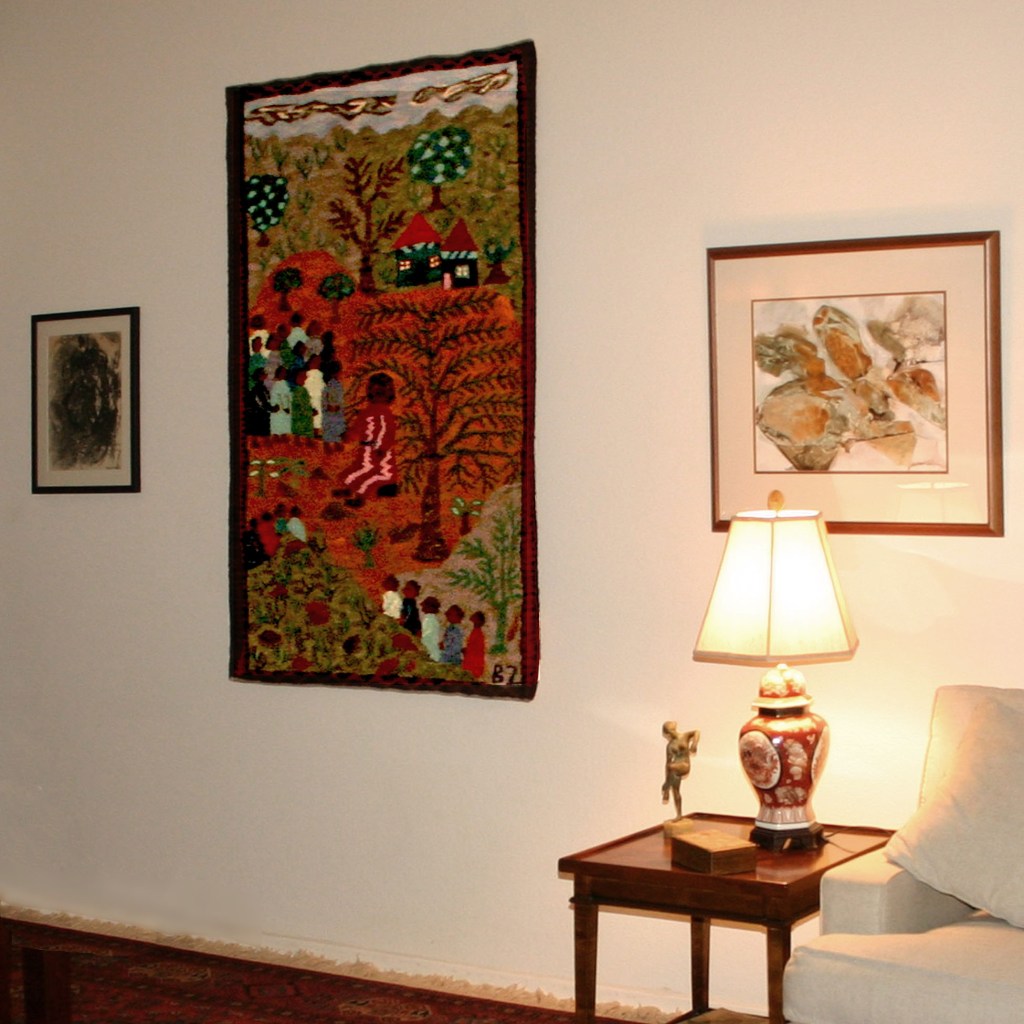
In the following photograph of the tapestry hanging in our Arizona home several years ago, there is a strange coincidence:
The blurry image in a black frame to the left of the tapestry is the work of another artist who studied at the Rorke’s Drift Art and Craft Center, George Msimang.
Untitled ink & charcoal, George Msimang, circa 1965
George Msimang was born in Durban, South Africa in 1948. Like Beatrice Zwane, he studied at the Evangelical Lutheran Art and Craft Centre, Rorke’s Drift. Afterwards, he was offered a study grant by the Italian government. He went to Rome twice, once to the Accademia di Belle Arti where he spent a period from 1971 to 1975 and another year in 1986 at the Accademia di Belle Arte, Perugia. His work challenged the social and economic imbalances in the Apartheid system. He died of pneumonia at age fifty-six.
Thanks to the Art and Craft Center at Rorke’s Drift, both George and Beatrice were given the opportunity to develop and express their artistic talent when South Africa’s education policies under Apartheid denied them the opportunity to advance their craft. It is debatable whether or not their talent is appreciated to the extent that it should be. Certainly, neither artist would be able to earn a living wage if one looks at current valuations of their work. But we are grateful.
The first in a series looking around our home at the paintings and objects we have picked up over the years, not because they are of any particular value other than that we enjoy them.
Snowy Pasture – Ink & wash – Margaret Taussig 1990
For many years, we spent a few weeks of summer in a two-hundred-year-old house beside a small lake in Canaan, New Hampshire where the artist created this image. Margaret lived a few minutes down Canaan Street where she had a studio.
The ‘ink wash’ technique that Margaret used here dates back to the Tang dynasty of China ((618–907). East Asian writing on aesthetics is generally consistent in stating that the goal of ink and wash painting is not simply to reproduce the appearance of the subject, but to capture its spirit. The American artist, Arthur Wesley Dow (1857–1922) wrote this about the technique: “The painter… put upon the paper the fewest possible lines and tones; just enough to cause form, texture and effect to be felt. Every brush-touch must be full-charged with meaning, and useless detail eliminated. Put together all the good points in such a method, and you have the qualities of the highest art”.
Notice the distant turkey vulture in the snowy sky and other signs of life: Deer tracks through the opening in the fence. A presence, a living spirit, can be sensed in the cold snow-covered pasture.
This is where Canaan is, a very small village among the hills, mountains, valleys and lakes in New Hampshire
And here is the front porch of the house where, sometimes with Margaret Taussig, we would sit in the evenings looking out at the fields on the other side of Canaan Street.
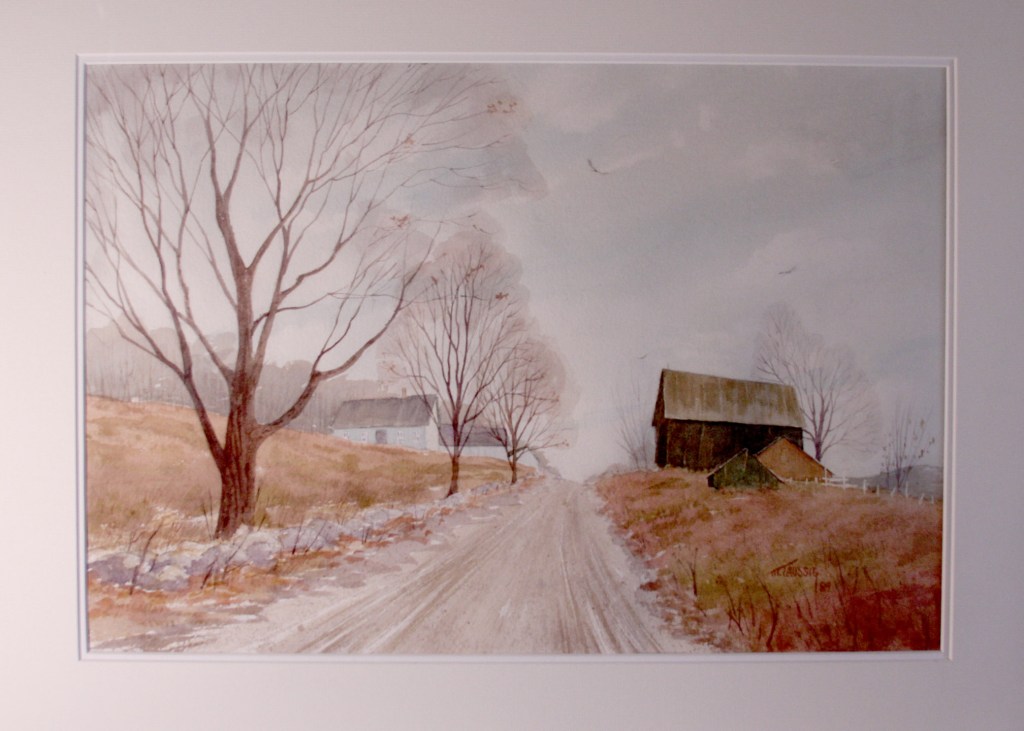
Here is another painting by Margaret, a watercolor that captures the sensibility of the place in Autumn.
In this image, an unpaved road passes through what might originally have been a family farm dating back to the late 1700’s when the area was first settled. The stone wall on the left is typical of New Hampshire farms when, at the turn of the century, farmers were urged to replace temporary wooden fences with rock walls. A pair of turkey vultures circle in the grey autumn sky, a common feature in Taussig’s paintings and a species of vulture that breeds in New Hampshire.
This oil depicts a scene typical of the view we had from the house on Canaan Street. The scene, priceless for us because of the memories it evokes. The painting for sale on Etsy for $68.
Margaret Taussig died twenty-five years ago.
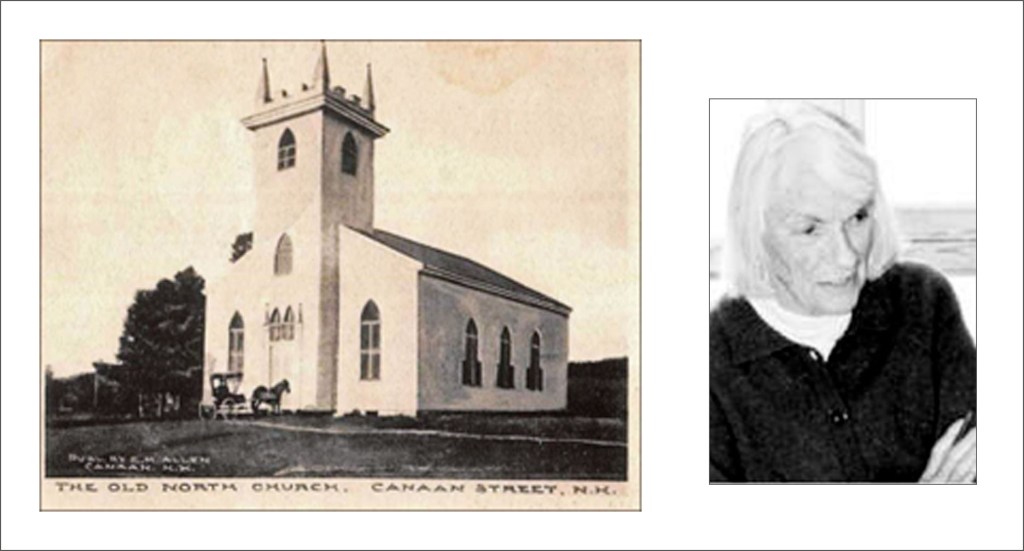
A memorial gathering was held at the Old North Church on Canaan Street near the old cemetery where her mother is buried.
Margaret’s presence is felt when we look at the two paintings in our home and, in her memory, I manipulated the painting I found on Etsy with an overlay of a Joe Pie weed to evoke a sense of spirit rising from the earth across the road on Canaan Street
Here is the first Monarch to visit our garden this year. It was a welcome surprise because the numbers of Monarch butterflies are dwindling. They have started migrating from their breeding grounds in Canada on a long journey through the US to Mexico, often covering fifty to a hundred miles per day, reaching their destination near early November.
Several tornados touched down in Northeast Ohio yesterday, yet the butterfly shown above survived to replete its store of energy by extracting nectar from verbena flowers in our garden. The damaged wing is likely a result of the storm.
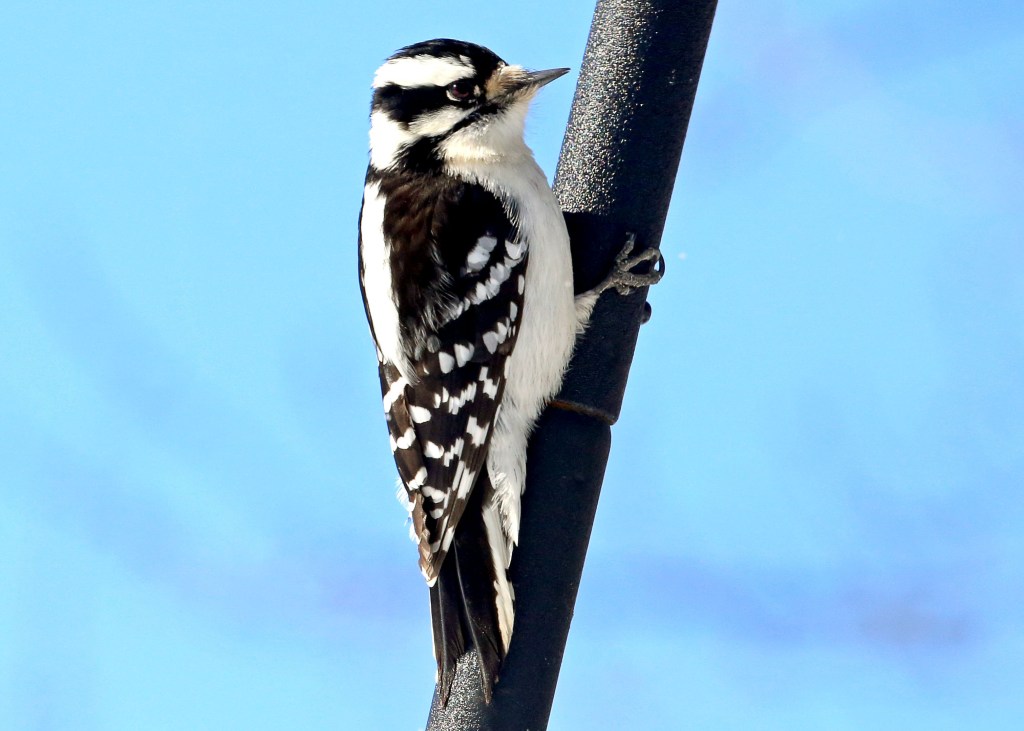
Another pair of reliable visitors are woodpeckers who come to feed on suet in our feeders. The first image is that of a Downy Woodpecker, the smallest species of woodpecker in North America.
The second image is that of the larger Hairy Woodpecker that gets its name from the long, thread-like white feathers that run down the middle of its black back. Like the smaller Downy it is at home at the edge of forests such as the one behind our home.
Another summer pairing in our garden is Cosmos, the familiar annual with colorful, daisy-like flowers in the sunflower family that sit atop long, slender stems. They attract birds, bees and butterflies to the garden.
Another variety of Cosmos is a tall plant with semi-double and double flowers ruffled in a variety shades – violet, lavender, white, and cream.
As I walk under the old oak tree behind the house or the tall red maple in the front, I’m reminded by some mushrooms of the microscopic network of fungus interwoven with the tree roots below the surface.
Mushrooms that I see above ground are the fruit of the fungus just below the surface. Generally, the fungus feeds on dead organic matter like rotten wood, returning its constituent matter to the soil. Its fruit, the mushrooms, are a reminder of the complex neuronal system of the tree roots just below the surface that live in partnership with fungi.
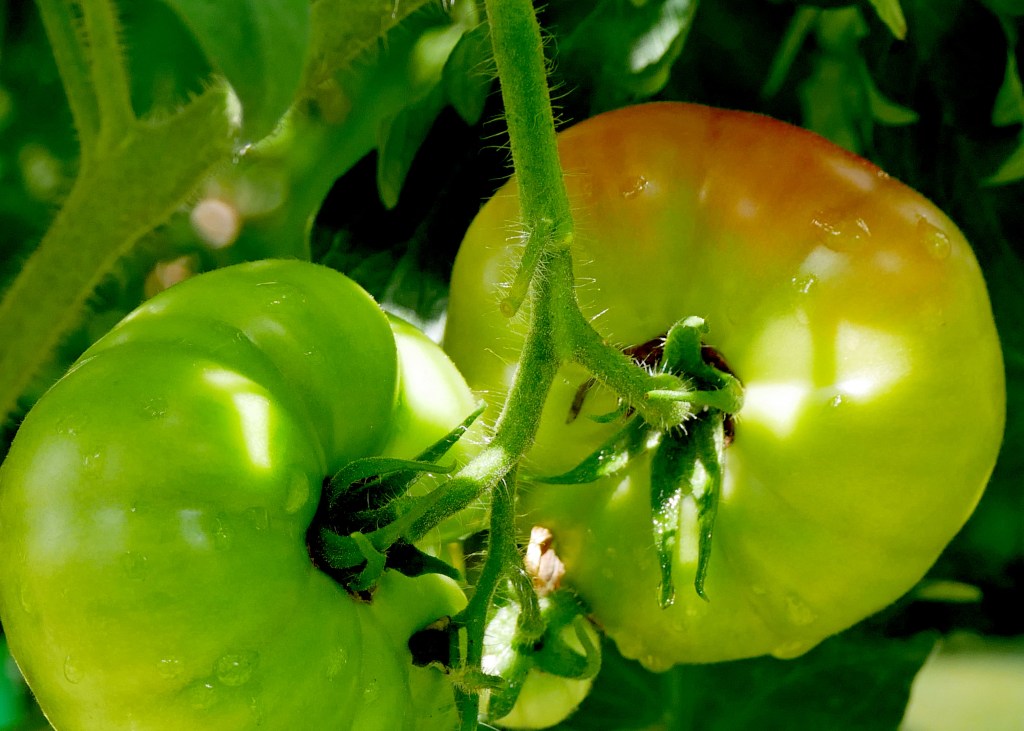
A final pairing on today’s walk around the house: Two tomatoes in a pot, green but turning red: A sign of many more warm summer days to come.




























 The Final Stretch